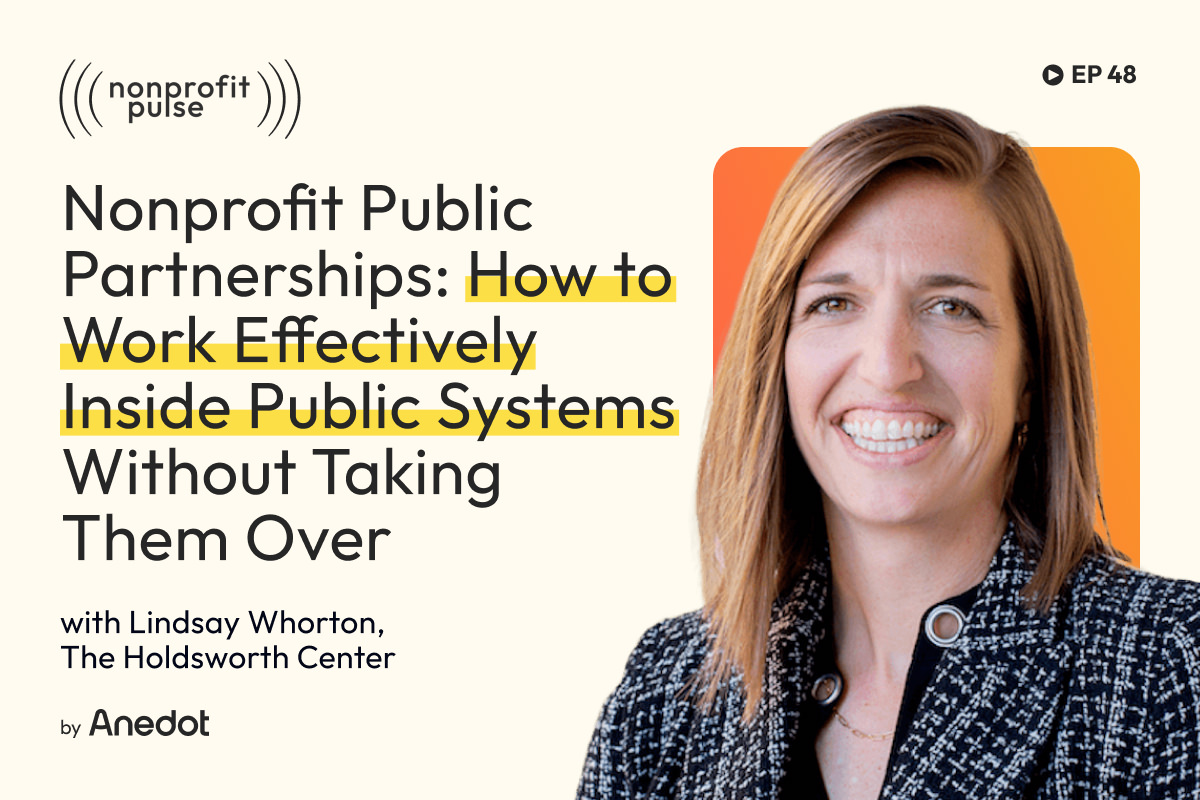
The short version: Nonprofit-public partnerships work when the nonprofit acts as a service provider to the system, not a shadow decision-maker. Lindsay Whorton, president of The Holdsworth Center, says lasting partnerships depend on confirming real alignment before starting, working through the public leader's own chain of accountability, and being willing to say no when the fit isn't right.
Key takeaways
- Start from alignment, not available resources. Before entering a partnership, confirm the work you're offering actually matches the system's own goals and priorities, not just a gap you're capable of filling.
- Be willing to say no. The Holdsworth Center would rather decline or delay a partnership than proceed without clear alignment, because an unaligned partnership can consume a district's limited time and capacity without benefit.
- Work through the public leader's own chain of accountability. The Holdsworth Center takes direction from the superintendent rather than approaching the school board directly, since the superintendent answers to the board and community for the district's strategy.
- Adapt your delivery, not your values. The nonprofit takes primary responsibility for adjusting how it works to fit each district's culture, while holding firm to boundaries like keeping district selection independent of funder influence.
- Sustained partnerships build real impact. The Holdsworth Center's five-year partnership with the Lockhart, Texas school district, working with then-superintendent Mark Estrada, helped redesign school leadership roles and produced standout results at Plum Creek Elementary School.
- Protect district confidentiality with funders. The Holdsworth Center doesn't let funders choose which districts get support, and doesn't disclose why a particular district wasn't selected.
- Design for sustainability, not just reach. Real scale means building a district's own capacity to continue the work after the partnership ends, not just serving as many people as possible in the moment.
- Watch for partnership language masking control. A partnership turns unhealthy when one party uses the language of collaboration to compel the other to serve its own goals and strategy.
- Her one-sentence takeaway: pair real ambition for what you're trying to achieve with genuine belief in the people you're working with, and stay humble about what you still have to learn from the system itself.
Guest: Lindsay Whorton, President, The Holdsworth Center | LinkedIn
Podcast episode transcript ↓
Josh:
Nonprofits working inside public systems can sound promising and threatening at the same time.
When people hear about those partnerships, they sometimes picture outside organizations taking over or pushing their own agenda.
That reaction raises fair questions about influence, control, and what partnership is actually meant to do.
Is the nonprofit there to support the public institution or to quietly reshape how it operates?
So how is a healthy public partnership different, and what should leaders understand about its purpose? How can nonprofits work deeply inside public systems in ways that strengthen them over time, without overstepping or blurring who owns what?
I'm Josh with Anedot and welcome to Nonprofit Pulse, where we explore trends, insights, and resources that help nonprofits accomplish their mission.
On this episode, we're joined by Lindsay Whorton on the topic of nonprofit public partnerships and how to work effectively inside public systems without taking them over.
Lindsay is the president and a founding member of The Holdsworth Center, where she has helped build programs that strengthen public-school leadership across Texas.
Since becoming president in 2019, she has led the organization’s growth to serve more than 1,900 leaders in 89 school districts. She is also the author of A New School Leadership Architecture and holds a doctorate in social policy from Oxford University.
Hi Lindsay, thanks for joining us on Nonprofit Pulse.
Lindsay:
Yeah, thanks so much for having me.
The growing need for nonprofit partnerships in public education

Josh:
Yeah, excited for our topic today.
We're talking about nonprofit public partnerships, how to work effectively inside public systems without taking them over. Just a great topic. Excited to explore it today.
So maybe starting off, why are nonprofit public sector partnerships becoming a more common and even necessary strategy in today's landscape, especially in public education?
Lindsay:
I'll certainly speak directly to kind of our approach and our experience, because my guess is there's a lot of different things and a lot of different forms of work nested under the idea of public partnerships.
So for us, the work that we do is to support school districts and schools to develop the leaders that they need, both for the present and the future.
And I think if we think about that question specifically, the reason why school districts may need a nonprofit partner is partly just due to the way that they're resourced.
It is well known and becoming more well known that our schools, both in Texas and across the country, are facing really significant resource constraints as they see rising costs.
You know, that we each see in like, our personal budgets, hit their budgets and trying to figure out how to stretch the resources they get from state, federal, and local governments to cover the most important priority.
So one, they should have a limited amount of resources.
And then two, there are some things that are important to the success of school or district that may be hard to persuade the public or taxpayers to prioritize.
And I think when we look at schools and districts, the focus is always on how do you get as many of your dollars to flow directly to classrooms and directly to students as you can? And it makes perfect sense.
It's a super important metric we should all keep our eye on. But the reality is investing in the strength of the teachers through professional learning and coaching and development.
Investing in both your sitting and future principals and superintendents. That matters a huge amount to your ability to deliver great results for kids, both today and in the future.
But it can be hard to make the case to dedicate resources to that important kind of long term indirect work.
So I think we as a nonprofit are able to step in and say, we're going to bring resources to the table to help accomplish this important goal that may be hard for you to fund for a variety of reasons.
That's like one example of where that partnership makes sense.
And I think others are this reality that in any organization, including a school, this objective that you're trying to accomplish often requires resources and intervention from other people beyond your organization.
What after school programs are available in your community can be a positive contributor to how students learn and thrive.
Food programs, health, there's a wide variety of factors that influence how kids show up ready to learn in school.
And so I think we see a lot of nonprofits trying to help coordinate and connect a school to other resources in their community that can make a difference.
What a healthy nonprofit partnership with public schools looks like

Josh:
Yeah, and when people hear about nonprofits working inside of those public systems, they sometimes imagine outside organizations kind of taking over, right, or imposing their agenda.
How is a healthy public partnership different? And what should leaders understand about its purpose?
Lindsay:
The way we think about this is really grounded in our organizational values.
So, we're guided by: be of service, believe in people, drive for excellence for every student.
And my personal orientation to this, before I worked at The Holdsworth Center, I studied international education. And one of the things that I concluded is that high performing systems around the world, one of the things that they do is they make big investments in the people.
But the other thing that's true of those systems is educators are really lifted up as important experts who we listen to and how we make decisions and who we count on to produce success.
And I think there are times when it's easy for folks outside of the system to think that we need to take on the responsibility, that we know what needs to happen. We all obviously have a role to play.
But I just realized that if we're going to have the kind of public education system we want to have, we have got to figure out how to empower and how to trust the people who make all of the decisions and are actually able to produce the schools that we want to have, which are teachers, principals, superintendents.
So that's just like a part of our DNA as an organization. And so it's been very important to us that we want to operate with humility, that we have something to offer.
We have an expertise. We have services that are valuable to districts, but with a great deal of respect that a superintendent is thinking about a wider aperture of goals and strategies than just how they develop leaders.
And if we can bring kind of that area of expertise that allows them to focus on that.
And then secondly, school districts are guided by a publicly elected school board. We've structured districts in this way in order to allow local communities to have voice in shaping what they want schools to be for kids in their community.
We don't want to think that we know more than the community about where their schools should go.
So it's been really important for us to strike that balance, to say we bring this really specific set of skills and resources, and it's not our job to tell you what to think or what to do.
But as we build leaders to help build your skills and how to think and how to be responsive to the needs of your community.
Working inside public school systems without losing your mission

Josh:
Yeah, and thinking about why The Holdsworth Center would choose to go inside the schools rather than staying purely external, what would you share with our audience around the most mission driven reasons that a nonprofit like yours would choose to go inside the school system instead of staying outside?
Lindsay:
For us, it's just fundamentally a strategy question.
So we know that the biggest factor in how a leader is developed is not actually a time they spend sitting in a classroom learning stuff or even coaching which is important.
Two things that we do. The biggest factor is the challenging experiences that they have in their jobs, that give them new opportunities to test and practice.
So we design all of our programs to say, how do we unlock the most powerful leadership development resource, which is the jobs and challenging assignments that people are given.
We have to partner with school districts in order to unlock kind of that resource.
And then the second question for us from a strategy perspective is I think we think about scale in unproductive ways a lot of times because we focus on scale of like, how do we just reach the most people, which I would say is spread.
But the other question of scale is how do you make sure that when you have reached somebody, it has the impact and it's sustained beyond your work with them?
Because otherwise you're just like reaching a lot of people and it doesn't matter and you just keep reaching more people.
And so for us, from a sustainability perspective, if we're able to help build the capacity of schools and school districts to continue the work that they do with us beyond the time of our engagement, that's how you get to impact, and that's how you get to like real scale and sustainability.
A public school partnership that strengthened outcomes for students and educators

Josh:
Yeah. Thinking about an example, can you share with our audience an example of a public partnership that genuinely strengthened that impact for students and educators, and what really marked that project as successful?
Lindsay:
Yeah. So one of the districts that we've, I'm going to talk about ourselves, at the risk of being self-serving, it's the thing I know best.
There's a district that we work with, we're based in Austin, and there's a community just south of Austin that you may know of because of their barbecue, Lockhart, Texas, and we were in partnership with that school district for five years from 2019 to 2023.
And they did some really incredible work through our time with them.
One of the things that they did was they really had this creative idea about how to think differently about how leadership works in their schools, and they wanted to elevate some of their incredible teachers, pay them more, give them more responsibility and authority, really empower them to make decisions as principals to distribute and share leadership a little bit more.
That also required them to rethink what happens in central office and how do we all work together. And there are campuses in Lockhart that their trajectory of student learning and the impact is really extraordinary.
There's a campus we worked with Plum Creek Elementary School that has established itself as just a really incredible high performing campus.
And there are others across the district that their growth just continues.
I think to the point of partnership, I think what's so important about that is we're really proud of what we brought to the table, but it was really a mutual process where the superintendent, Mark Estrada, like he had a vision, he had ideas about what he wanted to do and how he wanted to tackle the work.
It was both of us being responsive to each other and working together. Not just us showing up and saying, here's what we're here to partner with you to do.
So it really was kind of that sense of dialog and a true spirit of partnership.
Josh:
Yeah. And it sounds like candor is a big part of that as well.
Lindsay:
Of course. Yeah.
Josh:
It's just kind of breaking the ice there and saying, hey, we are here to partner with you. We are not here to impose our strategy necessarily.
It's a conversation, just those kind of basic upfront relationship skills as an outsider.
Lindsay:
Well, and I think it goes back to those values. I mean, I think and I'll go to like believe in people.
We will never talk about any educator in any way that is not with respect, appreciation, and a spirit of elevation.
We do not have deficit mindsets about what educators can do. And I think the reality is people can feel what you believe about them regardless of what you say.
So for us, it's again, it's like rooted in values of we have a genuine belief and commitment that the educators working in our schools are capable of doing incredible things.
And I think that shows up in how we approach them.
When people can really feel that and they can trust that belief that you have in them, it opens up a different kind of opportunity to work together. You can say all sorts of things, but people have to really feel and believe that.
So I think it has to be like a deep value that is consistent in how you operate.
The biggest fears about nonprofits working with public systems

Josh:
Lindsay, what are some common misconceptions or fears that public system leaders or even nonprofit leaders have when the topic of working closely together comes up?
The kind of first introduction of, hey, we're thinking about partnering with this organization or this school system or this public organization, what are some of the common misconceptions and fears?
Lindsay:
The challenge of working in partnership can be if you don't have shared goals.
And so I think a fear can be that party A has a set of goals that are not actually aligned with party B, and when that's true, you can spend huge amounts of time trying to coordinate efforts that are actually not moving in the same direction.
I think the other fear, and I think this can be a reality, is that we use the language of partnership, but what we really mean is that I am trying to compel you to act in service of my goals and my mission and my strategy.
And so I think that's where the language of partnership can contain a lot of different orientations and approaches and where we can sometimes find real challenges.
Strategic support versus short-term fixes in public partnerships

Josh:
That's a great segue into our next question, which is, how can leaders discern the difference between a partnership that is driven by short term fixes or control, versus one driven by long term strategic support for the public system?
Lindsay:
My starting point this isn't directly a response to that question, but I think we have to start from the assumption that not every partnership is the right work to be doing together at this time.
And so I think the first step to success is for both parties to really be clear eyed and honest about saying, like we're offering this resource, this investment, this support.
What we really need, and we actually start from the assumption that that may not be the most important thing for you to take on at this moment.
You know, depending on your organization, your goals, your strategy.
And we would actually rather us decide to not work together right now so that we don't end up mucking up the thing that you're trying to accomplish or wasting your time on something that's not aligned to your strategy.
That's an explicit goal that we have. And what we're really evaluating is like, how strong of a fit is this thing that we're offering to what you're trying to accomplish?
My first piece of advice is I think it's too easy to say, like every partnership is a new set of resources that you feel like you need. So we have this tendency to say yes to like every offer that comes our way, particularly in resource constrained public systems. I don't think that's a good move. It's far more important for folks to really say, is this thing that you're offering me aligned with the goals and the strategy and the priorities that we've established for our system?
And if it's not, we'd be better off saying, this isn't the right time for us to do this work together, and let's revisit it, than just entering into an infinite number of arrangements and partnerships that stretch our resources too thin.
So that to me is actually the key starting point where we need to spend more time and energy.
Josh:
Yeah. And I bet that's a challenge at times because I can see public sector organizations seeing a nonprofit’s mission as aspirationally aligned, like this makes sense for where we want to be and who we want to be, but practically, it's just not the time. It’s just not.
Lindsay:
It's not that when we think about our finite resources, which fundamentally are not just money, they're about time and attention.
You may come to the conclusion that of all the things you need to spend time and attention on to move your strategy, this is actually not on that short list.
And if so, it may have a time later. But I think that's very, very wise.
Building trust and shared culture across nonprofit and public school teams

Josh:
Lindsay, what would you say around the role of culture in nonprofit public partnerships?
And why is aligning values, trust, and ways of working across organizations often more challenging than aligning contracts or even program design?
Lindsay:
As the nonprofit resource that is trying to be of support to the public system, I think that shapes the way that I approach this, and this goes to our value of be of service.
So one, I mean, I think our organizational values are the foundation that drives how effectively we can partner with school districts. And we've already talked a lot about that.
For me, I think the way we think about this, when we reach out to a school district to work together, we operate with the assumption, we've already talked about that there are incredible people who are capable of doing extraordinary things to advance their school, their district, their community.
And we acknowledge that a lot of our partners working in the public system are already stretched very thin.
So their time, their capacity, their dollars are very limited. And so I think the way that we think about this is that it is our job primarily to adapt how we operate to meet the needs of the district that we're partnering with.
We don't take the stance that we all need to sit together and there needs to be this period of mutual adaptation or the district adapting to us.
So we tried to take the primary responsibility for figuring out how we can adjust our approach. That can't be infinite and it can't be on everything.
Just because I mean, when we run a program for 30 schools, we can't infinitely customize what we're doing across all 30.
And so this is where I think selection and fit kind of come in. Is this the right thing?
Is this the right match for where you are and what you need?
But then once we make that decision, I think we view it as primarily our responsibility as the nonprofit to be trying to adapt as much as we can to the different working styles, culture, orientation of the communities that we're working with.
Getting boards and executive teams aligned around a public partnership

Josh:
So thinking about boards and executive teams and really on both sides, so nonprofits and public systems, how should they approach partnership conversations, especially when identity, authority, and community expectations are so deeply tied to that public institution?
Lindsay:
When we work with the school district, to us, we're focused on finding alignment with the superintendent and their team on how this service program offering that we have fits in with their larger goals.
And we are very solicitous of the district, to understand what those are and understand how we fit in.
Generally we view that as their role to drive that and to shape that, which means we are not trying to go to their school board directly and make the case for why you should work with The Holdsworth Center.
We actually think that's where things can get a little haywire, because the superintendent has been hired by the board, he's been elected by their community, and the board's job is to hold the superintendent accountable for how they're advancing the vision and the strategy.
And so we think it is cleaner for us to focus on taking direction from the superintendent, for the superintendent to be the one who is receiving feedback and building alignment and shared vision with the board and with other stakeholders.
And so we try to be really careful to not be trying to own or influence those relationships ourselves, because that's where I think it gets a little confusing about who's setting the direction.
For us, it's not us. It's the superintendent in partnership with their boards.
Josh:
The takeaway is find out who your point of contact should be.
Find out who you need to have the conversations with.
Because if, for instance, in your example, if you were talking to the school boards across this, it would have been totally different outcomes as far as traction, getting agreements, meeting folks, etc..
Lindsay:
Yeah, I think a different take on that because I think there are different organizations with different strategies who may think about this differently than us.
To me, I think it's getting very clear on who is responsible for ensuring alignment.
And for us, we defer to the superintendent to build and set and coordinate the alignment of how our work fits in with everything else.
I think there are other nonprofits who want to play a bigger role in building the alignment, and I think that is a different strategy that might lead you to do different things.
But this is our orientation and what we think is appropriate and wise for what we're trying to accomplish and the kinds of relationships that we want to have with the communities where we work.
Questions to ask before entering into a public partnership

Josh:
Yeah. So thinking about those conversations, what are some key questions that nonprofits should ask before entering into a public partnership?
And really to ensure that they're supporting the system rather than unintentionally trying to reshape it or just take it over.
Lindsay:
I think I would start with getting clear on what you view as the boundaries of your work, like what are you trying to accomplish and where does your work end?
Because fundamentally, there will always be some other thing that influences your success. And there can be this temptation to take on more and more and more.
Being really clear on what your intervention or offering is, what that can achieve, and what the boundaries of your work are going to be.
I think it's important for you to be clear on that.
And then from there, I think the questions are really evaluating, one, are we communicating this in a way that is allowing the folks that we're trying to partner with to really understand what we are offering and what we are asking them to do?
Are we giving them the information they need to evaluate that clearly? And for us, I mean, I think that's something we've worked to get better at because it's easy for people to agree and not exactly understand what they're agreeing to.
And so I think we try to take responsibility for that.
And then once you've done that, then I think the question becomes, what evidence do we have?
What evidence would we need to have reasonable confidence that our partner understands the vision and strategy, that this is aligned to their most important goals and priorities, and that they have the capacity that they they need to benefit from what we're proposing to offer.
Those are the things that I think we look for or trying to evaluate.
What it takes to build a long-term public school partnership

Josh:
So zooming out a bit from a practical standpoint, what does an effective long term partnership with a public school system usually involve, and what timeline or phases should leaders realistically expect?
Lindsay:
I don't know if I think there's one answer to that. I think that there's many forms that partnerships and relationships can take.
So, I mean, I think for us, we've tried to stay with districts for 3, 4 or 5 years.
I think probably the only thing I can say that's true across the board is that your goals should be aligned, should have some relationship to the length and intensity and duration of the partnership that you propose.
Josh:
And you say that and it sounds so simple, but I imagine there are many school districts that are hurting, that are in such a position of need from outside resources, that they really don't care if the goals line up, they just want help.
And so I imagine you've seen that where it's they were eager to partner, but the goals just weren't lined up.
Half the battle is knowing what to say no to. When you're helping people, whether that's a public school system or individuals or groups of folks.
As a nonprofit, and we've heard it here on Nonprofit Pulse over and over again from nonprofit leaders and experts, and saying no in the nonprofit world is an absolute necessity, because there's always folks who’ll say, oh, you can help me.
And it's like, actually we're not a good partner. We're not a good fit for what we want to do and what you want to do.
Lindsay:
We want to be supportive to every district school leader that has need and wants to work with us if we can, right?
And it can feel bad on our side to say, no, we don't think this is the right fit at this time.
I think the reframe on that is to say, if you proceed when you have clear evidence that this is not an aligned partnership, you run the risk, actually, of consuming people's time and capacity on something that they're not positioned to benefit from.
And so I think we've got to reframe what feels bad about saying no on our side into it's not of service to enter into a partnership when you have clear evidence that folks are not well positioned to get the advantages from the time that they're going to invest.
Clearly communicating roles in a nonprofit-public partnership

Josh:
So thinking about communication, how can nonprofit leaders communicate partnership decisions and roles clearly, respectfully to staff, funders, other stakeholders so that everyone knows and understands who owns what and why?
Lindsay:
There's probably more to unpack in there. So I'm just going to pick one piece, which is we have really made some intentional decisions.
We communicate our values based boundaries with funders because I do think we try to be very clear about what our role is and what the district's role is, and try to be firm and not drifting into a lane that we're not to be in.
And we have found that just being really direct and transparent about that with funders sets us up for a lot more success.
Another example of that for us, just like a really concrete example, a lot of times we'll be seeking funding and there are a lot of funders who want to fund based on a specific geography.
We still operate in a way where we don't allow funders to weigh in on what districts or schools we select to participate in a partnership.
And one of the reasons for that is because it allows us to be really, really focused on kind of those ready, willing and able criteria that we use to assess alignment.
Is this going to be a good, mutually beneficial partnership? And so we think that's really important for both our success and the district’s success.
But that's that can be unusual. And we have gone further to say, and we don't share what districts are in our selection process with funders.
And the reason for that for us is because we wouldn't want for us to be sharing a district's business of like, why were they not a good fit for this thing?
So it's respectful to our roles to say that's not our information to share. And so we have just established some really clear boundaries and we stick to those, and we're explicit about what they are.
And I think if you can explain the rationale for why you're doing what you're doing, people can see it and they can accept it.
The future of nonprofit partnerships in public education

Josh:
Our mission here at Nonprofit Pulse is to explore trends, insights, and resources to help nonprofits accomplish their mission.
So thinking about trends, Lindsay, and looking ahead down the corridor of time, do you think nonprofit public partnerships will become a more essential tool for strengthening public systems or not?
And what advice would you give leaders who want to work inside those systems without overstepping?
Lindsay:
This may challenge the question a little bit.
So one thing I do think a lot about, and I think we as a sector need to think about is at a certain point, many of us who want to support the success of the public system also just need to find our way to work in the public system.
So I do think there is a risk. I think the reality is big systems and older systems can be more complex to change, and they can be slower to change.
And the reality is it's just much easier to start a new thing outside of the system to try to break through. And I do think all of us need to really ask the question.
Yes, it's really hard to drive the change within the bigger, older legacy systems, but where is what we need to do actually just to be the people taking the jobs, owning the jobs within the system?
And where do we actually need a new entity to be coming in and doing that form of partnership?
And just like when I think about this from a human capital perspective, if there's just an enormous flow of great people out of our public systems into nonprofits, that's not setting us up to have the kind of strong public institutions that we want to have.
So that's like one place that I would start. And so I actually think my hope is that we and I think we do see some evidence, I mean, it is harder for nonprofits to raise money right now.
There are some challenges as there are shifts with both federal funding and shifts in foundation priorities.
If there is some sort of consolidation in the nonprofit environment, I think the question is like, how do we get tighter and stronger and more focused on what we're doing as nonprofits?
And then also how might we be able to, like, reinvest people and attention, like within the public systems themselves.
So I don't know if that's where we're going. I think it feels a little hard to kind of read the signals, but I do want to make the case that we need, like great people who are motivated to do great work and service to people to also choose to work in our public institutions.
Closing thoughts

Josh:
Lindsay, any resources you'd like to share with our audience who would want to learn more about how to support public educators?
Lindsay:
Definitely. We have got lots of places for people to get involved. I mean, particularly if you're in Texas, come to our website: The Holdsworth Center.
It's a good place to learn about work we're doing and how to get involved. The area that we have upcoming that I'm really excited about, we host a series of teacher retreats.
We have a campus here in Austin. It's beautiful. And about four times a year we open up nominations to the public for people to champion and celebrate incredible teachers in their community.
And then we invite about 150 of them to come for the weekend, to just recharge, be renewed, be encouraged, be lifted up.
So if you're in Texas or know a teacher in Texas, we've actually got a cycle opening up soon.
And then I released a book last fall called A New School Leadership Architecture, which offers a diagnosis of why jobs in our school systems have become so hard, and an a framework and a way of thinking differently about that.
So for those who are curious about really going deep on school leadership structures, I would point you there.
But also, I just think it's so important for all of us to pay attention and get involved with our local schools and would encourage people to make sure, like, how do you get information from your school district and what are the big issues facing your community?
Where might there be opportunities to support your local school or school district?
And if you don't know, I'm sure that if you reach out to anyone in your local school district, they would be happy to put you in the right direction.
Josh:
Awesome, awesome.
And for our listeners, head on over to nonprofitpulse.com to check out the show notes.
We'll have links to Lindsay's LinkedIn profile as well as The Holdsworth Center. You can learn more about them as well as some resources there, as well as our newsletter.
I don't plug our newsletter enough I need to, so please sign up for the Nonprofit Pulse newsletter.
We have great, great links once a month, so we're not going to crowd your inbox or annoy you, so check that out. We have both the newsletter and show notes and resources at nonprofitpulse.com.
Lindsay, last question, my favorite question of every episode where I get to put the guest on the hot seat for a pithy response.
So if you were standing on stage in front of a thousand nonprofit leaders and could share one thing with them, one sentence about today's topic, which is working effectively inside public systems without taking them over, what would you say?
Lindsay:
I think you have to pair a great ambition about what you're trying to achieve with a genuine belief in the capability of the people that you're working with and an appropriate sense of humility about both the things that you know and the things that you can learn from others.
Josh:
Love it. Love it. And applicable to every nonprofit, too. I mean, that is such a good reminder.
Lindsay, thanks so much for joining us. I hope everyone will connect with you and check out The Holdsworth Center, an incredible organization and founded by incredible people, Charles Butt, the Butt family, HEB.
Just huge fans of their family and their work and how they treat the community, which is really in my mind, I've been in Austin for about five and a half years, five years or so, and when I look around and see corporations and those with wealth and influence and how they treat the community, I think of HEB, the Butt family, just incredible folks.
So head on over to nonprofitpulse.com and check that out. And Lindsay, again, thanks so much.
So much to take away from this episode. And I hope more and more nonprofits will choose to partner with public systems.
And I hope, as you said, that more and more great, ambitious, talented, humble people will go and stay in those public systems too.
So, Lindsay, thanks again.
Lindsay:
Thanks for having me.
Josh:
Hey, thanks for listening.
If you enjoyed this conversation, please share or leave us a rating and review wherever you listen to podcasts.
Also, head on over to nonprofitpulse.com to sign up for our monthly newsletter, as well as check out all the links and resources in the show notes. We’ll see you next time.
Frequently Asked Questions
What makes a nonprofit-public partnership healthy rather than controlling?
A healthy partnership treats the public institution's own leadership as the authority on strategy and community priorities. The Holdsworth Center president Lindsay Whorton says the nonprofit's role is to bring specific expertise and resources without telling the public system what to think or do, and to operate with humility about the wider goals a superintendent is balancing.
How can a nonprofit tell if a public partnership isn't the right fit?
Look for alignment between what the nonprofit is offering and the system's own goals, strategy, and priorities. If that alignment isn't there, Whorton recommends declining or delaying the partnership rather than proceeding, since an unaligned partnership can consume a system's limited time and capacity without benefit.
Who should a nonprofit work through when partnering with a public school district?
The superintendent, not the school board directly. Whorton explains that the superintendent is accountable to the board and community for the district's strategy, so The Holdsworth Center defers to the superintendent to build alignment and take direction rather than approaching the board on its own.
How does The Holdsworth Center adapt to different school districts?
The Holdsworth Center takes primary responsibility for adjusting its own approach to fit each district's working style and culture, rather than expecting districts to adapt to the nonprofit. That flexibility has limits: it can't customize infinitely across every school it works with, which is why fit and alignment matter before a partnership begins.
What role should funders play in selecting which public partnerships to fund?
A limited one. The Holdsworth Center does not allow funders to weigh in on which districts or schools are chosen for a partnership, and it does not disclose which districts were considered but not selected, to protect each district's confidentiality.
What is an example of a long-term nonprofit-public partnership that worked?
The Holdsworth Center partnered with the school district in Lockhart, Texas from 2019 to 2023, working with then-superintendent Mark Estrada to redesign school leadership roles and elevate teachers into positions with more authority. Plum Creek Elementary School, one of the district's campuses, became a standout example of the district's academic growth.
What is the biggest misconception nonprofits and public leaders have about partnership?
That partnership always means shared goals. Whorton says the real risk is when one party uses the language of partnership while actually trying to compel the other to serve its own mission and strategy, rather than genuinely aligning around shared objectives.
What is Lindsay Whorton's advice for leaders working inside public systems?
Pair genuine ambition for what you're trying to accomplish with a real belief in the capability of the people you're working with, and stay humble about both what you know and what you still have to learn from the system itself.
80 Community Service Ideas for Nonprofits