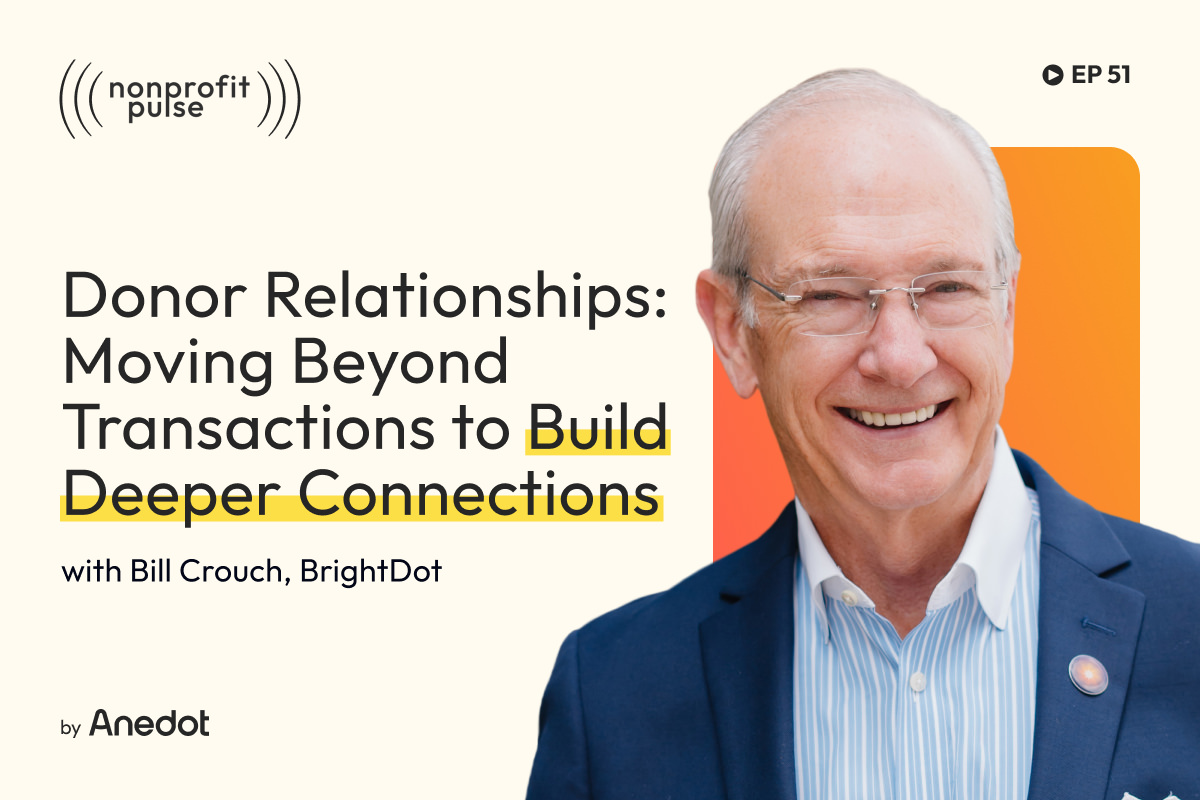
The short version: deeper donor connections are not a fancier thank you note. Bill Crouch, CEO of BrightDot Fundraising Advisors, says stewardship is still transactional. Real relationships come from personal attention, better questions, and a team that feels it matters too. His idea of mattership starts with one question every donor is asking: does my life matter?
Key takeaways
- Treat stewardship and relationships as different work. Bill sees stewardship as transactional. A deeper connection is not a fancier way to say thank you for a gift. It means building a real relationship, and for many leaders that requires new confidence with high wealth donors who think and talk differently than the people they serve.
- Put the most effort into the month after an event. Events like golf tournaments take a lot of staff time, and many organizations stop once the event ends. Bill met every team on the course, picked out the five or six people with real potential, and called them within three days to thank them and start a relationship.
- Help donors answer whether their life matters. A man who owned 35 funeral homes told Bill that everyone who walks in is asking one question: does my life matter? Bill built his mattership approach around helping high wealth donors find ways their lives matter and giving them a way to invest in the mission.
- Use personal touches that show a donor is known. Bill recommends quality personal stationery with your home address, first names instead of titles, handwritten notes, texts, phone calls, and showing up where donors are. His real test of a relationship is whether a donor answers your text within a few minutes.
- Ask questions that reveal a donor's joy. Bill's team asks high wealth donors about their favorite childhood toy, then listens for what made it meaningful. On the next visit, they tell the organization's story using the donor's own words, which helps the donor feel that same joy about the mission.
- Build a culture of mattership inside your team first. Outside supporters will not feel they matter if your staff do not. Bill met a prospect researcher who had never been thanked in 16 years. He suggests thanking behind-the-scenes staff and giving everyone in development the title Director of Major Gifts.
- Reward fundraisers for staying. Bill points to 16 month turnover as the biggest problem in fundraising. Because relationships take about five years to build, he suggests bonuses for longevity rather than dollars raised, such as a life insurance policy that names the fundraiser's spouse after five years.
- Treat small, thoughtful gifts as investments. Ask how a donor will feel when they open your note, not just whether it went out. A $20 garden lamp with a personal note about transformation can say more than a form letter. Bill urges leaders to know the difference between an expense and an investment.
- Tell long-term outcome stories and listen first. High wealth donors decide with emotion, so storytelling matters. Bill says they want to hear where people are 20 years after your program, not only who you serve today. Start by getting donors to tell their own story, then connect it to yours.
- Ask donors for their advice. Nothing makes a person feel like they matter more than being asked for advice. Bill would send a fundraising team to visit ten people this week, listen to their stories, and then build a plan to show those donors they were heard.
- His one-sentence takeaway: Be kind to one another.
Guest: Bill Crouch, CEO, BrightDot Fundraising Advisors | LinkedIn
Podcast episode transcript ↓
Josh:
Most nonprofits know what their donors gave, but fewer know why.
Appeals, events, and thank you notes keep the calendar full. But when every touchpoint leads back to a gift, supporters start to feel managed instead of valued.
Changing that takes patience, personal attention, and a team that sees donors as people, not revenue.
So how can nonprofit leaders move beyond transactions and build connections that make supporters feel they truly matter?
I'm Josh with Anedot and welcome to Nonprofit Pulse, where we explore trends, insights, and resources that help nonprofits accomplish their mission.
On this episode, we're joined by Bill Crouch on how leaders can move beyond transactional interactions to create deeper connections.
Bill is the CEO of BrightDot Fundraising Advisors, and for 40 years, he's helped nonprofits reimagine fundraising. His approach blends creativity, storytelling, and human connection with data-backed fundraising strategy.
As a fundraising expert and former college president, he has trained leaders nationwide.
A published author and Honorary Fellow at Oxford University, Bill recently released his second book, Mattership™: Making Donors Feel They Matter.
His work is rooted in the belief that giving is not an obligation. It's an opportunity to change lives.
Hey, Bill, thanks for joining us on Nonprofit Pulse.
Bill:
Thank you, Josh. Glad to be here.
What deeper donor connections mean beyond stewardship

Josh:
Yeah. Excited for our topic today.
Today we're talking about how leaders can move beyond transactional interactions to create deeper connections.
Bill, starting off, when nonprofit leaders say they want deeper connections, what does that really mean in practice and how is it different from simply improving donor stewardship or donor communications?
Bill:
Well Josh, it's quite different, and I believe that most nonprofit execs and CEOs really don't understand what that deeper relationship is and how it works.
It's not having a fancier way to say thank you to somebody for gifts. It's truly building a relationship with someone.
And as the demographics of our country have changed, and as the middle class has fallen down and less and less $100 donors are available for us, it turns more to the high wealth situations.
Most nonprofit CEOs and executive directors grew up in lower to middle class families. That's where their comfort zone is.
And to start talking to them about high wealth individuals and how they tick and how they operate is a whole different ball game.
And that's what we primarily focus on, is building that confidence that I can build a relationship with a high wealth person.
And it's not stewardship, that's transactional. This is a much different level than that.
And I had to learn it the hard way. I was a PK in churches that were made up of good middle class, wonderful people.
And when I became the president of a college, I was 12 miles in the shadows of the University of Kentucky.
I realized my alums, like a lot of Baptist college alums, were social workers, teachers, and preachers. They weren't business executives.
So I had to figure out how to bring those people into what I was doing. Because the missions that we have really don't matter if we don't have the revenue to run the mission.
And so we have to start thinking differently. And that's what I think is the challenge for these nonprofits going forward.
It's a different world, different thinking in order to have the revenue they need for the future.
→ Learn how a nonprofit data strategy can turn gift processing into donor intelligence and stronger donor relationships with Amberlee Burrows from Bearing Tree.
The hidden cost of letting events define donor relationships

Josh:
Bill, many nonprofits really interact with supporters mainly around transactions, right?
So we're thinking donations, event registrations, renewals, appeals.
What are the hidden costs of allowing those moments to define the relationship rather than real personal human moments?
Bill:
Well, I was asked the other day on another podcast, what is the one thing that I would suggest to nonprofits that they quit doing?
And my immediate response was golf tournaments, or any transactional thing that takes a whole lot of staff time. And when the event is over, you wash your hands and you don't do anything after that.
And that's not what it's about in the future. And so if you're going to do a golf tournament, you've got to do it differently.
You've got to understand that the most important part of the golf tournament is the month after the golf tournament, not the month leading up to the golf tournament.
It's about building the relationships.
So, just to give you an example, when I did golf tournaments at my school, I didn't show up and be there at the beginning and then leave.
I was on every hole putting with the teams that came through so that everybody got to meet the president and I could have a conversation with them.
And then I would pick out the 5 or 6 who I felt had real potential. And within three days after the tournament, I was calling them and thanking them for coming and starting to build the relationships.
And that's the piece that we see missing, Josh. Building the relationship happens after the events, not during the events.
And it's a hard thing to give up because the $30,000, $50,000, $70,000 we might make off an event usually goes right to the operational budget. And boards want you to balance your budget every year.
And so you do activities to do that, and you don't take the long term view.
And what we teach takes patience. Building a relationship doesn't happen overnight.
And we think that presidents and CEOs get too distracted in too many different ways. And so we call it segmentation.
There has to be a real clear focus on who I really want to build a relationship with, and going about it. Showing up when they don't expect you to. Using personalized stationery.
In other words, a high wealth person wants a relationship with you. I happen to be the CEO of a nonprofit. They don't want a relationship because you're the CEO of the nonprofit, because high wealth fundraising is all about trusting relationships, right?
So I've got to act like I'm confident being in the room with high wealth people.
It's a different vocabulary. Most nonprofits' vocabulary in their collateral is based upon the vocabulary of the people they're serving. High wealth people use different vocabulary.
So you've got to have new collateral. Don't change the collateral you've got, because it's great. But you've got to have new collateral that focuses strictly on the vocabulary of high wealth individuals.
And we've done a lot of research on the brain science of these individuals, how they think, and how we've got to think as nonprofit executives if we're going to build the relationships.
Josh:
That's right. And I love your perspective having been both inside and outside of these organizations.
You've been the president. You've been outside consulting with presidents and executive directors.
And just to clarify, this is not a matter of manipulation, but a matter of meeting people where they are and being able to immediately understand each other by, as you mentioned, using the right terms on collateral.
It's so that you don't present a stumbling block there, not so that you manipulate them.
Bill:
And I would take it even higher than that. We believe that every individual is on a quest for significance.
I'll give you an example. I've traveled around the country interviewing top performers from all different fields. The Blue Angel pilots, professional golfers, a farmer who owns a 1,200 acre farm, all kinds of people.
And I only ask them one question when I get the opportunity to sit down and talk to them. It's different depending on who I'm talking to.
I had the opportunity to interview a gentleman who owned 35 funeral homes across the country. And I asked him, is there one thing that you learned running your funeral homes that you could teach me? That I could teach CEOs of nonprofits to help them be more successful in what they do?
He said absolutely. He said, Bill, whenever somebody came into my funeral home to prepay their funeral, they're only asking one question. And when somebody came into my funeral home to pick out a casket after a tragedy, they're only asking one question, and it's the same question.
And the question is, does my life matter? When I die, are people going to say that my life mattered?
And he said, where you mess up in the nonprofit world, you always are focusing on the people you serve.
The reason you have a nonprofit is to serve people who are disadvantaged, ill, all kinds of reasons. And you're trying to say to them, you matter.
And what the gentleman told me was, Bill, you're missing the boat. Obviously you've got to tell that to the people you're serving. But every high wealth person is asking the question, does my life matter? And that's where you've got to focus first.
Because if your mission doesn't have the revenue, your mission doesn't matter.
So we've taken that, and we've trademarked and registered the word mattership. Our focus is on helping high wealth people find ways that their lives matter, and the nonprofit then giving them an instrument to invest in so that they will feel like their life was significant.
And as a result, I'm helping a homeless person's life become significant. So it's sort of turning all this fundraising upside down. And it's been really amazing, the results that we're having.
Signs a donor feels known, not managed

Josh:
Yeah. I want to talk about some of those results and signals.
What signals tell you that a supporter really feels genuinely known and valued by an organization, rather than simply being managed through a communications calendar?
If any of us have donated and been involved with nonprofits, we've certainly experienced those times where it felt like, oh, this is a calendar outreach. This is not something genuine.
Bill:
Correct. Well, first of all, the 10 or 12 people who are getting these types of communications, the communications they're getting are all personal.
So the most important one, and we teach all of our clients this, as CEO or executive director, you need to have quality personal stationery.
And we've done a lot of work with Crane Stationery, which is very nice, expensive stationery. And on the envelope, the return address is your personal home address.
And guess what? These people don't care whether you have a doctor's degree or a CFRE or anything like that. Quit using it. They only use first names, right? And that's the kind of relationship they want.
The real test is if you send them a text, will they return your text in 30 seconds or in a minute or five minutes? That's when you know you've got the type of relationship that's moving forward.
So handwritten notes are critical. The texting is critical. Phone calls. Showing up at a family reunion or showing up at one of their churches and sitting in the pew and talking to them afterwards.
I was told by a very wealthy person recently that all wealthy people love art and music. And he said, nobody should ever go visit a wealthy person unless you know what art and music they have. And you begin the conversations talking about those things, right?
You've got to go to where they are. You cannot ask high wealth people to come see you. You've got to go see them.
And you've got to image. If I'm going to see the farmer, I'm not going to show up in a suit. You've got to show them that you know who they are, right? And it's a very powerful way to begin building.
When I was the president of a college, back then you always wore a suit and tie, but I always had jeans and casual clothes in my office. And depending on who I was going to go see and who was going to see me, I dressed. Those image things are important in this whole process.
My daughter said to me recently, quit dressing like a retired college president. I said, well, then how should I dress? And she said, cool and wise. So that's why I'm not wearing a suit right now.
And we also think, Josh, it's the type of questions that you ask when you get to be with somebody.
It's not about tell me about all your children, which is important. It's not about where you went to school, and that's important. But it's really getting to know the person at their heart and in their joy.
Here's a question we teach our clients to always ask the first time they're with a high wealth person. Josh, what was your favorite childhood toy?
Josh:
Oh, wow. Yeah, probably a Dyno bike I had. It was a brand at the time that was really cool.
Bill:
What was it about it that made it so much fun besides being cool?
Josh:
Oh, it was super high quality. The gears moved so smoothly. You could do BMX type tricks on it. Super light.
All the cheap bikes had the cheap gears and were heavy, and this was super light and super smooth.
Bill:
And what did you do with your bike? Where did you go? How did you use it?
Josh:
Oh yeah. Rode it around the neighborhood. Did tricks.
Unfortunately, it was stolen. When I was 11, 12 years old, I went outside and my chained up bike was gone. It was really a life lesson that kind of tainted that love story I had with this great bike.
Bill:
So let me share with you this. Let's say I've asked you that question. I say, hey, that's great. And then I get back to other conversations.
But when I come back to see you the next time, I'm going to say, hey, Josh, I want to tell you a little bit more about my institution.
We're taking care of some kids whose lives have been stolen. Things in their lives have been stolen, and they're trying to figure out what to do. And there's hurt and grief, and they've never had the opportunity to just launch out and do things that were really new and exciting like other kids do.
And what we're doing in our organization is trying to equip them with vehicles so they can go on a journey. And on this journey, we can help take them to where they've never thought they could go.
So what I'm doing is telling you my story using your vocabulary.
And what happens when we ask this question? What you did happens 99% of the time. They say, oh my gosh. Then they get quiet, then they smile, then they start talking with their hands.
And what we know is we've hit your joy spot. If that bike brought you that kind of joy, what kind of story could I be telling you about my institution that would give you that same joy?
And if I can hit that joy, then I've got a lasting relationship with you.
Josh:
Love it.
Bill:
And that's how we coach and go about our work.
A lot of college presidents say it's stupid for me to ask somebody what their favorite childhood toy is. And I say, you know what? That's why they will remember you. Because you're going at it differently, and they're going to say something special about who you are, especially when you come back using their vocabulary.
→ Learn how to improve donor retention, build lasting loyalty, and re-engage supporters with James Misner from The Kipos Group!
How to build a culture where everyone feels they matter

Josh:
Thinking about culture, Bill, how can leaders build a culture in which staff see donors, volunteers, and partners as whole people, right? Not merely contacts, records, and revenue sources.
Bill:
This is one of the biggest challenges we see, Josh, in the people we work with. It's not having a culture of mattership.
The way that you help other people outside of your institution know that they matter is to make sure everybody inside your institution feels like they matter.
We were working with a public university with 147 development officers, and I interviewed all 147.
I walked into the office of a woman who had been there for 16 years as a prospect researcher. And I asked her, when was the last time a major gift officer who got a $1 million gift because of somebody you found and researched came into your office to say thank you?
And she said, I've been here 16 years and nobody's come into my office to say thank you.
Josh:
Wow.
Bill:
So we think it has to go internal first.
You know the 16 month turnover in fundraising professionals? When I started my career a number of years ago, that was the number one problem. Today it's the number one problem.
Nobody grows up wanting to be a fundraiser. They fall into it, right? And it takes 16 months to figure out you don't like the job, or it takes your supervisor 16 months to figure out you're not doing your job well.
Then we sabotage ourselves. The only way that we can get raises is to go to another organization. And within 16 months, you start looking for another place to go.
So we started doing some research. Why do people stay? Why do fundraisers stay five years? Ten years? It's not because they're getting wealthy.
And overwhelmingly, it's because they feel like they matter.
So one of the things that we've done is to say, let's say you have eight people on your development team. You probably have somebody doing the CRM. You have somebody doing the annual fund. You have somebody doing events, etcetera.
We think they all should get new titles. We think every person who works in a nonprofit development office should have the title Director of Major Gifts.
It does two things. One, it makes everybody feel like they're more important.
Two, it creates a mindset that the reason we do all this CRM and all this other stuff is to try to identify major gift people.
It means if you're going to do a golf tournament, you're going to be thinking differently, because you're going to be thinking, who are the major gift people that are there?
And it creates a mattership culture that really gets things done. This is a whole new way of thinking outside the box in a world that's outside the box right now.
Josh:
I love that, and it's such a good principle. People outside your organization will never feel like they matter if the people inside your organization don't feel like they matter.
Bill:
You got it. You just nailed it right there.
Josh:
And that's hard to do. You've got to have the right people. You've got to have the right defined culture.
And, as you mentioned, it's difficult whenever it's a revolving door of fundraisers coming in and out of the organization.
I think a lot of fundraisers are aware that when they go to a new organization, they have that 16 month window you're talking about. They already see this as a temporary thing.
And so leaning into that early on in the hire and saying, hey, we don't want you here for a year and a half, two years. We want you here for 10, 15, 20 years.
Bill:
Yeah. And we've created some incentives. We think there have to be bonuses. But the bonuses are for longevity, not for raising the money.
You've got your goals, and you've got to meet your goals in order to move forward. But if a fundraiser doesn't stay five years, the organization has lost their money, because it takes that long to build the relationships.
So we say at the end of five years, if you've stayed five years and you've met your goals, then you get a bonus. That's a whole new way of thinking for nonprofits.
But we do it in a way that's not a cash bonus necessarily. Just to give you one quick example, I could buy a half million dollar life insurance policy on you, Josh, at your age, for not a whole lot of money.
I would buy it for the institution, and the institution would own the policy. But if you stay five years, I'll make your wife the beneficiary of the policy.
That makes it a little harder to go somewhere else. That also says you really matter to us, and we're willing to make some future investments in order to keep you there.
Low-cost ways a small team can make donors feel they matter

Josh:
You've mentioned quite a few practical ways for nonprofits to build deeper connections, to build those relationships.
As you know, nonprofits are stretched so thin. So what are a few high impact ways that a small team can create more personal, meaningful connections without requiring a large budget or a major technology investment?
Bill:
So they need to just ask a few different questions.
When they're getting ready to send a thank you note to somebody, typically that's part of their goals. I've got to send out thank you notes. They send out a thank you note, and then they're through.
The real question is, when I send this note, how is the person going to feel about what they've received?
That's a different question. I have to spend a little bit more time thinking about what it is.
Also, we've got to learn how to write these types of things. I love to start off saying dear, such and such. Always use first names, by the way. I think that's critical.
And you say, hey, I noticed this about you, or I saw that in the newspaper, or I wrote down something you said last week and it just came back to me. Or I remember that you went to Southeastern, and I just met somebody who went to Southeastern.
It's not like the thank you notes that students write to donors who give them scholarships. Thank you for your scholarship, that really meant a lot to me. That's transactional, right?
So it's just saying to people, you matter so much. I care about who you are, and I'm going to demonstrate it.
I'm going to show you an example. We collect things to show fundraisers, to be able to send to people. This is a simple little black dish. But when you open it up, look at that. You can set it in your garden, anywhere.
But it goes with this note. Hey, when I saw this butterfly, I immediately thought of you. Butterflies remind us that transformation can begin quietly, that beauty can emerge in unexpected ways, and that one small presence can have a remarkable impact on the whole world.
That's what you've done all your life. And this lamp is yours now as a reminder to you of how much you matter to our organization.
That's the difference, right?
Josh:
Yes.
Bill:
This little thing costs 20 bucks. And what happens to a lot of nonprofits is, we can't afford to do that.
We grow up in the nonprofit world worried about expenses. And we don't understand the difference between an expense and an investment.
This is an investment. It's not an expense. And on the other side of this, if I get to the heart, that person could be a $1 million gift.
But it takes this type of creativity to really get a high wealth person to say, wow, this organization is different than other organizations I've dealt with.
How one donor went from $100 a year to a $5 million gift

Josh:
Yeah. Thinking of other examples, can you share an example of an organization that shifted from that transactional engagement to relationship-centered engagement?
What changed, and really, what outcomes followed that shift?
Bill:
Okay. So yeah, I can tell several, but one that we were working with in Boston was very transactional in what they did. We were brought in, and we coached their team.
We needed something to take the pressure off of the development staff to meet their goals that year. Because it was hard to have the patience to do what we were teaching them to do, but still have to meet their goals.
So we went to a donor and said, we need X amount of dollars to make sure we're able to balance the budget this year while we're learning how to raise more money for the future. And it worked.
So all of a sudden, the pressure was off for this year. So now we could start taking the long term view.
We found in their database some clues of some people that might have higher capacity than we thought. And we picked out a handful of those and began to develop this type of relationship.
We discovered that high wealth people can buy anything except an experience that you might be able to give them that they can't buy.
So we found a person who had just retired. Single, no children, a bank president who had just sold the family bank.
Josh:
Wow.
Bill:
We created an opportunity for her to meet a person who was very important to her in her life. She had never met this person, but they had a relationship with her parents.
We were able to get them together for a dinner, which began to establish a relationship. Then we followed up with a video of her with that person, and several other things.
And at the end, this person, who had been giving $100 a year, wrote a check for $5 million.
Because we had hit a significant moment in her life. And what she needed more than anything else was a sense of legacy for her life.
And now her name is on a very prominent place at this organization.
→ Learn how to build a recurring giving program your budget can count on with Dave Raley from The Center for Sustainable Giving.
How to tell stories that invite donors into the mission

Josh:
That's incredible. Bill, thinking about storytelling. You've done quite a bit of that in your days, both inside and outside nonprofits, helping shape those stories and what stories to tell.
From your perspective, what role does storytelling play in deepening relationships?
And how can organizations tell stories in a way that really invites supporters into the mission, rather than treating them as an audience to be persuaded, which I think is so often the case?
Bill:
First of all, storytelling is critical. Because high wealth people make their decisions from emotions, right? It's not numbers. It's not logistics.
Second thing, it's not you telling your story. It's getting them to tell you their story.
That's the big shift. You've got to listen to their story. Then you bring their story into the mix with your story.
The other thing that we've learned is it's not about the people that you are serving right now. That's not the stories high wealth people want to know.
They want to hear the stories of people who went through your program 20 years ago and where they are today.
And we're telling the wrong stories. We're talking about the poor child or the sick child or the homeless person.
They want to know, do you have any stories about people who were homeless 20 years ago, but today own their first home?
Josh:
That's right.
Bill:
That's what I want to know.
And we now tell our donors, we want to put all the people we serve on a journey to gain generational wealth. Because that's what changes poverty. That's what changes families. That's what gives people confidence.
And of course, in today's world, owning a home is a more difficult thing. So the pathway is a little bit longer than it's ever been.
But it's getting the person to tell you their story, bringing their story into your story, and then telling them the successes that you've had with people who've been out for 20 years now.
And they're the storytellers, not you. They're the ones that you want to film.
I've got to show you one other thing that I think you'll find fascinating.
Every board member must become a storyteller. And board members aren't too good at telling stories. So what we've created is the board storybook.
It's the size of a business card, and when you open it up, there's a video. Every board member is given one, and they're to show it to ten people before the next board meeting and come back and tell us who they showed it to.
A board member can keep it in their pocket or their pocketbook. And they often say, well, who do we tell the story to?
We say, why don't you start with the two people who live on your left and right? They might know you're on the board, but they don't know what you're doing.
Why don't you take it to your Sunday school class and ask for five minutes at the beginning of the class? You know, we've got to have ways to spread it.
Josh:
Sure.
Bill:
So you've got to give them tools in order for them to do that. Again, this is a part of the creativity that's required.
Why asking for advice shows donors they matter

Josh:
Thinking about our audience, thinking about who's listening right now, what is one question that they should ask their team this week to uncover where their organization may be unintentionally treating relationships as transactions?
Bill:
People want to know how much they matter before they decide how they're going to give their money away. Donors have to feel that they matter before they're going to open up.
And I call it, Josh, going from cash to assets.
Transactional is all about cash. Relationships are all about assets.
By the way, I'm on the board of a nonprofit here in Raleigh. And last week, the president of the institution called and asked if I would meet her for coffee because she needed my advice.
Nothing makes a person feel like they matter more than somebody asking them for their advice.
And I think those are the types of things that, if I had a fundraising team now, I would tell them all, go visit ten people this week and ask them for their advice. Go listen to their story. Come back.
That's so powerful. And then let's build a strategy to let them know we heard them. People feel unheard, unseen.
Another way that this is incredibly important is women over the age of 70. With the transfer of wealth that's happening, there's $352 billion sitting today in donor advised funds across the country, mostly held by women over the age of 70, who now might be in a senior living facility.
They were in a very powerful part of their lives where people paid attention to them. They served on committees. They were the hostess at the church.
But now they're in a senior living home, and they get up every day and there's one less person sitting at the table. Their grandchildren aren't coming to see them as often as they used to. Nobody's asking them for advice.
And they're in search of what we call the fourth quarter of their lives. Where is the meaning for the fourth quarter of their lives?
So we've created a process called the ethical will. We go into those places and we ask the people to write an ethical will, not a financial will.
The ethical will is where they write down the values in their lives that they would like to pass on to the next generation. And it's amazing how that makes them feel that they're going to be heard even after they're gone.
Josh:
Love that.
Bill:
I put everybody on the road. That's one thing we say all the time. Nobody comes to you to give you money. You've got to go get it.
And you've got to go build relationships. And it's not manipulation. It's allowing people to know they can matter until the day the good Lord takes them away.
Matter of fact, a poll just came out that said one half of all the people in America have felt lonely this year, and one third of the people in America feel lonely every day.
Josh:
Wow.
Bill:
And what a great calling that you and I have to go and try to impact their lives.
Closing thoughts

Josh:
I love that. Bill, as we close out this episode, any resources you'd like to share on today's topic or anything related?
Bill:
If you're a CEO, president, or executive director of a nonprofit, we do a lot of one-on-one coaching to help understand this high wealth level.
If you're in a development office, we've created experts. For instance, in planned giving, the woman who helps us with our planned giving was one of the starters of the planned giving program at St. Jude's Hospital. One thing that they know at St. Jude's Hospital is it's all about the heart.
So we have experts in every area. We can do a capital campaign, but what we'd rather do is get you ready to do a capital campaign. Plus, we think capital campaigns are a thing of the past.
We think it's going to be all about sustainable major gift relationships. It's never up and down like a campaign, but just regular. We call it building your philanthropic engine.
Our website is thebrightdot.com. I'm glad to talk to anybody, because we're here to help you be able to impact more lives.
Josh:
As always, for our listeners, head on over to nonprofitpulse.com. We'll have links to Bill's organization's website as well as some other resources and show notes.
Also there, you can sign up for the Nonprofit Pulse newsletter. Great curated content every month in your inbox to help you and your organization accomplish your mission.
Bill, last question of the episode. My favorite question of every episode.
If you were standing on stage in front of a thousand nonprofit leaders and could share one thing, one sentence about moving beyond transactional interactions to create deeper connections, what would you say?
Bill:
Be kind to one another.
Josh:
Love it. Well said, well said.
Bill, this has been such a great conversation.
I hope everyone heads on over to nonprofitpulse.com to find the route to connect with you and get some other resources.
The end of the year is here. Everyone's kind of written their end of the year campaigns, but I hope anyone listening right now will go and pencil in some changes off of this episode and what you've shared, Bill.
It's so helpful. I've seen so much of what you've laid out be effective in organizations that I've been in and outside of.
Again, thanks, Bill, for sharing. And I hope many folks will reach out and connect with you.
Bill:
Thank you, Josh, and thank you for what you're doing.
Josh:
Hey, thanks for listening.
If you enjoyed this conversation, please share or leave us a rating and review wherever you listen to podcasts.
Also, head on over to nonprofitpulse.com to sign up for our monthly newsletter, as well as check out all the links and resources in the show notes. We'll see you next time.
Frequently Asked Questions
What is mattership in fundraising?
Mattership is a term trademarked by Bill Crouch, CEO of BrightDot Fundraising Advisors. It is built on the idea that donors, especially high wealth donors, want to know their lives matter. A nonprofit practicing mattership helps donors find ways their lives matter and gives them a way to invest in the mission so their giving feels significant.
How is building donor relationships different from donor stewardship?
Stewardship usually means thanking donors and reporting back after a gift, which can still feel transactional. Building a relationship means getting to know the donor as a person. That includes personal notes, phone calls, texts, visits, and questions about what brings them joy.
How can a nonprofit tell if a donor feels known and valued?
One test Bill Crouch uses is how quickly a donor replies to a personal text. If they respond within a few minutes, the relationship is moving forward. Donors who feel known also use first names and welcome personal contact rather than formal mailings.
Why should nonprofits rethink events like golf tournaments?
Events often take a lot of staff time and end with no follow-up. Bill Crouch says the most important part of a golf tournament is the month after it. Leaders should meet attendees during the event, then call the few with real potential within days to thank them and start a relationship.
How can small nonprofits build personal donor relationships on a budget?
Start by asking how a donor will feel when they receive your thank you note. Use first names and mention something specific about the person. A small, thoughtful gift with a personal note can cost around $20 and still show a donor how much they matter.
What stories do major donors want to hear?
According to Bill Crouch, major donors often want to hear about people who went through your program years ago and where they are today. He also recommends listening to the donor's own story first, then connecting it to the organization's story.
How can nonprofits reduce fundraiser turnover?
Fundraisers tend to stay when they feel they matter. Bill Crouch recommends thanking behind-the-scenes staff, giving every development team member the title Director of Major Gifts, and offering bonuses tied to longevity rather than dollars raised.
Where can I listen to this Nonprofit Pulse episode?
Nonprofit Pulse is a nonprofit podcast from Anedot hosted by Josh Breland. You can listen to this episode with Bill Crouch on Spotify, Apple Podcasts, and YouTube, and we list every episode with show notes at anedot.com/nonprofit-pulse.
80 Community Service Ideas for Nonprofits