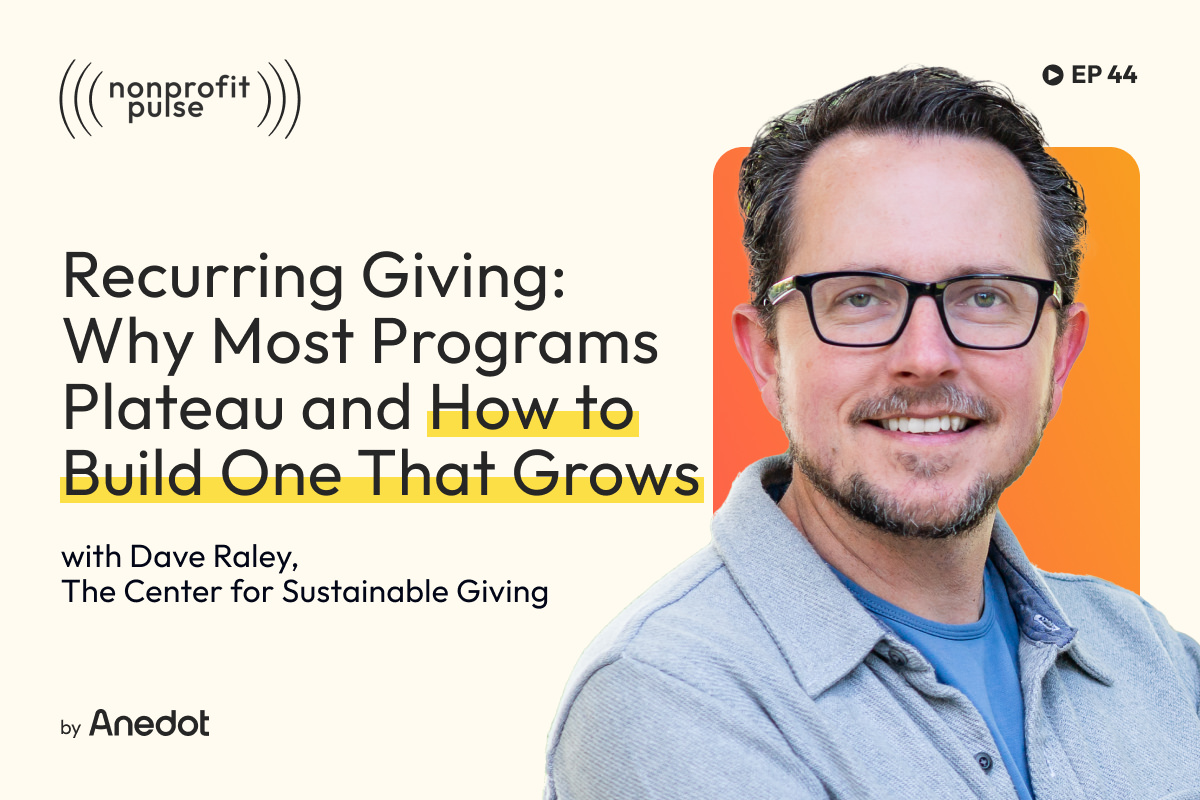
The short version: most nonprofit donor programs stall because they are buried, under-promoted, and treated as a checkbox instead of a discipline with clear ownership. Dave Raley, Founder & CEO of The Center for Sustainable Giving, explains how a visible offer, an ongoing value proposition, and active payment recovery can turn a flat donor base into a durable source of support. The starting point is simple: know how many ongoing donors you have, how much they give each month, and which existing strengths you can use to invite more people in.
Key takeaways
- Programs plateau when they are invisible and rarely promoted. A checkbox on the donation page or a buried navigation link does not make ongoing support a priority; organizations need to make it visible and invite both new and existing donors to participate.
- Ongoing donor support deserves to be treated as a full discipline. Raley puts it alongside major gifts, capital campaigns, grants, and single-gift fundraising, rather than treating it as a side project.
- Retention changes the long-term value equation. Raley cited an average ongoing donor retention range of 78% to 84%, compared with 19% for new single-gift donors and about 42% for multi-year donors.
- A core strategy can build a larger base over time. The Joshua Fund grew from about 1,900 to more than 4,000 ongoing donors in two years after deciding to make this work a central part of its strategy.
- Clear ownership needs real support. One person should be responsible for cultivating and growing the program, but they also need time, training, resources, and organizational influence to make progress.
- Donors need an ongoing value proposition. The question is not only why someone should give once, but why they should continue supporting the organization and the impact it creates.
- Separate involuntary churn from voluntary churn. Declines, expired cards, and replacement cards can end a gift without the donor choosing to stop, so payment updates and recovery processes matter.
- Failed-payment outreach is worth the effort. Raley says the organizations he works with see average donor long-term value ranging from $1,500 to $3,000, which makes a timely email or phone call a meaningful retention step.
- Technology should remove barriers, not become the strategy. A useful platform lets the person responsible update the donation page or value proposition without waiting for a custom developer.
- Start with 'how many' and 'how much,' then find your natural resources. Know the size and monthly value of your current base, then look for assets such as website traffic, content, events, geographic reach, or access to a distinctive audience.
Guest: Dave Raley, Founder & CEO, The Center for Sustainable Giving | LinkedIn
Podcast episode transcript ↓
Josh:
Recurring giving should be one of the most reliable and scalable revenue streams a nonprofit has. But for many organizations, it plateaus.
Growth slows, donor retention becomes a challenge, and what once felt like momentum turns into maintenance.
So why do so many recurring giving programs stall out? What separates the ones that keep growing year after year? And how can nonprofits design a recurring giving experience that donors actually want to stick with?
I'm Josh with Anedot, and welcome to Nonprofit Pulse, where we explore trends, insights, and resources that help nonprofits accomplish their mission.
On this episode, we're joined by Dave Raley on why most recurring giving programs plateau, and how to build one that grows.
Dave is an author, advisor, and the Founder and CEO of The Center for Sustainable Giving.
He's the author of The Rise of Sustainable Giving and writes a weekly column called The Wave Report.
As an advisor and speaker, he has worked with thousands of nonprofit leaders to grow both personally and organizationally.
Dave also hosts The Sustainable Giving Podcast, a show that shines a light on what's working in sustainable giving.
Hey, Dave, thanks for joining us on Nonprofit Pulse.
Dave:
Oh, glad to be here.
Why most recurring giving programs plateau (even though they’re so resilient)

Josh:
Yeah, excited for our topic today. Today we're talking about recurring giving and why most programs plateau and how to build one that grows.
Dave, you said recurring giving is one of the most resilient revenue streams in fundraising, and yet most of them plateau.
So when you look under the hood, what's usually going on there?
Dave:
Well, first of all, recurring giving, you know, monthly giving, people refer to it, regular giving, if we were in the UK right now, it's not new, right?
Recurring giving has been around for thousands of years. In fact, in the research for the book, I did a brief history, ancient history on recurring giving.
And did you know that the oldest form of recurring giving in human history was the ancient Jewish people?
And it was this idea that, like, this practice of what they would call then first fruits.
So recurring giving is not new. But here's the deal. There's a problem.
The vast majority of charities, especially if we're speaking about North America and the US, the vast majority of charities have been left behind.
There've basically been three kinds of recurring giving programs historically. 1 to 1, so think about your sponsorship or staff support or deputized support.
There's different language people use, but the idea is a donor, I as a donor give and an individual receives. That's great. Like if your charity can do that, wonderful.
Problem, most charities don't actually have the programs or services to have a 1 to 1 program.
Second kind of program historically has been what we call membership. So think about I as a donor, I'm receiving some sort of actual benefits.
Like I listen to the radio program or I receive the materials, or I take my kids to the zoo. And so then I'm a donor, right?
So those are what we would call membership programs. But, Josh, three quarters of charities are in the third bucket.
They don't have a 1 to 1. They don't have membership. They don't have the ability to sort of provide benefits directly to their donors per se.
They're in the last category, which is literally everybody else.
So 75% of charities, 1.1 million charities in the US today, have been left behind.
But times are changing. And the reality is that today, because of the subscription economy and the changes in generosity, the way people think about giving to organizations on a recurring basis has completely changed.
And so now today is where I get fired up to say, like, how do we equip charities to have the strategies, the tactics to actually then take advantage of this moment?
Quick wins to jump-start a stagnant recurring giving program

Josh:
Yeah, and I want to talk about your work with nonprofits.
What do you see as the kind of the most early wins that a nonprofit can make in getting that stagnant, recurring program growing again?
Dave:
First thing, most common early win is just make it visible.
When I talk to organizations and I talked to literally thousands of leaders a year, we work with dozens in our consulting practice.
But when I talk to organizations, they say, hey, recurring giving is a priority for us. How do we grow it?
And I say, well, let's bring up your website right now. Where is it?
Usually recurring giving is a checkbox on the donation page. Or it's a button buried in the third level of navigation.
And this isn't just a digital commentary, but if recurring giving is important to you, the first thing is we've got to make it visible.
Then the second area I would say to look at is, how are you inviting existing and especially new donors to your organization?
How are you inviting them into making an ongoing impact through recurring giving?
We just don't ask. And sending a direct mail piece in January is not going to cut it, right.
We've got to actually think about this as a core part of how people support the organization. Make it visible and invite people into it.
→ Discover how to turn nonprofit data into clear decisions, stronger stories, and a more confident team with Stephen Minix from UpMetrics.
What nonprofits can learn from Netflix and Spotify about recurring giving

Josh:
I love that. You've talked a lot across your articles and in publications about the subscription economy changing donor expectations.
What can nonprofits learn from companies like Netflix or Spotify when they design a recurring giving experience?
Dave:
Yeah. You know, it's funny, when I speak at conferences now and I say the subscription economy, I'm pretty sure the majority of the audience is eye rolling me on the stage.
Because when I started speaking about this ten years ago, obviously it was a different world. The trend hadn't really caught steam yet.
And I would say to people like, well, you know, like the subscription economy, and they'd be like, what? Say what?
I said, well, you know, like Netflix and Amazon.
So honestly, the first thing is those consumer trends, the fact that we live in the subscription economy today.
By the way, Josh, the average subscription business over the last 12 years has grown four times faster than the average non-subscription business.
And I quote that in the book with what's called the subscription economy index.
So there's some lessons we can learn. Like anytime you see a bright spot like that you're like, hmm, what can we do with that?
So I'll give you one example of a lesson I think we can learn from Netflix or Spotify. And that is this focus on what is the biggest long term value we can create.
If you're Netflix or you're Spotify, those organizations are spending billions of dollars, with a B, tens of billions of dollars in reality to acquire new subscribers.
The only reason that model makes sense is because they're going to then keep those subscribers for the long haul.
The first few payments you make to a Netflix or to a ChatGPT or whatever subscription you're paying for, they're at a loss for that subscription.
And so with fundraising, we understand that the average recurring donor stays around a lot longer.
The average recurring donor retention rate is somewhere between 78 and 84%. Compare that to the average new donor, new single gift donor retention rate, which is 19%, or the average multi-year donor retention rate, which is about 42%.
So if we can keep twice as many of them or four times as many of them, and we can create more long term value, that's one of the lessons I think we can apply from the subscription economy.
When recurring giving becomes a core strategy, not a side project

Josh:
So, Dave, many organizations launch a sustainer program, but it never really becomes central to their fundraising. And I'm seeing this more and more.
What does it look like when a nonprofit truly treats recurring giving as a core strategy and not simply a side project?
Dave:
First of all is to recognize that sustainable, recurring giving is a full fledged discipline.
It's just as deep and unique as major gifts fundraising or capital campaign fundraising or foundations and grants fundraising, or what I would call single gift fundraising.
Like these are all kind of within the family, right? There's some principles that we can apply across those.
But recurring giving is just as deep a rabbit hole, and it's a practice that we need to really embody and embrace and learn and grow.
So let me give you an example. You asked about like when a nonprofit really treats recurring giving as a core strategy, not a side project.
So an organization called The Joshua Fund, Chris Free is their VP of development over there. He called me a couple of years ago and said, Dave, we've already seen the writing on the wall.
We've seen the opportunity, we want to make recurring giving a core part of what we do. And so he was just on the beginning of that path.
We got a chance to work with him. And at that time, by the way, Joshua Fund was a few million dollar organization, and they had about 1,900 recurring donors.
Not bad, by the way. Most charities would be like, I'd like to have 1,900 recurring donors.
Josh:
Absolutely.
Dave:
Today, Josh, two years later, they're an $18 million organization. And he just texted me the other day. They surpassed 4,000 recurring donors.
Josh:
Wow.
Dave:
These are the faithful partners. And these aren't just like, yay, we got 4,000 new donors and we're going to lose 80% of them, like would happen in single gift fundraising.
We're actually going to keep 80% of them, right. And so what does it look like to actually see that base really grow.
And so I think the organizations that are brave and willing to say like, hey, let's make this a core part of our strategy, not just a checkbox on the website, are the ones that are seeing the most fruit.
→ Get practical strategies to build community before a crisis, strengthen local partnerships, and keep volunteers ready for response with Laurie Hood from Alaqua Animal Refuge.
Who owns recurring giving? Why clear ownership drives long-term growth

Josh:
Yeah, that's a great segue into my next question talking about ownership. And whether you're a business or a nonprofit, the question of ownership is ever present.
Anytime there's dysfunction, a go to question is, well, who's owning this, right?
So, one, in recurring giving, how important is ownership? And when you look at programs that keep growing year over year, like you just mentioned, The Joshua Fund, who is actually responsible for that growth internally?
And what are they doing differently?
Dave:
Well, first of all, and I think this comes back to just really good fundamental leadership lessons, because if everyone is responsible, then no one is responsible.
Far too often I think recurring giving is treated as like, yeah, yeah, that's the job of the fundraising team or the development team or what have you.
And the reality is if everyone's responsible, then no one is.
So what I would say, whether you are a one person nonprofit, it's just the executive director with a board and some volunteers, or you're a, some of our organizations we work with have hundreds or even thousands of people.
There needs to be at least one person that feels like I am responsible for cultivating and growing this recurring giving stream.
And it might be the executive director, it might be the VP, depending on who you are. It might be somebody on your team, but someone needs to own it, and they need to be resourced to actually take advantage of it.
I see one of two mistakes. More often, nobody owns it and nobody's thinking about it.
But then they hear somebody like me say someone should own it. And then they say, hey, that young kid who we hired the other day, he does subscriptions. We should make him responsible for it.
It's like, well, okay, technically now someone is responsible for it, but they don't have the knowledge, the access to resources.
They don't even have the influence in the organization to do something about it.
Sure, give them a copy of my book, right. And that's fine. But the reality is that they not only need to own it, but they also need to be resourced.
And resourced could mean you're giving them the time, like a little bit of the, hey, this is not the only thing on your plate, but this is the most important thing on your plate.
You're giving them resources, you're sending them to conference. Or we host a workshop twice a year, two and a half days, just dedicated on this topic.
Like you're sending them to the workshop. You're bringing in help, right?
How are you resourcing that one person? But ownership is critical.
Josh:
Yeah. And resourcing it again not as a side project. So resourcing it as a core, if not the core, strategy of your fundraising.
Dave:
Yeah. Like why would you, if it's just a checkbox, why does anybody need to spend more than ten minutes on it, right?
Turn the checkbox on and move on.
And the reality is you're not going to see the kind of fruit that you could see if you really make this a core part of what you're doing.
Crafting a recurring value proposition donors actually want to stick with

Josh:
So next, I want to talk value proposition and what separates a recurring offer that donors say yes to and stick with from one that feels like more of a one time gift on autopay, which is, I don't know, probably 90%.
If I had to give a number of what most recurring gifts are, it's a one time gift that's on autopay.
Dave:
Yeah. You know, I think the most important difference, because value proposition is so important just in fundraising, right.
Like, how's my gift going to make a difference? The team over at NextAfter has done a great job at really defining that for the industry.
And so I'll use their definition.
The idea of a value proposition is answering this question: if I am your ideal donor, why should I give to you rather than some other organization, or not at all?
And for time, I won't unpack every one of those phrases, but it's about who are your ideal donors. This is not your opinion. This is the donor's perspective.
And here's the piece for recurring giving that's so critical.
Why should I not only just give to you that one time, give you that $50 gift, or that $20 gift, or that $1,000 gift?
But why should I give to you on a recurring automated basis, usually monthly, right?
So the big word I want you to think about, if you're listening to this show, is what is our ongoing value proposition?
Why should I give to your organization on an ongoing basis?
And that changes the game because a single disaster gift is nice, but it's a tip at the end of the day.
How do we move people into an ongoing relationship?
And I think one of the keys, and we talk about this in our workshop and in the work we do with organizations, is articulating it in a way that people see the ongoing impact that they can make in the lives of the people that you exist to help.
→ Learn how to improve donor retention, build lasting loyalty, and re-engage supporters with James Misner from The Kipos Group!
Reducing churn and winning back lapsed recurring donors

Josh:
So thinking about churn, you know churn is inevitable. It's going to happen. Cards expire, donor circumstances change, life events.
What are the most effective practices you've seen to reduce cancellations and win back those lapsed recurring donors?
Dave:
Oh, man. And you guys know this at Anedot, but the reality is there are two kinds of churn in recurring giving.
And by the way, these are the terms I'm about to use are subscription economy terms. So these are terms we need to use in the nonprofit space.
The first type of churn is what is called involuntary churn.
Second type of churn is called voluntary churn.
The reality is most churn in recurring giving, I believe, is what is known as involuntary churn.
That means the donor didn't mean to stop giving. Their credit card got declined. The expiration date went by and they didn't get it updated.
There's some fraud that happens. We've all got that letter in the mail from our bank that's like kind of nondescript and a little thicker than usual.
And it's like, oh no, I have to go update my credit card with 22 different subscriptions and half a dozen different charities, right?
So the reality is, I've heard anywhere from 20 to 25% of credit cards basically go bad every year.
First of all, look at your technology. Does your payment processor enable what is often referred to as auto updating?
So sometimes they can auto update the expiration date. Some payment processors are so good that they can actually update the payment information, like if the credit card gets replaced.
So that's the first place to go.
And then also look at your process and your donation platform's ability to just send reminders.
Hey, in three months your credit card is going to expire, right.
Some of the automations, but then also just practically, depending on how large your program is, you just need a report either once a week or once a month that just says, hey, these are the names of people whose payments have failed, and have an outreach plan.
It might be the person at the front desk, it might be you. It might be somebody, and send them an email, give them a call.
The average donor, Josh, it ranges in the organizations that we work with, but $1,500 to $3,000 a donor, like in terms of long term value, and that's a pretty wide average, like they're worth a call.
That's worth a phone call.
And so just think about the fact that your donors are stopping giving, even if they don't intend to. And what are you doing about it?
Josh:
Absolutely. And we've helped nonprofits. Customers love our credit card updater feature that solves some of that.
But, as you know, you still need to monitor that. You need to connect with those folks because like you said, a lot of it is involuntary. It's just one thing that slipped through the cracks.
And it's also just a great time to connect with donors as well.
You can have some great conversations, checking in on a card that's expired, a donor who has a card expired, that otherwise you wouldn't have contacted them at all.
So don't see it as like trying to recover. See it as just connecting with an important donor in your organization.
Growing recurring giving without a big tech stack or dedicated team

Josh:
So Dave, a lot of smaller or midsized nonprofits think they can't grow recurring giving without a big tech stack or a dedicated team.
I know you know that's not true. So what do you say to that and what's actually required to see meaningful growth, even for these smaller organizations?
Dave:
Oh man. It's a great question. What I always say about technology, and I've got a technology background and I think technology is hugely critical.
But the reality is technology is not going to grow your recurring giving program. Like no amount of secret technology pixie dust is going to grow your program.
However, technology can either be your biggest barrier or best ally to scaling recurring giving for your organization.
That's something we're deeply passionate about. We don't build technology at The Center for Sustainable Giving, but we do try to point people to that.
And so there's some criteria that we look at when choosing technology or when considering changing technology.
There's six criteria outlined in the book. I'm just going to give you one, because I think for small or midsized nonprofits, this is very relevant, and that is simply ease of use.
Now when I say ease of use, I don't mean the technology is so simple a monkey can use it. Well, if a monkey can use it, it's probably not very powerful, right?
It should require a little bit of training and a little bit of like know-how.
But do you need like a custom developer? Like we can only change things on the third Tuesday of every month because we have four hours of a custom developer's time. Like that's a problem.
And so I would just, one of the questions is can, like, for example, can your marketing manager or your executive director or whoever is responsible for it, can they go in and make a change to the donation page, or can they update the value proposition statement?
Like, these are the kinds of things that are simple but powerful.
Josh:
I love that, I love that, and some who are listening may think, well, surely that doesn't happen that often in 2026.
And I can tell you, it happens every single day.
Dave:
From personal experience. Yep.
Josh:
Depending on what tool you're using. I mean, some of the larger kind of legacy technology platforms are still a bear for small teams and those who aren't subject matter experts with that technology.
So yeah, it's a real problem. And, at Anedot, we've designed it to do that so that your marketing manager can do it.
Your new hire can step in and update your pages and your campaigns. But that's just vitally important.
If you are at a place where your technology is a barrier for efficiency and ownership, as we talked about earlier, you need to switch off of that. You need to find another tool.
→ Learn how to grow a monthly giving program to boost donor retention and ensure long-term success for your nonprofit with Stephen King from GrowthForce!
First steps to turn a flat recurring program into long-term sustainable growth

Josh:
Dave, so for a leader listening who has a recurring program that's really plateaued, it's flat.
They look at the numbers every quarter and they're underwhelmed.
What are the first 2 or 3 steps you'd have them take in the next, let's say, 6 to 12 months to build a program that is truly going to grow over the long term?
Dave:
I would say, know where you stand and look for your natural resources. I'll unpack each of those briefly.
So know where you stand. I have two questions I want you to answer.
Not in the next 6 to 12 months, in the, like, by the end of today, depending on when you're listening to this and what, you know, if you're mowing the lawn, I want you to get to the answer to this by the end of this week.
And these questions are how many and how much?
How many recurring donors do we have today, and how much are they giving on a monthly basis?
Because with that knowledge comes power. Some organizations, many organizations in some ways, don't actually know the answer to that question.
And so it's like, yeah, once a year we look at that or yeah, when was the last time we looked at that?
It's not very motivational if you don't know what that number is.
So, because the way I like to say it is, you can't get to where you want to go until you understand where you are today.
So first thing is just know where you stand, and then the second is look for what I call your natural resources.
Now this is something, when we do the deep dive assessments that we do with organizations, we spend a lot of time as outsiders saying like, okay, let's understand these organizations, not only just their unique DNA, but what I call their natural resources.
Every organization has things that are naturally sort of occurring or existing within their organization, their culture, their programs that are like super powerful resources that we can leverage.
And I can think of a dozen examples, but, whether it's we do content and programing and we have a large audience.
I just got off the phone with a charity we're working with that has like huge amounts of traffic coming to their site for these different content pieces they put together.
We're like, perfect. That's a natural resource. How can we turn that into invitations to ongoing impact?
Some organizations it's, we have a footprint all over the country or the world, or some organizations it might be, we have special access to a certain audience, or we do live events or we host this thing or that thing or whatever.
Again, I don't know what those are for you, but too many leaders spend time sort of kind of being jealous of other people's resources.
Like, man, if only we had a celebrity founder, we would do as well as them.
And it's like, well, if you don't have a celebrity founder, then you can either sweat that or you can move on and say, what do we have that other people are jealous of, right?
By the way, Josh, as an outsider, it's so fun for me because I'm like, I get giddy about the stuff that, I'm like, you guys have this, like, this is huge, you know? They're like, oh yeah, we do have that.
And so look for your natural resources and know where you stand.
Now, if you're at a certain size, like, yeah, get help with that.
Like there's some organizations, you're at that place, like I said, Chris was at 1,900 donors.
We have organizations we work with that have 100 donors. We have some organizations that have 100,000 donors.
If you can get help, get help too.
Closing thoughts

Josh:
Love it, love it. Dave, as we're closing out this episode, any resources you'd like to share with our audience?
Dave:
When I put the book out, the book came out, as we record this, a little over a year ago, and it's just been such a fun journey.
By the way, writing the book was a very painful journey. We can talk about that in another episode.
But we had over 25,000 leaders in the last year engage with the message of sustainable giving, whether that's listening to The Sustainable Giving Podcast, which we host, or subscribing to our, we call it The Wave Report, which is our weekly on how nonprofit leaders can grow themselves and their organizations.
And so what I thought is, yes, people can go ahead and get a copy of the book. We have an audiobook now. You can get a copy of that.
But we've put together a guide. It's called The Sustainable Giving Growth Blueprint, and it basically takes section three of the book, which is really talking through the seven steps to really grow a thriving recurring giving program.
And we've compressed it into just a free resource for folks to have.
And so if folks are interested, they can get that. We can put that in the show notes.
The URL is just Sustainablegiving.org and it's slash blueprint.
So Sustainablegiving.org/blueprint and they can grab a copy of that and we'd be happy to send it to them.
Josh:
Awesome, awesome. And yeah, as you mentioned, head on over to Nonprofitpulse.com for the show notes.
There you'll find a transcript of this episode, all the links that Dave has mentioned, as well as sign up for the Nonprofit Pulse newsletter.
Once a month, we send the best trends, insights, and resources from around the web in one newsletter.
And we love that resource for folks who can't spend hours and hours sifting through all of the nonprofit-related trends, insights, and resources that are constantly being created.
Which is a good thing, but you need a good curator of that. So again, Nonprofitpulse.com.
Dave, last question of the podcast, my favorite question of every episode, which is if you are standing on stage in front of a thousand nonprofit leaders and could share one thing, one sentence about today's topic, what would you say?
Dave:
Sustainable, recurring giving is more accessible to more charities than at any other time in history. The question is, are you going to take advantage of it?
Josh:
Love it, love it. Dave, thanks so much for the great conversation.
As you mentioned, in another episode, I would love to have you back on maybe next season and reconnect about all the goings on that's going to happen between now and then.
Life and industry is moving so fast. But again, thanks for joining us and I hope everyone connects with you over at Nonprofitpulse.com in the show notes.
Josh:
Dave, thanks again.
Dave:
Happy to be here and so grateful for what you guys are doing for the sector.
Josh:
Hey, thanks for listening.
If you enjoyed this conversation, please share or leave us a rating and review wherever you listen to podcasts.
Also, head on over to Nonprofitpulse.com to sign up for our monthly newsletter, as well as check out all the links and resources in the show notes. We’ll see you next time.
Frequently Asked Questions
Why do recurring donor programs stall after early growth?
Recurring donor programs often stall because they are hard to find, rarely promoted, and treated as a side project instead of a core fundraising strategy. Dave Raley recommends making the option visible and building invitations to ongoing support into the way an organization engages both new and existing donors.
How can a nonprofit diagnose a flat sustainer base?
Start by answering two questions: how many ongoing donors do you have today, and how much are they giving each month? Raley says those baseline measures show where you stand, while an inventory of your natural resources can reveal underused paths to growth, such as website traffic, events, content, or a distinctive audience.
What causes churn in a recurring donor program?
Churn can be voluntary or involuntary, and Raley believes much of it is involuntary. Declined cards, expired cards, replacement cards, and fraud-related changes can stop a gift even when the donor did not intend to cancel.
How can nonprofits reduce failed payments from ongoing donors?
Use payment technology that can refresh expiration dates or replacement card details when possible, then monitor failed payments with a weekly or monthly report. Follow up with a thoughtful email or call, because a failed payment can be an opportunity to reconnect with an important donor.
Who should own a nonprofit's recurring donor strategy?
One person should be clearly accountable for cultivating and growing the program. That person also needs time, training, resources, and enough organizational influence to act, rather than being given ownership without support.
What makes donors stay in a recurring donor program?
Donors are more likely to stay when they understand the ongoing impact of their support, not just the value of a single gift. A strong ongoing value proposition answers why an ideal donor should keep supporting your organization on an automated basis rather than give once or choose another option.
How can small nonprofits grow a sustainer base without a large team?
Small and midsized nonprofits do not need a large technology stack or dedicated team before they begin to grow. Raley advises choosing tools that are easy enough for the person responsible to update the donation page and value proposition without depending on a custom developer.
80 Community Service Ideas for Nonprofits