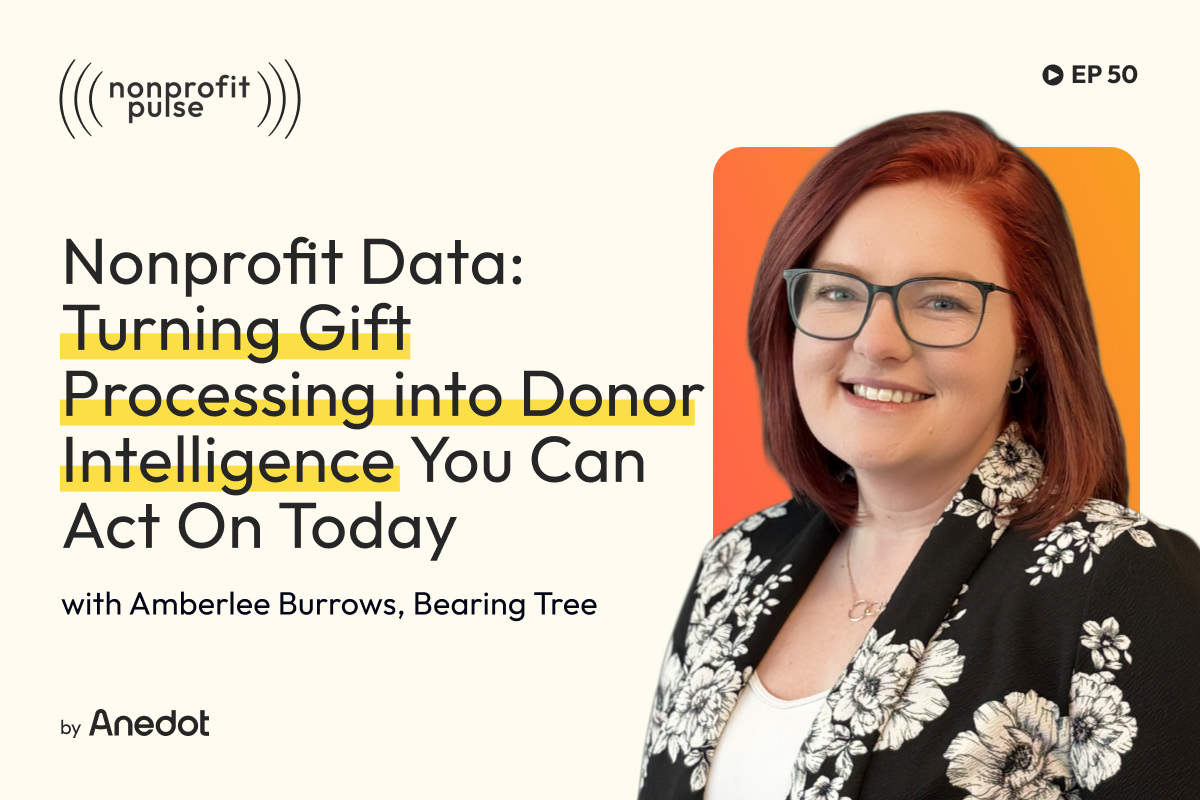
The short version: A strong nonprofit data strategy starts with reliable gift processing and complete donor records. Amberlee Burrows, Development and Salesforce Director at Bearing Tree, explains that every gift contains useful information about a donor’s relationship with your organization. When teams capture, organize, and maintain that information well, they can segment donors more accurately, personalize outreach, improve fundraising decisions, and build stronger long-term relationships.
Key takeaways
- Treat gift processing as the start of donor intelligence. Every donation can reveal something meaningful, including how a donor gave, which campaign or program motivated them, who signed the check, and whether they have another address, spouse, or preferred communication channel. Capturing those details turns everyday transactions into information fundraisers can use.
- Poor donor data can damage donor relationships. An unrecorded gift can lead a gift officer to ask a donor to renew shortly after they already gave. An outdated household record can result in a painful or awkward mailing. These are not only communication mistakes. They are operational breakdowns that can make donors question whether their gift and relationship matter.
- Duplicate records can hide a donor’s full value. When a donor’s giving history lives across multiple records, fundraisers may see only part of their lifetime giving, make the wrong ask amount, or overlook them when building a major-gift travel plan or donor portfolio. Matching on names, addresses, and emails helps create a more complete donor profile.
- Run simple data quality checks before assuming your data is good enough. Start with a duplicate-contact report, a contact-completeness report, and a current-donor report that includes this year’s giving, last year’s giving, and lifetime hard and soft credit. If top donors are missing or totals do not look right, investigate before using that data for fundraising plans or asks.
- Standardize gift processing and donation caging. Give one person ownership of the process, train a backup, document clear timelines for deposits and tax receipts, and reconcile gifts with financial records regularly. Clear procedures reduce the risk of lost checks, incorrect receipts, delayed records, and stressful audits.
- Capture the data that supports segmentation. At a minimum, collect accurate donor contact information, gift date and amount, giving method, campaign or page source, and the signer for mailed checks. Over time, also track program interests, event attendance, volunteer history, giving patterns, outreach activity, and other information that helps fundraisers understand a donor’s relationship with your organization.
- Give every donor at least one valid contact method. For small and mid-sized nonprofits, a practical data standard is ensuring each donor record includes a usable email address, phone number, or mailing address. This reduces returned mail, helps teams reach more supporters, and creates a dependable foundation for future donor communication.
- Clean data before using AI or advanced analytics. AI cannot produce a genuinely personalized outreach plan when a donor record is missing interests, giving history, campaign engagement, meeting notes, or other relationship details. Cleaning and connecting that data gives AI and predictive tools the context needed to produce more useful recommendations.
- Automate online gift processing into your CRM. Manual entry takes staff time and creates opportunities for human error. Connecting your online donation platform to your CRM can help ensure gifts are recorded faster, mapped to the right fields, and available for timely acknowledgments, reporting, and follow-up.
- Use the time you save to build relationships. When teams spend less time entering gifts, correcting records, and building parallel spreadsheets, they can spend more time thanking donors, following up personally, planning better asks, and advancing their mission.
- Her one-sentence takeaway: Your long-term donor relationships are only as strong as the data behind them.
Guest: Amberlee Burrows, Development and Salesforce Director, Bearing Tree | LinkedIn
Podcast episode transcript ↓
Josh:
What if the information your nonprofit needs to build stronger donor relationships is already in your database, but your team can't see it?
Fundraising strategy often gets the spotlight, but the quality of that strategy depends on the information behind every gift, every donor record, and every interaction.
A duplicate record can hide a donor's full giving history. Missing details can lead to an awkward acknowledgment, a missed follow up, or a fundraising opportunity that never reaches the right person.
This is not about having a perfect database or a large data team.
It's about creating reliable processes that help your organization turn everyday transactions into donor intelligence your fundraisers can use.
So what does that look like? How can nonprofits strengthen gift processing, improve data quality, and use the information they already collect to make smarter fundraising decisions today?
I'm Josh with Anedot and welcome to Nonprofit Pulse, where we explore trends, insights, and resources that help nonprofits accomplish their mission.
On this episode, we’re joined by Amberlee Burrows on how nonprofits can turn gift processing and donor data into practical intelligence that strengthens fundraising.
Amberlee is the Development and Salesforce Director at Bearing Tree, where she helps nonprofits build efficient, compliant, and structured development operations that support long-term donor relationships.
Her work includes gift processing, donor research, and Salesforce management, helping teams spend less time managing data and more time engaging donors and advancing their mission.
Hi Amberlee, thanks for joining us on Nonprofit Pulse.
Amberlee:
Hi. Thanks so much Josh for having me. I really appreciate it.
Where weak fundraising operations show up first
Josh:
Yeah, excited for our topic today.
We're talking about turning gift processing into donor intelligence that you can act on today.
So maybe starting off, when nonprofits focus on fundraising strategy but overlook operations, where do you see that gap show up first in their results?
Amberlee:
Yeah. Well and that's a really great question because we see it fastest is in their ability to build relationships.
You don't always think about your gift processing impacting your ability to build relationships.
But we see it in three different places.
Your basic contact information. A donor mails in a check. There could be a phone number that nobody catches, and the staff is sending letters rather than picking up a phone call and actually talking to the donor.
Also, we see it in return mail.
A lot of people that have direct mail or annual reports, tax receipts, if they're getting return mail and they're not updating the address, they're wasting money on sending undeliverable mail.
And a simple tip that I feel like a lot of people don't always realize is there's a sticker normally at the bottom of your return mail that will have a forwarding address.
So that's a free update for you, that then you're still having that communication with your donor.
Why gift processing should be part of your nonprofit data strategy

Josh:
Yeah. So how should a nonprofit leader think about gift processing and data entry as part of their kind of overall fundraising strategy, and not simply as back office work?
Amberlee:
I definitely challenge nonprofits to stop thinking about gift processing only as admin, and it really should be the start of your donor intelligence gathering. Every gift is telling you something about that donor.
Was it online? Are they only giving me a check? Who signed it? Do they have a second address? Do they have a spouse?
Are they giving to specific campaigns? Are they interested in specific programs because a letter or an email was about that?
If you're not capturing that information, you're not able to segment your donor list or identify those really long term donors who are interested in your mission.
And that shaky foundation then will impact your fundraisers as you move forward.
It's how are we getting all of the information that we can about that donor from the gift that they're giving us and really understand how are they involved in our mission and preparing our gift officers before they're talking to them even?
How poor gift processing and data entry affect fundraising results

Josh:
Yeah. So you kind of alluded to a couple of the outcomes there, and I want to lean into that.
So when gift processing and data entry do break down, what are 1 or 2 concrete outcomes that you see in real organizations such as lost revenue or maybe some awkward donor moments?
Amberlee:
Yeah, absolutely.
So there's really two that have come to mind.
One that we've seen before is a gift officer is calling a donor about renewing their gift for the year. And the donor gave like two weeks ago, it was not updated in their CRM.
The gift officer then has to spend the call kind of apologizing and trying to build that relationship back up.
And the donor then kind of thinks, well, does my gift even matter if they didn't even know that it came in?
That just right there puts a wedge in that relationship and then makes the donor start questioning, is this nonprofit, do they have it together? Is there going to be a reason that my gift should be going on?
The second one is a little bit more awkward.
An MGO, they've gone they've met with a donor and found out that her husband recently passed away and that MGO never updated their database.
And so a few months later, when their team was sending out a donor mailing, they had that donor's husband on the piece of mail, which doesn't seem like a big issue.
But then the donor calls and reminds them, hey, my husband passed away.
It's not only awkward, but it's painful because you have a major gift officer that's going and talking to these donors.
And they're supposed to be building these relationships, and then you aren't updating a system that will prevent that situation from happening.
They're really not just relationship failures. They're operational ones. You want to make sure that you have your operations to help enforce that relationship with your donors.
How duplicate donor records distort donor value

Josh:
Yeah. And thinking of major gift officers and donor value more broadly, can you share a specific story where duplicate records or missing details caused a nonprofit to misjudge a donor's value?
And then what changed once the data was cleaned up?
Amberlee:
Yeah.
Duplicate records, they're going to happen, right?
You always are going to have duplicate records that just it's a constant management because donors will give with a different email than they did the first time. And you're matching.
But that's why it's so critical to really have some of those good matching and data quality to say, okay, we're looking at more than just an email, but where we've seen it really impact things is that you have donor records that are segmented.
So you have their giving history in two different places.
So if you're trying to run a report to say how much should we ask this person? How much did they give last year, then you're maybe getting only a portion of what they gave last year.
Or their history, maybe someone has been giving for the last five years.
On that one donor record, you're only seeing maybe 1 or 2 years of their giving history.
And where we see that really impact, like the bottom line MGO’s is that you either are asking for the wrong amount because you don't actually know what their total giving was.
If you are missing someone entirely, say you have an MGO or a development officer that's going to a city to meet donors, and you're running reports in your CRM to say, great, who are the other donors that are in that area?
You have to obviously filter donors by saying, okay, who are the ones that have maybe given the longest, who are the ones that are donating at a certain level?
If you have segmented, incomplete donor records, then you're maybe going to miss out on having a one on one opportunity with a donor that's been donating to you for five years. And it's all because of duplicate contacts.
Three ways to check whether your donor data is good enough

Josh:
Amberlee, we probably have some listeners right now who are assuming that their data is good enough.
What simple checks can they run this week and what real results have you seen from organizations that did those checks and then fix those issues?
Amberlee:
Yeah, I always tell people don't assume.
If you have a database, you should be able to verify if your data quality is good enough.
At Bearing Tree, we have started rolling out a data quality dashboard because we want to be able to keep an eye on this for partners.
And so we have 12 different data points that we are looking at. But I think the three most important is one, it's the duplicate contacts report.
So being able to pull that and get it to match based on email, address, and the name of the donor.
So then you're able to match on multiple data points rather than just relying on email. Email is great. Don't get me wrong, it's amazing, but it doesn't always catch everybody.
And back to our conversation a little bit ago about duplicate records, that is really important.
And making sure that you're asking for the right amount. They're getting pulled on the correct reports.
The second one that we like to see is a contact completeness report.
So we like to associate depending on, how you're normally communicating with your donors, that you have a score for each contact based on their email, phone number, and address if they have that filled in.
So then you can get a sense of what percentage of your contacts have missing fields that your team finds important.
Because if you're not able to call your donor, email, or mail them something, that's going to have a huge impact on what you're doing.
And then the last one is a current donor report.
We want to be able to pull a report easily that says who's given this year, who gave last year? What's their lifetime giving hard or soft?
And if you pull that report and your top donors are missing, you know for a fact that there is something wrong within that data.
And that's where we usually will see people. Okay, wait, I can't pull this type of report or this report that we pulled from our CRM, it's not correct.
That's when digging into it and finding those issues are going to help so much when you're looking at planning for next year.
When you're looking at what are you trying to bring in the door? How much money have those top donors given? What are your increase in asks?
If you're not able to pull those reports, then you're not able to do any of that planning.
And you're also, again, going back to you could be asking for too little, or you could be asking for too much. If you think someone's been giving more than they have been.
Josh:
That's so helpful.
And just thinking about some of those data fields, what in the past couple of years have you seen organizations adding to their donor records for segmentation, for prediction modeling, etc.?
What are you seeing?
Amberlee:
Yeah, absolutely.
So I think a big one is figuring out a way to really track your interests and where they're interested within your organization.
That really has helped people segment.
If you have a lot of different programs. If you have a lot of different events and being able to track all of that within your CRM.
So yes, you want to have all the basic contact information for them. But then getting more information on sometimes their age.
Their age is really helpful when you start looking at planned giving programs.
You also are looking at their interests. What are the other nonprofits that they're giving to and understanding kind of where your organization lies in kind of their broader philanthropy plan.
That's usually something that we find helpful.
And that, again, helps people segment, because if you know that you have a donor who they like you, they're still going to give to you, but you're maybe number ten on their list and they have other priorities.
That's a good signal for your team to be able to segment them.
Still, you want to build a relationship, but maybe they're not going to have as much, like one on one time with a CEO or a program manager as someone who your nonprofit’s their number one in philanthropy.
How better gift processing and caging improve fundraising operations

Josh:
So thinking about processing and caging, when you talk about optimizing those, can you walk us through a before and after example and what measurable difference it made for their fundraising?
Amberlee:
Yeah, absolutely.
Let me paint you a little picture, because caging I think is always so hard for people to think about.
But really what we've seen before, people have created standardized operating procedures around gift processing is that you have no single owner of it. It's just whoever has time that day.
There have been checks that sit on desks for weeks or they get lost. You'd be surprised how many groups lose checks.
One organization, before we started working with them, they told us during the onboarding process that they had lost a six figure check and then had to call the donor to get that back.
And that's not a fun conversation to have saying, hey, we lost this check that you mailed us.
So that is one of the big that there's like no process around what happens with these checks or cash that's coming in online.
Josh:
This is a very scary, spooky painting.
Amberlee:
Yeah, I know it is.
When you don't have standard procedures around it, it is. And donors get tax receipts that are not correct if, say, they haven't had their donation tracked.
And then also your annual financial audit takes so much time.
If your CRM and your financials don't match, it's going to take you so much longer.
And so what we see after, right, is that we want you to have a standard operating procedure for this.
You have someone who is the primary owner of the process, and that they also have a trained backup, because inevitably we all go on vacation, right? You can't be there 100% of the time.
You want to have, like, clear timelines around your deposits when your tax receipts are going out, and then also your donation documentation for those financial audits.
And then we always recommend reconciling with your financials, to make sure that constantly you're not missing anything.
You're not missing an ACH or a wire that came in and for Bearing Tree, our partners, what we do is we do this actually every month.
Then we do a quarterly and annually for all of the audits. And after someone really takes that in, creates the standard operating procedure around gift processing, what we see is that they have faster and less stressful audits.
Their tax receipts are going out accurately and they're on time. So then donors are getting that information right away.
No lost checks. We haven't seen anyone lose a check yet, which that's always great.
And the big part of this is that you have your leadership and your MGO’s or your development staff, they stop building spreadsheets and other systems, and they're adopting the CRM because they're trusting that the data going into it is valuable for their work that they're doing, and it can be trusted.
It's not, oh well, maybe there have been checks added in.
Maybe there have been online gifts that have been added, but they're three weeks old.
That is the biggest win I see is that their CRM adoption increases.
And then with that we usually see CRM, your adoption increases there. And then that means that your fundraising will increase as well.
The donor data you need for better segmentation and communication

Josh:
That's so helpful.
So, thinking about donor records, what donor details do you consider non-negotiable to capture from everyday transactions?
And how do those details actually change how fundraisers segment and communicate with those donors?
Amberlee:
Yeah, absolutely.
So the way that I always think about this is based on the method that the donation comes in.
If you're getting a mail check, non-negotiables are address, phone number, date that the gift came in, the amount, the method, and then the signer.
A lot of people don't realize that the signer normally indicates who might be the primary contact at that household that you should be engaging with.
Sometimes it just depends on who's maybe writing the checks, but a lot of times you'll start seeing a pattern of, oh, wow, Sally is always the one writing the checks.
We should really make sure that we're getting a meeting with Sally and not just John, in that household.
For online gifts, same thing of you have your name, address, but definitely email.
You always want to track the email that's coming in for those online gifts as well as the campaign or page. Those are really critical because anytime you're doing online gifts, you might have specific campaigns that are going out.
You might have your normal donate page, emails that are happening. If you can't get the ROI from those activities, then you're really missing half the picture.
Also, with that, you are getting again, little bit of Intel into what the donors are thinking.
If you sent a specific program email and you have a campaign dedicated to it, and now you're able to capture that and you see that every time you send that type of email they're giving to your organization, that is a very good indicator that they care about that program.
I would say that these methods, they really matter because if you know someone's giving online, if you know someone's giving via the mail, that's how you're going to be interacting with them.
You also want to make sure that all of that data is then there and easily accessible to your major gift officers to then inform that strategy that they are doing moving forward.
A realistic nonprofit data strategy for small and mid-sized teams

Josh:
So for a small or mid-sized organization that doesn't have a data team, what is one realistic data standard that they can adopt this quarter, and what sort of payoff have you seen from organizations that really stuck with it?
Amberlee:
Yeah, absolutely.
No matter the size of your organization, data quality is going to matter.
And organizations and nonprofits, we just have to really understand that it also is everybody's responsibility.
It's even more true when you have that small or midsized nonprofit because everyone is talking to donors, right?
Everyone's talking to the individuals that are key for your organization.
And so that means that you all also have to be able to put in that data to make sure that your CRM is working for you.
One of the biggest things that I would say in the next quarter for them to work through is make sure that you have a valid contact for every single donor in your system.
You want to be able to contact your donor, and if you aren't able to contact your donor, you're more than likely not going to be getting another donation.
So it's simple, it's measurable, and it's immediately actionable because you can run a report from your CRM, say who does not have an email, phone number, or address.
And if they don't have one have your team research it. Look at where they gave their donation to try to get one of those three.
When we have groups do that as just the base level, we see that they're getting a lot less of bounce back letters.
And so then they're not spending money on that.
They are able to then have their team spend time calling those donors, talking to them, create a strategy and a plan to then really connect with them and not necessarily kind of miss people who might not ever come up on their list because they have missing contact information.
Why clean donor data needs to come before AI and advanced analytics

Josh:
Amberlee, thinking about AI, which is all encompassing right now for everyone.
Amberlee:
Oh, yeah.
Josh:
But thinking about AI.
So when organizations try to adopt AI or AI advanced analytics on messy data, what actually happens in practice?
And can you share a real example of how cleaning the data first improves that AI output and AI outcome?
Amberlee:
Yeah, absolutely.
I love this question.
And it is coming up a lot right now, just as you would imagine.
Everybody is interested on how can AI help with either fundraising or work on donor communications?
And it's an older saying, but it's garbage in, garbage out, right?
The AI is only as good as the data that it's trained on.
And so if you have messy data like missing addresses, misspelled names, you have no activity history for that donor, or you have the unreliable giving history because of duplicates in the system, then the AI that you're trying to use, the predictive giving isn't going to actually happen, because it's being trained on data that's incomplete.
That is not true to what that actual donor looks like.
Where we've seen this with a couple of our partners that we've worked with is that they have tried to ask AI to build out, like outreach plans for major donors.
It seems pretty common as like one of the things that people want to do.
And they were getting very generic responses, because when you look at their CRM that they've connected in with the AI platform, there's no interest areas for that donor.
There's no giving history that is saying, what campaigns did they give to? When did they give? And then you're also seeing that there's no outreach activity tracked.
So you're not seeing when was the last time we met with them? When did we have an email with them?
You're getting these very generic responses because AI is like, well, yeah, I can create an outreach plan for a major donor, but it's not going to be personalized to that person or that donor that you want.
So having the group clean up that data first.
So making sure great, what are the meetings that you've had, making sure that you have, what are the campaigns or events that they've attended for you? All of those.
Once you put that information in and it has more to work with, it was able to build out and give a much better structure of this is what your outreach plan should look like for this major donor.
And that is just I think that's really the key part, is that you really want to clean the data first, and then you can let AI do its job, which is a really great and useful tool.
Josh:
I love that, and it's just got my mind thinking of donor records and what should be in there.
I mean things like have they volunteered as well.
So when AI writes that outreach email for you and then you go to clean it up, it already has, thanks so much for your history with us, for your commitment over these past seven years.
You've served as a volunteer. You've also given to 16 campaigns, 3 programs that couldn't have been a success without you.
You know, all of that enriching that outreach.
Amberlee:
Absolutely.
And you think that if you're trying to get, if you have a really large database, right, you say you're a 20 plus year organization, you have maybe, hundreds of thousands of contacts from volunteers, from board, from donors for years.
And you want AI to say, hey, we want to really reengage some of our lapsed most engaged donors at their certain time, right?
If they were a donor for like 3 or 4 years, they were a volunteer, and we want to engage that group of people.
All of that data is so critical to have in there, because then it can help you really segment and pull these lists together on who you should be targeting.
And that's where your CRM being able to connect to kind of having it be everything within your nonprofit.
So if you do have volunteers, if you have programs, if you have events that you're doing, having it all connected, so then you can get a picture of someone's relationship with your entire organization.
The one gift-processing improvement to make in the next 30 days

Josh:
If a nonprofit leader did just one thing differently with gift processing over the next 30 days, what would you recommend and what kind of short term result should they realistically expect to see?
Amberlee:
Yeah, one thing is automate your online gift processing into your CRM.
I am always surprised on the partners that when we onboard them, that they have been manually entering in online gifts into their CRM.
Most tools that you're going to work with have a native integration, it's usually free to set up, and they have really great support.
So don't get your team working on all of these online gifts and entering them into your CRM, if it can be done automatically for you.
We have partners that are using Anedot and the CRM integration with Salesforce is really great and you get to set up your own mapping, and so you can really make it hit all of those data standards that we've talked about, where we want to have certain data points for every donor.
And it's happening without your staff doing it.
That's the biggest, short term result that I see is that your staff is getting hours back, and those hours is where they can actually be thanking a donor.
They can be writing a thank you note, building relationships, or maybe they're out getting sponsors for your next event. And it's very clean.
It's cleaner than having one staff member entering it all in because there's always human error.
Closing thoughts

Josh:
Amberlee, this has been so helpful.
As we're kind of closing out the episode here, any resources you'd like to share with our audience?
Amberlee:
I really love talking about gift processing.
It maybe sounds silly, but donation caging is one of my favorite things, so always feel free to reach out to me.
I'm happy to talk to anybody about their process that they have.
Also on Bearing Tree’s website, we have blog posts related to this topic to just help organizations kind of get a start on how should they be thinking about gift processing and what are some of these best practices that we see?
Josh:
Awesome, awesome.
And as always, our listeners can head on over to nonprofitpulse.com.
There you'll find this episode with the show notes, with links to Bearing Tree, as well as Amberlee’s LinkedIn and other resources as well.
Oh, also, you can subscribe to our monthly Nonprofit Pulse newsletter, which is curated by myself and our producer Joseph.
Highly recommend it, great stuff, nonprofitpulse.com for that.
Amberlee, last question of this episode.
My favorite question of every episode where we put the guest on the hot seat for a short, pithy answer.
So here we go.
If you were standing on stage in front of a thousand nonprofit leaders and could share one thing with them on today's topic, one sentence, what would you say?
Amberlee:
Probably that your long term donor relationships with your organization are only as strong as the data that you have behind them, because the data is the only thing that's going to stay over the next 20, 30, 40 years as you engage them.
Josh:
Love it, love it.
You can have a messy bedroom or a messy kitchen, but you cannot have messy donor data.
Amberlee:
Correct. I love that saying.
Josh:
Awesome.
Amberlee, thanks again and I hope everyone will go to nonprofitpulse.com.
Check out this episode.
Connect with Amberlee.
She's going to be a great resource for you as well as Bearing Tree.
Amberlee, thanks for joining us.
Amberlee:
Yeah, thank you so much for having me. Appreciate it.
Josh:
Hey, thanks for listening.
If you enjoyed this conversation, please share or leave us a rating and review wherever you listen to podcasts.
Also, head on over to nonprofitpulse.com to sign up for our monthly newsletter, as well as check out all the links and resources in the show notes. We’ll see you next time.
Frequently Asked Questions
What is a nonprofit data strategy?
A nonprofit data strategy is a plan for collecting, organizing, maintaining, and using information across the organization to make better decisions. For fundraising teams, it includes reliable donor records, consistent gift processing, clear data standards, useful reporting, and processes that turn donor activity into actionable insight.
Why is gift processing important to a nonprofit data strategy?
Gift processing is often the first point where donor information enters a nonprofit’s CRM or database. Accurate processing helps teams capture gift amounts, dates, payment methods, campaign sources, contact details, and other information that supports donor segmentation, stewardship, reporting, and future fundraising decisions.
How does poor donor data affect fundraising?
Poor donor data can lead to missed follow-up, incorrect or delayed tax receipts, duplicate outreach, returned mail, and inaccurate fundraising reports. It can also cause fundraisers to overlook a donor’s full giving history or make an ask that does not reflect the donor’s actual relationship with the organization.
How can nonprofits find duplicate donor records?
Start by running a duplicate-contact report in your CRM. Review potential matches using multiple data points, such as the donor’s name, email address, mailing address, phone number, and giving history. Matching only on email can miss donors who use multiple addresses or give through different channels.
What donor information should nonprofits collect?
At a minimum, nonprofits should capture accurate contact information, gift date, gift amount, giving method, campaign or donation page source, and relevant household information. Teams can also track donor interests, program engagement, event attendance, volunteer activity, outreach history, and communication preferences to support more relevant segmentation and stewardship.
What is a simple donor data standard for small nonprofits?
A practical starting standard is to ensure every donor record has at least one valid contact method: an email address, phone number, or mailing address. This gives the organization a reliable way to thank, update, and re-engage donors while reducing returned mail and missed communication opportunities.
Should nonprofits use AI before cleaning their donor data?
No. AI and predictive analytics are only as useful as the data available to them. If donor records have missing contact details, duplicate profiles, incomplete giving histories, or no engagement notes, AI-generated recommendations and outreach plans will likely be generic or inaccurate. Clean, connected data gives AI the context needed to support more useful fundraising work.
How can nonprofits automate gift processing?
Many online donation platforms offer native integrations with nonprofit CRMs. Automating the flow of online gifts into the CRM can reduce manual data entry, limit human error, make donor data available faster, and free staff time for acknowledgments, stewardship, and relationship-building.
80 Community Service Ideas for Nonprofits