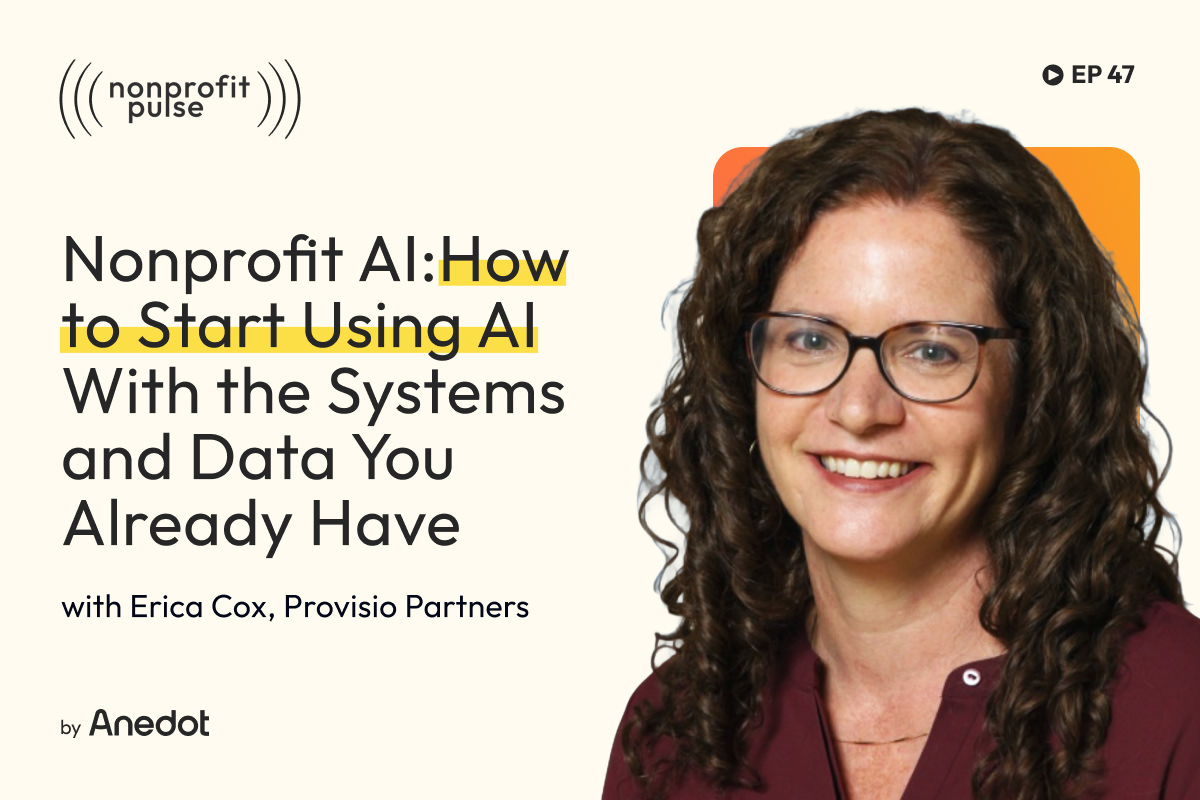
The short version: AI adoption at an established nonprofit is not a single large transformation. Erica Cox, Chief Innovation Officer at Provisio, argues for the opposite: several small, controlled pilots inside the systems you already run, an honest inventory of the data you already hold, and governance work that will likely take longer than the technology itself.
Key takeaways
- Start small and pilot several use cases at once. The goal is to fail fast or win fast in a controlled scope, then publicize the wins so early adopters pull everyone else along.
- Data readiness does not correlate with system size. Organizations running spreadsheets and ad hoc SQL databases sometimes have higher data literacy than those on modern platforms, because they know exactly what they have.
- Inventory before you build. A data assessment needs both a high-level scan of which categories and systems will be most useful and a detailed pass through individual data elements.
- Governance is the bigger half of the project. For one client, consent forms, payer contract disclosures, and regulatory review consumed more of the effort than the technology build.
- Restrict what the AI can see. Pacific Clinics’ agent, Hope, was given one identifier and nothing else about the individual: a clear, enforceable guardrail.
- Agents can cover the hours your staff cannot. Hope answered program questions and booked enrollment callbacks after business hours, which is when referred members actually called back.
- The pace of change is the real difference from past tech waves. Unlike a cloud migration, this is not one big investment with a defined end state.
- Ignoring AI is riskier than adopting it. Staff are already using it. An inventory, anonymous if needed, is the most effective way to make the case to a resistant board.
- The strongest ROI is removing work nobody wanted. One client reported staff seeing ten kids instead of five and finishing three grant applications instead of one. Not hours saved, but more time spent on the human part.
- Her one sentence: get started today if you haven’t already, and take small, incremental steps.
Guest: Erica Cox, Chief Innovation Officer, Provisio | LinkedIn
Podcast episode transcript ↓
Josh:
Nonprofits don’t have to overhaul their technology to begin using AI.
They can build from the systems, data, and processes already in place.
This is not about a full data cleanup or a major technology rollout. It is about finding a practical use case within the work your team is already doing.
So what does that look like? How can nonprofits turn early wins into broader adoption, while using AI responsibly, protecting sensitive information, and making more room for the human work that matters most?
I’m Josh with Anedot, and welcome to Nonprofit Pulse, where we explore trends, insights, and resources that help nonprofits accomplish their mission.
On this episode, we’re joined by Erica Cox on how nonprofits can begin using AI with the systems and data they already have.
Erica is the Chief Innovation Officer at Provisio, where she helps organizations unlock their full potential by building and executing impactful visions on the Salesforce platform.
A deeply experienced technologist, Erica has architected tailored solutions for dozens of human services and behavioral health organizations, bridging the gap between complex technology and meaningful community impact.
Hey, Erica, thanks for joining us on Nonprofit Pulse.
Erica:
Oh, thanks for having me Josh, I'm really excited to be here.
The smartest way to introduce AI at an established nonprofit

Josh:
Yeah, excited to have you, excited for our conversation.
Today we're talking about how to start using AI with the systems and data you already have. A great topic. Excited to get into it.
So maybe just starting off, many nonprofit leaders hear AI and picture a full technology replacement.
Erica, you work with large, established organizations.
What does realistic AI adoption actually look like when you're building on top of years of large existing infrastructure?
Erica:
Yeah, I'd say it's actually the polar opposite of that large, singular transformation.
So where we have seen organizations have success is by starting small and working incrementally.
So work with one small use case or several small use cases, pilot several things at once within your existing infrastructure, or with another tool that you're going to experiment with and just get some successes.
Fail fast, right?
You're going to fail. It's inevitable because this is brand new technology. It's changing almost daily. You're going to fail. So you want to do something that's small and controlled so that you're failing fast or winning fast.
And when you succeed, you're going to trumpet those successes and get to a point, hopefully, where you have taken your early adopters and gotten them so excited and have forums for them to share their successes so that everyone else wants in on that too.
That's how you're really going to get adoption and break down the barriers that a lot of us are feeling with introducing AI into an organization.
How to identify and clean the data AI can actually use

Josh:
Your data strategy at Provisio starts with assessing what an organization already has, so an audit.
When you walk into a large nonprofit and look at their data for the first time, what do you typically find and how do you decide what's usable or helpful for AI?
Erica:
I'd say there's nothing typical like with most things within consulting and within nonprofits in general.
I don't know that there's a typical I think we see it's not really dependent upon the size of the organization, but we see a wide variety of data literacy and data readiness, and it doesn't even necessarily correlate with the systems that they're using, because we may have a customer who has been on spreadsheets and the SQL server databases that their program managers have spun up, and yet they have a really high data literacy and that they know what they have.
It's controlled, it's well managed, they have good data governance. Whereas we may have a client who's coming off the most sophisticated systems.
Maybe they even are already on Salesforce, but they've struggled with adoption because they don't have that data governance and data literacy internally, and therefore they have a bigger mess to clean up, right?
I think there's a sense and this seems unique to nonprofits. Maybe it's not unique, but it's just magnified within the nonprofit space.
But this desire that more is better where data is concerned, right? Everyone thinks, oh, but if I take everything, then I'll always have what I need.
But what we find is that one, it creates compliance issues. Because if you're expecting a user to enter 100 fields, there's going to be some fatigue.
If they don't really understand the purpose of that data, you're not going to get good solid data. And so it's a barrier to, like I said, adoption, compliance, all those things.
But it also creates too large of a context window for AI.
So if you're creating fields that are only sometimes relevant or we want to collect this, maybe someday, but we're not going to collect it now.
So you have all of this half baked data, right? AI is going to take a look at it. It's going to be much, much harder for it to make sense of that.
And I think that's easy to see and conceptualize when we're talking about structured data like a database. But it's also true of unstructured data.
So a really good example is I live in a high rise building. And we recently implemented, they implemented an AI chatbot to ask questions about the building.
I asked it when the dry cleaners was open. Seems like a really simple question.
And I got back a response that was inexplicable that said, the dry cleaners are open Tuesdays and Thursdays from like 10 to 2, and I knew that obviously wasn't the case.
So luckily there was a citation option, and that had come from minutes of a board meeting in 2020. AI, that reasoning engine that LLM is going to try to answer you no matter what.
So it is going to go looking for the answer even if it doesn't make sense. So we like to think of this concept of minimum viable data.
So you go in, you identify what the good use cases are, and we can talk more about good use cases in a minute. But when you do, what is the absolute minimum amount of data that you need to make that use case really effective?
Then focus on cleaning that up and making sure that data is intact and relevant and all those things, deduplicate it, all those things.
And it takes what seems like an impossible task and makes it far more manageable.
→ Learn how to build an annual nonprofit fundraising plan, turn big goals into a one‑page annual roadmap, and focus on the revenue drivers that matter with Krissie Kelleher from Team IMPACT.
Why giving staff room to experiment with AI builds momentum

Josh:
I want to circle back to something you said earlier. You talked about quick wins with AI.
Can you give us a specific example of an organization that started small, saw real results, and what that did for buy in across leadership?
Erica:
Sure. So we recently hosted what we call Changemaker Collaboratives in Chicago. And we bring in a group of our clients for a panel.
One of our clients from the Higher Learning Commission was saying that early on, they realized that this was coming, whether they you know, I think that's another message like, it's coming, people are doing it no matter what.
So they quickly put out a policy that basically said, you can't use any of your own stuff, you can only use our approved stuff. And by the way, we have no approved stuff right now.
But if you're interested in learning more and digging into this, reach out.
So they formed a committee of people who were early adopters. He calls them the runners, right? The people who are going to run.
Brought them in and had them pitch their use case, you know, teaching them about how to write a good prompt, how to use the tools, gave them access, gave them permission to fail, which I think is key, right? Gave them permission to fail and just started experimenting.
And so soon those runners were telling people about, oh gosh, I did this thing on ChatGPT, I saved an hour and a half and this was awesome. And that group kept growing, right?
And as they have gone, their tools have become more sophisticated or their use cases have become more sophisticated.
They've grown their toolset and they've really gotten buy in across the organization.
But he said that his goal, in any race, you've got your runners, you've got your walkers, and your bystanders. So his goal is to get everybody to a walker.
You're never going to make everyone a runner, but you want to get people off the sidelines and walking.
Josh:
I love that. And that's really what we've seen here at Anedot as well.
As we have the runners. We have people who've from the beginning sought out AI tools.
Then we started implementing AI tools and we're still getting people to use it.
We have folks who have been working at their craft for 15, 20 years, and it's hard to say, oh, wait, I can do my job and my craft better with AI.
And so it is a sell for sure. But I think like what you said is so helpful that once they see other people winning with various AI tools or strategies or changes in operations, it kind of becomes contagious and gets that snowball moving downhill.
Erica:
Yeah. And it's kind of the carrot and the stick in one, right?
Because they're both seeing wow, this looks fun and cool. I can save myself time. Look at all these things I could do.
But they also it's like oh gosh, I can't fall behind, right? So there is that element too, that I've got to keep up.
The first steps to make scattered data useful for AI

Josh:
So many organizations, they're sitting on years of data across multiple systems but don't know how to make it useful for AI.
What are the first 2 or 3 steps that a leader should take in that situation?
Again, spread across multiple systems. It's overwhelming. They don't know what the next steps are. What would you say?
Erica:
I would say they should ask for help and call us to come in and do a data assessment.
But that's, you know, whether it's us at Provisio or someone else, but really doing an inventory of that data, it really requires both, first, a high level scan like which categories of data, which systems are going to be most useful?
And then it does really require getting into the weeds and really prosecuting each element of data like, we've got some tools that we've developed that will do a data scan of a large amount of data to tell you, give you at a high level certain things like this one's only populated X amount at the time, or this is dirty.
Tools like that can really help, but it's really sitting down with teams doing that level analysis, but also working with the teams that work with that data day in and day out and getting their pulse on their comfort level with that data, how reliable it is and how useful it is.
So what are the things, if you're going to do a predictive analysis, you want to know, based on an application who's most likely to be successful, right?
What grant applicant is going to be most likely to make an impact? You want to know what people feel like really matters. It's very likely not every piece of data in that data set, right?
So looking at each piece of data, for both of those lenses, usefulness and readiness, but then also figuring out how you can combine that data and get it where you need it.
And this is an area that is getting easier every day.
More and more tools have more connectors, more ways of accessing things than they have ever done before.
But more than likely there's still going to be some level of integration needed, especially if you're talking about a large number of systems.
And working with the consulting and professionals to determine what's the best way to bring that data together, that it's available for this use case and scalable for others in the future.
→ Learn how to scale a volunteer-powered nonprofit, equip local leaders to thrive, and turn everyday volunteers into lasting impact with Luke Mickelson from Sleep in Heavenly Peace.
What AI agents can do for clients and staff every day

Josh:
So you've helped organizations deploy AI agents that handle all sorts of things. So, intake, answer questions, free up staff time.
For leaders who've never seen that in action, what does that actually look like day to day?
Erica:
Well, we have one client, Pacific Clinics, who was a real innovator. Like they really led.
Their team was at Dreamforce, Salesforce’s big conference when they announced Agentforce and they immediately said we need this.
They had a use case we were already in process with in which they get huge numbers of referrals from health plans, and they need to reach out to those health plan members to tell them about a program called Enhanced Care Management that is a benefit under their health plan in the state of California.
So it's basically like a cold call. And as you can imagine, like most cold calls, what happens most often is that they get a voicemail, you know, they leave a voicemail.
And so it was delaying getting help to the people who really needed it. These are people in populations of focus.
That means that they really could benefit from this higher level of care. And that was the part that was most important to Pacific Clinics, is they felt like they weren't able to get help to folks quickly enough.
And it was somewhat demoralizing for their staff, right? Because nobody likes to just be, you know, get a voicemail over and over and over again.
And so we were already embarking on a journey with them to use marketing cloud and other features to do outbound outreach to these clients, but realize that outbound outreach could then direct these folks to an agent who could answer their questions.
Because what happened most often is that people will call back, but they would call back after business hours.
So how could they inform people about this program in a way that was accessible to them when they needed it? Meeting them where they were at whatever time was convenient for them.
So they get to talk to agent Hope. Hope answers all their questions about Pacific Clinics, answers questions about the program, and then they're able to set up a time to get a call back to actually enroll.
The AI guardrails nonprofits need before working with sensitive data

Josh:
I love that, I love that, and that's such a great segue to my next question, which is talking about governance.
And, when you're serving vulnerable populations and handling that sensitive data, what guardrails need to be in place before you turn any AI on? And what is a simple governance framework look like?
Erica:
Yeah, that was a far larger portion of the project than the technology piece.
I will tell you that from the beginning is making sure that one they had the because they were introducing other technologies at the same time too.
They were introducing outbound SMS and some, you know, so making sure that you’ve looked through all the appropriate regulatory statutes and that you're really comfortable on the regulations.
So do you need to change your, for their use case, it was working with the health plans.
But for any use case in AI where you're using client data, does that mean that, you need to have a look at your consent forms?
Does that mean that you need a change to your consent forms within one of the things you're doing?
You have to look at your payers. They had actually with most of their contracts, they realized as they looked that they had disclosures that were a part of those contracts, that if they were using AI, they needed to disclose it.
So that was a really important critical piece of this. So, that was again, a huge part of the project for them.
And actually, even more than the technical, what they decided was that no information, that Hope didn't need to have any information about the individual other than the ability to say, this is the person who requested this particular appointment.
Yes, I talked to them. But other than that, other than that one identifier, Hope had no access to anything about the person.
So that was a really clear solid guardrail that we could put into place.
Josh:
That's so helpful and a good point about your local or state laws.
Although right now we're kind of in the wild, wild west, I know a big part of this AI spending bill out of Washington had a clause on it that said the states cannot regulate AI.
Trying to keep this at a national level for innovation and competition.
But I think that's going to change very soon. And in many ways hopefully so, because there are serious, serious dangers.
But also, I think it's going to be a lot easier to do governance regarding AI soon because of how ubiquitous it is, right? I mean, you mentioned even your high rise was using AI, a chat bot, you know, simple.
But still, we're just seeing how AI is being used everywhere.
And, if we thought data was ubiquitous, now just wait till everything from your TV to your washer and dryer and everything else is sending data and using AI to enhance the functionality.
→ Learn how nonprofits can leverage AI to streamline operations, enhance donor engagement, and stay mission-focused with Albert Chen from Anago!
Why AI is changing work faster than any previous technology shift

Josh:
Erica, you've been in technology consulting for over 30 years. Congratulations on that. That's a huge commitment over the years to stay there and dig in.
And I'm sure you have so much wisdom to offer your customers, your clients.
What makes this AI moment different from previous waves, like digital transformation maybe 15 years ago or moving to the cloud?
How do you see this as someone who's been decades in the space?
Erica:
I think the pace of change is unlike anything we've ever seen. I mean, there are new announcements, new features, like pretty much daily, right?
If you're watching the news, things are evolving at such a rapid pace that it's hard for even those of us who have been in technology for a very long time to keep up.
And, it's not just like, unlike some of those other things like the cloud based it was we're making a big investment.
We're moving this one thing to the cloud. It's going to take us a year and then we'll get there. These are things that are like rapid fire, right? And it's everywhere.
It's in every single system that you're using. I think you'd be hard pressed to find a single piece of software out there today that doesn't have some AI component to it, and there's a lot of overlapping features.
So trying to figure out where to invest your money is not just really where to invest. It's making the decision of where is the work going to be done, right? And that's a more fundamental decision.
And because of the fact that it's so ubiquitous, it's oftentimes users that are making that decision, not the IT department, right?
Like they're voting with their time and they're going rogue and they're getting their own version of Claude and they're starting to use it.
So I think that's a really big change. It's kind of a bottom up initiative or movement rather than top down like some of those others that we've seen in the past.
Josh:
Yeah, that makes sense. And people feel empowered a lot more to pursue this.
And I think too, maybe they're feeling more empowered because this technology is going into their personal lives, too.
Digital transformation didn't touch my household after 5:00, like it didn't have anything to do with my life. It was a business thing.
But yeah, it is incredible. I was just thinking earlier, I think I spend probably 15% of my week trying to stay up to date on all of the AI news in product and marketing and all of that, and I think that's going to be a change for a lot of leaders in nonprofit organizations, whether that's technology leaders or CEOs who have that depth in the organization with technology, not all do, but some are very hands on.
Yeah. It's unbelievable how fast, and I keep wondering, is it going to slow down? And I don't think it is, especially once we get to AI being recursive and fixing itself and creating new LLMs and more functionality.
I mean, it is overwhelming to even think about.
Erica:
Yeah. Now we went from an agent itself 18 months ago or two years ago was like novel and revolutionary. Now we have agents talking to agents.
And, I think the other difference between this and other technology, you kind of touched on it a bit is this is touching everyone's life in a very personal way, kind of more like the cell phone revolution.
But it's also the case that the human aspect of this is unlike, aside from yes, I'm using it in my day to day life.
The way it affects the human element of people in their jobs is very different.
If I was moving from an on-prem system to a cloud system, yeah, I probably would, maybe I’d participate in implementation. I would get some training, my processes would change a little bit.
But after a couple of weeks it would settle and I'd go on about my day, this is fundamentally changing the way in which work gets done.
And anybody who is using an agent or using AI is in some way responsible for supervising this digital worker that's now entered the picture and giving them the tools to do that and think about it in that way is really important.
I think that's, kind of is turning everyone into a manager or a supervisor in a way that I think is unprecedented.
Josh:
Absolutely, absolutely. And not just the how work gets done, but equally how we think about work and how we think about goals. It's just totally different.
And even just thinking about digital natives, right?
So I'm a millennial. I was born in 86. I have that unique perspective of living in an analog world, but then coming of age in the digital world.
And the beginnings of my career were digital world, not analog. And so I can hearken back to the beauty of the 90s.
I have a 13 year old, 11 year old, 9 year old. AI is all they're going to know. When they enter the workforce, when they go to college, it's going to be radically different.
When they enter the workforce. I mean, and we're talking about how fast things are changing. My oldest daughter, like I said, she's 13. So let's say she enters the workforce at 23.
So in ten years, we don't even have the imagination to imagine what work will be like in ten years.
Erica:
I'm guessing that she will, one day they're going to look at the applications we're using today, and they're going to seem as foreign as the blue screens do now, like or Pong.
Why ignoring AI can be riskier than adopting it

Josh:
So I want to talk about how the board relates to AI.
If a leader is convinced that AI could help but is struggling to get their board or executive team on board, what's the most effective way you've seen leaders make that case internally and affect that change?
Erica:
Do an inventory of all the AI use cases that are happening within their organization today.
And because it's happening. I have said this earlier, but I don't think there's a single organization out there in which some employee isn't using AI somewhere.
So even if it takes, if there's a lot of resistance at the top, it may need to be an anonymous survey.
But pulling back the covers and seeing what is actually happening, they got to get their hand out of the sand, right?
If you're not controlling it, it's going to happen anyway.
Because to your point, it's easy to get, it's accessible, it's ubiquitous. And that's far, far riskier than not moving forward.
Josh:
Yeah. And hopefully the number of organizations that are battling their board on AI resourcing or implementation is very small.
But I imagine it is out there and it's a tough, tough situation to be in as leader I can imagine.
Feeling like you're falling behind, like you're not winning as much as you could be.
You're not helping as many people as you could be. That's a tough spot.
Erica:
Yeah. And I think a lot of it, though, is driven by that risk aversion.
So if you can make the case that it's riskier to do nothing, I think that makes a big case, right?
And we're getting to the point where you can get incremental gains. Obviously some investment is required. And it depends on how deep you're going.
But kind of goes back to that quick wins and permission to experiment and fail.
If you can even get a small pilot program going and get those guardrails in place, and show how you can establish a governance structure.
So we started talking about that, but didn't really dig too deeply into that.
I think the components of a successful governance structure for AI are, it's going to be iterative like any of the, you know, all governance is iterative.
But as we've been saying, this is changing so fast that this is something that needs to be revisited, like monthly, right?
Like not quarterly, not yearly, probably monthly, but really thinking, ideally you're going to come up with a guiding principles of responsible AI.
So that may take several iterations of maturity. Probably a difficult thing to come up with at the beginning.
But as an example, Salesforce’s guiding principles of AI include that they will be responsible, accountable, transparent, empowering, and inclusive. So that may be something that might help an anxious board.
But as we talked about before, surveying that regulatory landscape, inventorying the usage, as I said, these aren't in any particular order.
But then really having a framework with which to evaluate your AI risks, identifying those risks, calling them out because they do exist.
And I think pretending that they don't is going to make it harder to get that board and executive buy in, but call them out, group them into logical groups, things like technical, ethical, operational, reputational risks, regulatory risks.
And then for each of those kind of assess the impact of those like, okay, worst case scenario, what could happen but also the likelihood and then prioritize them.
And for those that are higher priority, develop really concrete mitigation strategies and keep iterating.
I think that a board can feel far more confident moving forward if they know that that type of structure is in place.
→ AI search is changing how people find you. This guide to nonprofit website AEO explains what to update so your site stays discoverable.
How AI can actually strengthen the human side of nonprofit work

Josh:
I want to talk about the human element.
As you were talking about risk aversion, one of the risks that a lot of leaders and board members see is losing that human element.
And nonprofit work is all about the human element. It's about serving humans. It's about being human. Tapping into what makes us human, which is caring for others and empathy and serving and selflessness.
And a lot of nonprofit leaders worry that AI will replace the human element, especially in program delivery.
So how do you respond to that? And where have you seen AI actually strengthen the human side of the work?
Erica:
It's a tricky question, because it is something that many people are worried about, and it's rightfully so.
I think we've dehumanized much of what we do in our day to day worlds.
But I think that everyone who has gotten into, particularly in the human services space, people who have gotten into that line of work do it because they love that human interaction.
That's what they come to work for every day. What they haven't loved is having to fill out all the, write down their case notes in the right format.
And document every single thing that they're doing. And that time in front of the computer, none of them like that, right?
So how do you remove that friction point?
To me, those are the most valuable use cases in this space, is removing that element of the work that they don't like.
And when we talk about AI use cases in ROI, a lot of people talk about save time and oh, how much time could you save them?
And we have another client recently talk about it in a way that he's like, I don't know that they save time.
They're still working eight hours a day. But what it did enable them to do is see ten kids and help them instead of five.
Or they got three grant applications done that day instead of one. So more of the time that they're spending is connected to that human element.
So in that sense, I think it could actually strengthen it and reserve their time for those pieces where they're most valuable.
Josh:
Yeah, I love that. And I wonder if organizations are going to say, hey, look, you've saved so much time and become so much more productive with these AI tools.
Let's take that time savings and not compound the productivity on that area, but actually spend time with people.
Call a volunteer. Call a donor. Get more face time. Send emails to folks and tell them how thankful you are, even in your department, how their donation helps you do your job well and impact those in the community.
That would be really cool to see is to say we're taking all of this saved productivity time and putting it back into face to face calls. The real personal human touch.
Erica:
Yeah, yeah. And that's exactly what that organization is doing, which I found to be incredible.
Closing thoughts

Josh:
So, Erica, as we wrap up the episode, are there any resources you'd like to share with our audience?
Erica:
Sure. Our website, provisiopartners.com is a wealth of resources.
We have a lot of client success stories there, blog posts on this and many other things, as well as recordings to some of the events and webinars that we've put on in the past, as well as that's where you can subscribe to our newsletter and be informed of any upcoming events that you may want to join.
Josh:
Awesome. And as always, for our listeners, they can visit nonprofitpulse.com to see the show notes for this episode, as well as sign up for our newsletter.
Just great resources there. Check it out, nonprofitpulse.com.
Erica, last question, my favorite question of every episode, which is where the guest has to be pithy.
So if you were standing on stage in front of a thousand nonprofit leaders and can share one thing, one sentence about today's topic, what would you say?
Erica:
Get started today if you haven't already, and take small, incremental steps. That's the quickest way to get where you want to go.
Josh:
Love it, love it. So helpful. Erica, thanks so much for joining us. I hope everyone will go to nonprofitpulse.com, check out the show notes, connect with you.
We'll have your LinkedIn link there as well as Provisio’s website. This has been such a helpful conversation.
And regardless of the size of the nonprofit, regardless of where you're at with AI, I think what everyone can take away from this is get started, get quick wins.
Push, push. Let runners be runners. Let walkers be walkers.
But you will not be left behind by this transformative era if you just get started.
Erica:
Yep. All right. Well thank you, Josh. Thanks for having me. It's been a pleasure.
Josh:
Hey, thanks for listening.
If you enjoyed this conversation, please share or leave us a rating and review wherever you listen to podcasts.
Also, head on over to nonprofitpulse.com to sign up for our monthly newsletter, as well as check out all the links and resources in the show notes. We’ll see you next time.
Frequently Asked Questions
How should a nonprofit start using AI?
Start with several small, controlled pilots inside the systems and data you already have rather than one large transformation project. Erica Cox recommends picking one or a few narrow use cases, accepting that some will fail, and then broadcasting the wins internally so early adopters build momentum for wider adoption.
Does a nonprofit need new software to use AI?
Usually not. Realistic adoption at an established organization is described as the polar opposite of a full technology replacement. It means experimenting on top of the infrastructure you have already invested years in, sometimes alongside one new tool being trialled.
What data does a nonprofit need before using AI?
You need an inventory of what you actually hold. That means a high-level scan of which data categories and systems are most likely to be useful, followed by a detailed pass through individual data elements. Data readiness varies widely and does not track with the size of the organization or the sophistication of its systems.
What AI guardrails does a nonprofit need for sensitive client data?
Review the regulatory statutes that apply to your programs, check whether your consent forms need to change, and read your payer or funder contracts, since some require disclosure when AI is used. Then limit what the AI can access. In one deployment the agent was given a single identifier confirming who requested an appointment and no other information about the person.
What can AI agents actually do for a nonprofit?
At Pacific Clinics, an agent named Hope handled outreach follow-up for health plan referrals. Members who called back outside business hours could ask questions about the Enhanced Care Management program and schedule a callback to enroll, instead of trading voicemails with staff.
How do you convince a board or executive team to allow AI?
Inventory the AI use already happening inside the organization, using an anonymous survey if there is resistance at the top. Staff are almost certainly using these tools already, and unmanaged use is a larger risk than a governed pilot.
Will AI replace the human element of nonprofit work?
The argument made in this episode is the reverse: the most valuable use cases remove the work staff dislike, such as case notes and documentation. One client measured the result not as hours saved but as staff seeing ten children instead of five, and completing three grant applications instead of one.
80 Community Service Ideas for Nonprofits