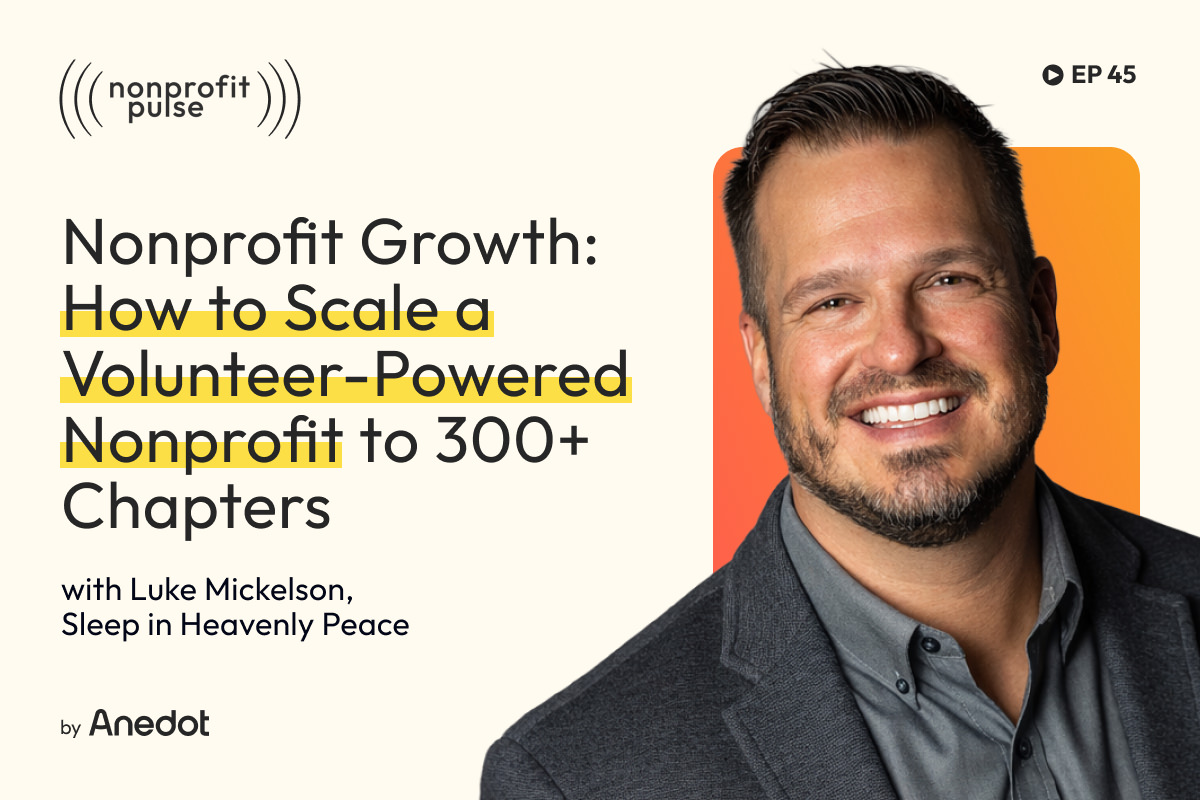
The short version: scaling a volunteer-powered nonprofit requires a repeatable local model, a centralized backbone, and founders who can evolve from daily decision-makers into culture keepers. Luke Mickelson, Founder of Sleep in Heavenly Peace, explains how the organization made it easier for local leaders to focus on building and delivering beds while the national team handled the administrative work, standards, and support that make growth sustainable.
Key takeaways
- Scale requires founders to change roles, not abandon the mission. Mickelson realized that staying in every meeting and making every decision would make him the bottleneck, so he shifted from executive director work toward serving as a national ambassador for the mission.
- Centralize the work that keeps local leaders from the mission. Sleep in Heavenly Peace built a platform to handle business creation, reporting, accounting, and other administrative requirements so chapter leaders could focus on building and delivering beds.
- A narrow mission protects quality at scale. The organization resists mission creep by keeping its focus on building and delivering beds, even when volunteers see other needs they want to solve.
- Rapid growth will expose weak systems. The organization grew from seven to 125 chapters in less than a year and from an $80,000 annual budget to $1 million in about six months, revealing that its banking and account-access setup could not handle the volume.
- Do not launch a chapter around one heroic leader. Sleep in Heavenly Peace now requires at least four core team members before a chapter can start and teaches chapter presidents to begin training their successor immediately.
- Choose chapter leaders who are coachable. Local leaders need a heart for the mission, but they also need to follow processes and understand decisions that serve the full network, not only their own town.
- Give people work that clearly matters. Mickelson learned that a meaningful, necessary assignment can make a volunteer experience more fulfilling than an easy one and can lead people to return, give, and bring others.
- Transparency gives local leaders a reason to trust the system. The organization holds quarterly internal financial presentations, posts its 990s, and sends each chapter president a weekly profit and loss statement.
- Use culture and checks and balances to keep a distributed network aligned. The organization returns decisions to its shared mission and expects even the founder to run choices through other people before acting.
- Let the organization mature before pushing the next stage of growth. Mickelson advises founders to be patient, allow mistakes, and build the internal structure needed to support scale instead of forcing a newer operation to match a more mature one.
Guest: Luke Mickelson, Founder, Sleep in Heavenly Peace | LinkedIn
Podcast episode transcript ↓
Josh:
Scaling a nonprofit sounds straightforward until you try to do it across hundreds of chapters powered almost entirely by volunteers.
What starts as a simple, effective model can quickly become harder to manage.
Growth introduces complexity, consistency gets harder to maintain, and the systems that once worked begin to strain under the weight of scale.
But when it works, that same growth can turn a local idea into a global movement that reaches thousands of families.
So what does it actually take to build a model that can grow to 300 plus chapters and still work in every community?
How do you decide what to centralize and what to leave in the hands of local leaders? And what needs to be true for that kind of growth to not only protect the mission, but amplify its impact?
I’m Josh with Anedot, and welcome to Nonprofit Pulse, where we explore trends, insights, and resources that help nonprofits accomplish their mission.
On this episode, we're joined by Luke Mickelson on how to scale a volunteer-powered nonprofit to hundreds of chapters.
Luke is a keynote speaker, nonprofit founder, and the driving force behind Sleep in Heavenly Peace.
From his roots as an Idaho farm kid to being named a CNN Hero, Luke has dedicated his life to his humans helping humans philosophy.
His work has been featured on NBC Nightly News, Good Morning America, The Today Show, People Magazine, and even American Ninja Warrior.
Having helped deliver more than 350,000 beds to kids in need, Luke now travels the country inspiring audiences to see how tiny moments can create massive impact and to rediscover the joy of serving others in their own communities.
Hey, Luke, thanks for joining us on Nonprofit Pulse.
Luke:
Josh, it's great to be here, my friend.
When a nonprofit founder should step back from daily leadership (and why it’s so hard)

Josh:
Yeah, excited for our topic today, which is how to scale a volunteer-powered nonprofit to 300+ chapters.
So excited for this because we haven't had on the podcast yet an organizational leader who has scaled from zero up to the size that y’all are, which is really remarkable and really remarkable in multiple ways, which we'll get into.
But maybe just starting off, Luke you founded Sleep in Heavenly Peace, but currently you're not the executive director. You made a deliberate choice to step out of daily operations.
So when did you realize the organization needed a different leader for that role? And what made that decision so hard?
Luke:
Oh, man. And we're coming out swinging, Josh, let's go. It's difficult, and I talk about this a lot.
When your business evolves to a certain scale, we as individuals and leaders in these businesses and CEOs and founders, we evolve much differently.
And, a business doesn't have feelings. It doesn't care about that kind of, you know, it just wants progress and move forward.
And, it is a challenge for founders, CEOs that have very successful businesses, businesses that grow beyond themselves. And that is a challenge.
For me, you're the guy that started it. You're the guy that wore all the hats. You're the guy that answered all the questions, did all the interviews, made all the decisions, right? Faced all the challenges.
And then as more people come to your organization, you start passing some of these hats off, which is amazing, right? And that's all great signs of growth and success. And you feel great about that.
But there is a tipping scale I think at least it was for me where, you know, and in the nonprofit world, it's even worse than the for profit world, at least in my experience, because and I've started many, many businesses, started stop many businesses.
But when it came to the nonprofit, a lot of nonprofits are built out of some sort of trauma, some sort of very personal experience.
So you become very fused with this nonprofit. You become very identity fused and becomes very personal. And so as your business grows, as Sleep in Heavenly Peace grew, it was hard to swallow realizing that I can't be in every meeting and I can't make every decision.
And, I mean, I could, but I would quickly become the bottleneck.
And so although I've always wanted and most leaders, I would think every leader at some point wants their business to grow beyond themselves, but they don't know necessarily what that means.
Certainly they don't know how that's going to feel and how you're going to react and you're not ready for it. My gosh, I was a farm kid one night and the next day I'm a CNN Hero on the cover of a Lays potato chip bag.
I'm talking to CNN, I mean, this crazy world you get thrust into, especially really fast, like I did. You're not ready. You're not ready to go oh, I'm not invited to this meeting?
I'm not part of this decision? What's going on? And that's a difficult thing.
It's called founder’s syndrome. But for me, it was just a couple of years ago we decided we, as in the board and the chairman of the board at the time was a good friend of mine.
I spent most of my time as executive director, not doing executive director things, which is managing the organization, managing people, looking at expenses.
I spent a lot of my time doing this. Doing speaking events, PR work, being the voice of what was such a fast growing organization, still is.
And so luckily, we had such amazing people that it didn't require a whole lot of management at the level we were at.
But if we wanted to jump to the next level and the donors we were taking on, like Lowe's and Ford and some of these big national donors, man, you kind of have to realize, look, if you're going to hit this next level, there's some sacrifices that need to happen.
And yeah, so about three years ago it was determined that, and I was reluctant, but I knew it. I knew that I didn't want to be the bottleneck.
And so you kind of have to, I don't want to say you step back, you just step differently to a different role.
How to balance national control with local chapter autonomy

Josh:
Yeah, and it reminds me of the adage, what got us here won't get us there.
And there's times when things have to change in an organization's life, and especially with the growth that y’all have seen, it's been incredible.
So speaking of that growth, Sleep in Heavenly Peace runs more than 300 chapters across 47 states, with only around 20 full time employees, which is incredible.
What does your organization centralize versus leave to the local chapters? And really, how did you figure out where that line should be?
Luke:
That's a great question. You know, originally, number one, this was a family's Christmas project.
It was never going to be a nonprofit, certainly a business of this scale until I realized, oh, child bedlessness is a major problem.
And it's not just in my own hometown. It's everywhere. I quickly learned that if I was going to do any solving of this issue nationwide, it ain't going to be solved by some farm kid from Idaho, right?
It needs to be solved on a local level. So that means producing a scalable platform that people could copy, mimic, do what we do in their own hometown, and not have to struggle with the boundaries, the boulders that people face when they start businesses. We want to take that away.
So call it dumb luck. Call it strategic planning. We didn't know what we were doing at the time, although it turned out very successful.
We wanted to keep all of that heavy lifting, business creation, reporting, accounting, all of those administration things. Get it away from people that really want to do what we do is build beds for kids.
So we centralized those types of administration requirements and just wanted these chapter presidents, which by the way, we've now trained 470+. And we're in four countries.
We've just grown that fast since probably you and I have talked or shared information, but by centralizing it now, we created a very clean, clear, transparent and quite frankly, easy entryway into starting a chapter.
I talked to other nonprofits that realized, there's a lot that goes into starting an organization. For profit or nonprofit, it doesn't matter.
And those hoops you have to jump through can be taxing, can be overwhelming. And so people won't do it.
But if you provide a platform where they don't have to worry about that stuff, all they have to worry about is the mission.
In our case, building, delivering beds. That's all they worry about. Then the barrier to entry is very, very short, very small, very easy.
And by making that possible and providing the necessary needs to run quote, your almost own organization, your hometown, that was the trick.
That was the key. And we've just been very successful at it.
→ Learn how to grow recurring giving, reduce churn, and build sustainable donor revenue your team can rely on with Dave Raley from The Center for Sustainable Giving.
When a founder’s real job becomes vision not operations

Josh:
Luke, you currently describe your role as being the national ambassador for the mission.
For founders who feel guilty stepping back from operations, how do you make the case that vision casting and culture keeping is a real full time job?
Luke:
It's a great question. My gosh. Culture is a big thing, and it comes down to listen, organizations like ours start from passion.
They start from a mission, very simple minded, simple solution to a problem that is unknown in our case, child bedlessness, no one knows about it. I didn't know about it.
And when you know about it, you find a way to solve it as simple and as clean and as pure as possible.
Then you mimic it and you repeat it, and you allow other people and teach other people how to repeat it. And so as a founder, you're growing this, and you're wearing all the hats again.
When you realize that those hats now can be worn by much smarter people, much more capable and skilled people, it gets exciting.
I wouldn't say, at least in my experience, I never felt guilty stepping back, right? When you feel these feelings, when you're so fused together with your organization because that's who you are.
I mean, whether it came out of a trauma or a personal experience, right? Your organization now feels, you're one in the same. People refer to it as your baby.
As, 99.9% of the people on the planet only know Luke Mickelson because of Sleep in Heavenly Peace, right? So you become one and the same.
So as your organization grows and evolves and you do as well, this decentralization can start feeling like a loss. It can start feeling like you're losing a little bit of yourself.
And in a way, you are, because this was you.
Your whole focus, your whole energy was put into this organization. And so for me, it wasn't so much guilt, it was feelings
I was frustrated and challenged with of trying to understand a new role that’s no longer maybe so centralized around the founder, which is all great signs of success.
But these new feelings, these new roles and I don't know, assignments that you may be tasked with. The problem is you wore so many hats and you made so many decisions and that all equates to need, right?
You're needed so much by the organization. Well, any organization as it grows and more people get involved, that need becomes more specific, which seems like less. You're not needed as less.
And that need and that lack of need starts to feel like lack of value and lack of worth. And that's where you really struggle.
That's where founder’s syndrome really plays a hard role in founders that, call it step back.
I don't like to call it step back because gosh dang it, I would never want to feel like I'm stepping back from my mission because that would be stepping back from my identity, my personal passion. It's just stepping differently.
In founder’s syndrome, I have a part of these disciplines I teach people, and one of them is trying to understand where you're at in your role as a founder now and letting everybody know that.
I think it's important that people need to know. I'm not the executive director anymore. And in ways, yes, I'm still the founder, but my new role is not to make decisions day to day.
It's not to make decisions on what's the next step or who's the next donor or all this. My role now for me anyway, is the ambassador, right?
So now I'm the mouthpiece. I get to share and relate and raise awareness and find areas that people don't know about child bedlessness people don't know about the solution and then hopefully inspire people to donate, be involved, get involved.
How to keep quality consistent across many chapters and volunteers

Josh:
Thinking about standards, y’all have more than 100,000 volunteers spread across the country.
How do you ensure a chapter in Maine delivers the same experience and upholds the same standards as a chapter where I'm at in Texas, without really micromanaging that and being constantly in their inbox or constantly reviewing their work? What does that look like?
Luke:
Big brother, you mean? It's a challenge. It's probably the hardest thing that we had to deal with early on.
Some of the main problem is and nonprofits struggle with this and it's mission creep. When you're dealing with people, nonprofits and people enter your nonprofit to be involved.
Look, they're big hearted people. They love people, they want to help. And when you go and deliver a bed to a room that has nothing in it, right?
No toys, no coats, no dresser drawers. As a nonprofit and a big hearted volunteer, what do you want to do? You want to solve that problem for them.
So you come back and you're like, hey, Luke, I not only delivered a bed, I'm going to go deliver a dresser drawer to them. I'm going to go deliver some toys to this kid. And it's extremely hard to say, well, you're not going to do that wearing an SHP hat because I mean, it's difficult, man.
Tell you what. Let's wear a different hat and I'll go in with you. I love it.
But it's important to understand that mission creep is a big thing and it's when you dilute your mission, when you dilute what you're known for. And there's a great example. I know a nonprofit, Beds for Kids right there.
They're the only nonprofit that provided beds for kids back in 2012. When I look to see who else is doing this, it was the only nonprofit in the entire country that was doing it. And now they provide a lot of great stuff.
Not just beds, right? Beds and shelves and all sorts of stuff, which is amazing.
But our focus was beds and that's why we went from, those guys, they deliver 2,000-3,000 beds a year, which is amazing.
We deliver 100,000 beds a year, but that's all we deliver. And by staying focused on that, which is not an easy thing to do, you have a lot of people that have a lot of different ideas.
Even the way we build these beds can become a challenge. You get a lot of these old timers that have a lot of time on their hands, and they go in the workshop and they start creating all sorts of different jigs and ways of doing this.
And, I mean, trust me, you can imagine sometimes our worst enemy is the engineer that comes in and says, you know what?
We build this jig. We'll build these things ten times faster with ten times less people. And it's hard to help people understand.
Look, that's not what this is about, right? It's not about speed. It's not about getting to the end goal as fast as we can.
No, it's about building beds for kids safely, with people that have never maybe touched a tool in their life.
And the volunteer experience, involving as many people as we can.
So, the training of that, the teaching of that and disseminating that throughout a sea of chapters, a sea of people that have different views or different parts of the country, a different religions and different political views, it becomes a challenge.
I think the most success that we've had in dealing with that is making sure that the culture that we have, the family of SHP is still focused on one thing. We build and deliver beds.
That is it, right? And if you're not here, if you're more worried about how I deliver a bed or how I build it, and this has to be the way I want to do it, then maybe this isn't the right solution for you.
And we've had some of that, of course we've had some of that.
But for the most part, these are amazing people that really just want to focus in on let's build and deliver as many beds as we can and get as many people involved as we can.
And we've just been very successful at it. So it's really hard to have anybody argue that process.
→ Discover how to turn nonprofit data into clear decisions, stronger stories, and a more confident team with Stephen Minix from UpMetrics.
What to do when rapid growth breaks your nonprofit’s systems

Josh:
SHP went from under $1 million in revenue to over 35 million in only about five years.
Was there a moment during that growth where your systems or people broke and what did you learn from it?
Luke:
Oh my gosh, I love this story. So when we kind of blew up, it was 2018 towards 2019 we went from 7 chapters to 125 in less than a year. I mean our budget was $80,000 a year.
We went from $80,000 a year to $1 million, like in six months.
Which is awesome. However, the way we were structured and the way I wanted to structure this was I wanted these chapters to have autonomy. I wanted them to go buy wood locally and tools locally, and support local company.
I mean, that’s just how it's going to work, right? This is the way we wanted to do it.
I didn't want them to require, we require them to buy it from us or a certain place. So to do that, they have to have their own expense program. They have to have their own, quote, bank accounts.
So we had each chapter president start their own bank account. Well, I mean, we started it for them, but they had their own bank account.
Well, think about it. When you have 7 bank accounts, okay, that's in 7 QuickBooks, what do they call it.
Josh:
Workspaces.
Luke:
Workspaces, whatever, right? Okay, yeah, not a problem. When you have 127 that's a different story.
And all of a sudden we had so many transactions happening that our chapter presidents when they went online to look at their bank account, on their mobile app, there was so much because it was downloading everybody's even though they could only look at their own, it was downloading everybody's.
And the problem with that is there was so much information going on it would freeze. So no one was able to get into their account.
So put yourself in my shoes where these people are flying in from all over the country, learning how to do what we do, sending money to us so we can put it in their bank account, and we're talking hundreds of thousands of dollars and all of a sudden they have no access to it.
I mean, my gosh, some farm kid from Idaho, what's going on? I mean, it was a lot of sleepless nights to try to figure this out, right?
And that was just one of the hardest things we had to go through personally had to go through because it was hard to tell people, listen, we're working it out.
Just trust me. That’s all I can say, don't throw me in jail. I promise you it's there.
And scaling is awesome, but it's very challenging. It's very difficult and there's a lot of things that you don't know that will be going to be thrust in your face at critical times.
I taught all my staff, listen, we're on a highway going fast. There are potholes in front of us. You got to be looking down the road and seeing these potholes and fill them as fast as you can.
Especially the deep ones. And I think we did. Overall we've done that very well.
Now, we have probably, I don't know, 30 full time employees now. We're much more supported staff wise. And so each individual when you do that now each individual has less potholes to fill.
So they get them done. And now we have a much stable much more stable base.
And we have processes in place that are just rock solid, which allows us to expand and explore other areas that are successful both in marketing and product resourcing and logistics, all those things just the growth of an organization.
How to choose and support strong chapter leaders

Josh:
So thinking about the chapter model that Sleep in Heavenly Peace has, it puts enormous trust in local volunteer leaders because every chapter has a president.
What is your organization look for when selecting a chapter president? And what have you learned from chapters that didn't work out?
Luke:
Yeah. Well, let me address the second part of that. The first thing we learned, the chapters that don't work out, usually, I'm going to say most of the time it happens when you got a chapter president, big hearted, super excited, very passionate.
And he or her does it all by themselves. And we learned early on that just 1 or 2 people can't run a chapter.
They get burnt out too quick. In fact when we started blowing up in the beginning of 2018, we went from 7 to 127, right? Really quick.
Well, about 40 of those we lost, throughout the next couple of years. But to give you an example, we filed 40 in probably a year, year and a half. We lost 40 of those.
Now we put on 50-60 chapters a year, we might lose 1 or 2. And we've learned the reason why is because people come in just 1 or 2 people coming in trying to start a chapter.
And they put too much into it. Becomes too addictive. And all of a sudden it consumes you so much that, yeah, you're going to do well for six months, a year, maybe a year and a half, and then you're going to burn out, right?
So now we have a requirement that no chapter can start unless we have at least four core team members, right?
And we teach people the minute you get trained as a chapter president, you need to start training the next person that's going to be chapter.
Succession planning is a big part of what we do, and we've been very successful at it knowing now the result of that.
And the second, the other part of that, being a chapter president, really, it's just having a heart for what we do. I grew up in a small town.
I grew up kind of the jock of the town. And I've done a lot of coaching. And one thing's consistent in athletes that are successful.
They're coachable. And that's a very common term.
What that means is being able to understand bigger than what you think and understand and follow processes that you may not necessarily agree with or you have a different way you think of doing it.
We tell people, listen, you got to think outside of your chapter borders because there's decisions and there's things that are happening that may not really affect you or changes anything, or even might actually be more of a stumbling block in the way you're doing it in your own hometown.
But nationwide, in an overall, there's a huge benefit to it. And so when you have someone that's coachable and that can understand as a team player, but most importantly has a heart for what we do, that's the most important thing, because it's challenging.
It's challenging and you're so passionate about, I mean, for crying out loud, we're building beds for kids that are sleeping on the freaking floor, right?
How can you not? I mean, when you see that you got tough, grown men and women that bawl as they see that, they just cry. They're so emotional about it.
When your heart is wrapped around something like that so much, you can get the term wrapped around your own axle pretty quick if you feel like there's something that's inhibiting that.
And we've had that before. And I just look at it not as an argument or not as someone trying to kick against the pricks.
No. You just have someone that is extremely passionate about the same thing I'm passionate about.
And so, education and working through those and helping them understand that, hey, there's a bigger picture here than just the boundaries of your town.
We can make it work and we have. Just understand that there's other ways to skin this cat, if you will. And there's reasons why we make the decisions we do.
Josh:
Yeah, it reminds me of the leadership phrase or lesson of the best leaders are great followers.
And that teachable comment, when you're looking for a chapter president, I imagine you're looking early on to see can this person follow our model, follow our guidance, our standards, because it's pretty evident quickly if someone is willing to follow that.
Luke:
So we train chapter presidents and we used to train them in just one day, which we don't do that anymore, but we train them in one day and then we break for lunch and then go back and finish the training.
Well, we were at lunch one time and I had this chapter president sitting right across from me.
And he's telling me this, that, oh, I can't wait to get back and I'm going to build a bunch of beds sitting in my garage when I've got spare time, blah, blah, blah.
I'm like, well, you're not going to be building SHP beds in your garage by yourself. You know that, right?
And the guy was so upset he left training. He didn't understand that listen, this is about building it with the community and getting community involved.
And otherwise if you do just by yourself, you're going to build 10, 20, 30 beds a year and that's it.
If you get your community involved, you'll build 300, 400 beds a year and help so many more kids.
And so, yeah, it becomes a challenge when you deal with people that have what they want to do in their mind but are completely inflexible with what may be best for the organization.
→ Learn how nonprofit leaders can prepare for and overcome adversity from our conversation with Erin Davison from BBBS Southwest Louisiana!
How to turn one-time volunteers into long-term nonprofit champions

Josh:
Luke, a lot of nonprofits struggle to convert one time volunteers into long term, committed partners. SHP seems to do this kind of naturally within your culture.
What is it about the bed build experience that turns a first timer into someone who comes back and then eventually leads, as you just talked about with that leadership pipeline?
Luke:
Great question. There's two problems we solve. Obviously child bedlessness is one.
But I learned early on, which was a little bit of surprise to me. Well, probably a big surprise to me now that I look back at it that there are millions of people, Josh, that they want to help.
They just don't know how. They don't know where to volunteer.
The reason why is they probably volunteered before, but it's the volunteer experience that matters, almost, not more, but dang close to what your mission matters.
And listen, a lot of nonprofits out there, this is a gold nugget. And I learned this the hard way I would say.
I'll give you a story. It was my very first public build.
I put it in the newspaper, hey, we're building beds for kids. Come on down. I mean, this middle of January in Idaho, freezing your butts off in the middle of this cold warehouse.
And I want people to come in on Saturday morning to build beds. I really didn't think I was going to get a whole lot of people, but we got like 60, 70 people that showed up, which was awesome.
And one of those was a guy named Hank. Hank was like 700 years old. I mean, this guy is an old dude, right?
He comes walking in and I remember him so well because he had this grandpa smile, and instantly loved him. And he came up to me. He says, so you're the guy.
And I said, sure. Why not? He says, where do you need me? I said, well, tell me, what did you do for a living?
He says, I was a carpenter for 40 years. And I'm like, oh yeah, okay, I know exactly where to put you, brother. There's one part of our build process you can't screw up is cutting wood, and it's the most dangerous, right?
So we put them on the miter saw and the thing about a build, especially if you're the chapter president and there's only a few of you that know how to do this, but there's 70 other people that may have never touched a drill in their life.
You you get a lot of questions. And so 4 hours this build goes on and I'm back and forth and answering, doing this and making sure this is right and all this stuff.
I completely forgot about Hank. Oh my gosh, is he still alive? So I ran back to where the cut station was, and there was Hank covered in sawdust.
I mean, his face and his clothes were as white as his hair. It was hilarious, but I felt bad. I mean, and he kind of looked at me and with his last cut, if you will, and I said, Hank, how are you doing?
Oh, my gosh, I forgot about you. So sorry. And he looked at me with that grandpa smile.
And he said, Luke, let me tell you something. And I thought, oh crap, here it comes. And he says, I volunteered my time.
I've been to many events my whole life, he says, but I've never shown up to an event and in five minutes I was put on an assignment that was so critical and people relied on me so much I couldn't leave.
I couldn't even go to the bathroom. And I said, Hank, I know, sorry, I've been running around.
And he like, held up his hand like, telling me to stop. Right? He held up his hand and he goes, no thank you.
It blew me away. Josh, it just blew me away. And I realized that as a nonprofit leader and a volunteer that's running this event, I worried so much about exhausting these people.
And I wanted to make it easy for them because I wanted them to come back and oh, let me get that for you and let me do this for you, let me let me grab this piece of wood and carry it across the freaking build for it.
You know, I was doing these heavy lifting assignments because I didn't want to exhaust my volunteers.
Hank taught me the happiest volunteer is the sweatiest and the dustiest.
And why that is, is you learn that, listen, if you're going to volunteer your time, if you're going to sacrifice Saturday morning in a cold warehouse that you could otherwise be watching the college football game, right?
You want to feel like you did something. You want to feel like what you did mattered. Well, there's nothing more fulfilling than doing a hard assignment that you know would not get done had you not shown up. And that's the key.
Volunteer experience is extremely important. I would argue that it's just as important as your actual mission, because if you didn't have a good volunteer experience, eventually you're not going to have volunteers and then you're not going to have your mission.
So providing a meaningful, not easy necessarily, but a meaningful and fulfilling experience, one that that volunteer is going to come back, not only come back, Josh, he's actually going to get on his social medias. He's going to blast what he just did. He's going to volunteer again.
He's going to donate. He's going to tell other people to come. We tell chapter presidents look, you want to raise money, go build beds.
And what that means is when you build beds, it spawns other build days, which spawns other build days. And now we have chapters that are booked out sometimes for a full year. I mean, they've got 10, 15 scheduled, you know, thousand beds they are going to build.
They almost can't take any more build days and they get requested because it's such a meaningful and fulfilling event for all these volunteers.
Josh:
I love that and it just makes me think of quick wins, right? Quick wins are so important. Whether you're a new chapter president at an SHP chapter or you're a volunteer.
Like if he had to wait around a week or more to have that sense of win, that feeling of, okay, we accomplished something, it would be a totally different story.
And I love that that's baked into your organization's volunteer experiences. Quick wins.
When you show up, you're going to get to work and you're going to make a difference. And I love that so much.
Luke:
Well, it's not just it's not just pushing a broom around or pushing a button, and you're actually touching.
Ours is a little unique because you touch every piece of wood that's going to be a bed that's supporting a child sleeping that night. I mean, they literally put their fingerprints on it, and that's lucky that we have that.
Not all nonprofits have that ability, but that experience, right? That feeling of I had to be here in order to build that. I got to touch it.
I got to see it. I got to feel it. That volunteer experience it's hard to come by in nonprofit service now sometimes. We're just lucky we have it.
How radical transparency changes the way a nonprofit runs

Josh:
I hear you, I hear you. So another remarkable statistic of Sleep in Heavenly Peace is you maintain a 95 to 96% program expense ratio at scale.
What operational discipline or decision making framework keeps your team from letting overhead creep as the organization grows?
Luke:
Great question. I think the first and foremost is we are completely transparent. I mean, as transparent as we possibly can and not just to the public.
We're transparent to our family, our SHP family. I mean, if you're a chapter president in Miami or Alaska or wherever, right? You obviously don't know what's going on nationwide, right?
You don't know how the money is being spent. You don't know why that expense happened and why do we invest here and what are we doing with this money?
Every quarter we do an internal presentation and our executive director, Jordan Allen, goes over with a fine tooth comb and answers any questions.
We want people to know exactly where every single one of our dollars goes.
You know as much as we can, obviously, $35 million in expenses. It's a lot expense.
But, we want people to know exactly where it's going and what the direction is and how we're doing as a family and letting them know how they're doing as a chapter compared to others and how they can improve.
And then we post our 990s on our website. We send it out to our chapter presidents. Every chapter president every week gets a P&L, profit and loss statement emailed to them on how they're doing.
We want them to know and be responsible for their actions and what they're doing as well as we are.
And that's important. I mean, when I started Sleep in Heavenly Peace, it was a family Christmas project, in fact the name of it wasn't Sleep in Heavenly Peace.
It was Bed for Babes, but only for like two seconds, by the way. But when we decided to be a nonprofit, I remember I was like, listen, I don't want it to run like number one, I didn't know how nonprofits ran. I never ran one.
So I was going to run it the way I thought nonprofits should be ran. When you donate a dollar, it stays in that community.
When you build or provide the service you provide, it provides the service for the people in your community, because we wanted this to be a community resolved problem, and I wanted to be able to show that to people and I want people to have the confidence that that's the way this organization is going to be ran, because it's not going to be solved, child bedlessness is not going to be solved by some farm kid from Idaho.
It's going to be solved by people in their local community wanting to step up and wanting to provide this service for the kids next door.
And it was our challenge to make that process successful and transparent as possible.
Josh:
So what culturally, do y'all kind of push down into your chapters for that?
To have that efficiency across your chapters, like, is there some phrases that y'all use in onboarding presidents, or is it something in kind of monthly or quarterly meetings that you remind them, what does that look like for a scaled nonprofit to have that efficiency mindset baked in at the leadership level?
Luke:
Yeah. There's probably a number of things that we do. It all surrounds one, I think one obvious and blanket, if you will, statement. And that's we’re a family. And listen families argue families disagree.
But ultimately we're a family unit. And ultimately it's always about the mission. It's always about no kid sleeps on the floor in our town.
And we remind people that, we remind ourselves of that. I remind myself of that all the time.
Am I making this decision, am I being on this podcast today talking about this for the sole purpose of providing beds for kids. And sometimes that can be diluted. Sometimes that can be a hard decision or not as clear as possible.
So we have to rely on other people.
I mean, I'm the founder of Sleep in Heavenly Peace and I still and should every founder still have a reporting system of checks and balances system even in the decisions I make, like being on this podcast, let's run it by people.
What do you think? Is this something we should do? Does this fit into the end of the scope and the mission of Sleep in Heavenly Peace?
I think when you develop that culture, that trust that you have with these chapter presidents, that's how this remains stable and remains a foundation that that they can trust and build and continue to support.
We've had some chapter presidents that have felt differently and have left and even ran and started their own bed building nonprofits, which is fine.
That's great. Hey, you're helping kids. I don't I don't care.
And if we do it a little differently than what you want and how you do it, that's fine. You know, I understand that. And, again, there's more ways to skin this cat.
For us, when you look at the ability, well, number one, you look at the scale of what we have to deal with. Child bedlessness and how it's 3% of the total population represents kids on the floor.
I mean, that's a huge number. 12 million kids sleeping on the floor, right? That's a huge number.
I'm glad that the people that stick with Sleep in Heavenly Peace and recognize that, listen, to me that number was way bigger than what I could handle. And people understand that.
So it has to be a family. It has to be a group of individuals coming together in a common goal and a common process to make a dent in this terrible dilemma that we have in our country, not 470 individual people doing it different ways, if we can all come together on one process.
What's the adage in baseball? There's more than one way to roll a double play, right?
But you just do it the way the coach tells you. Then we're all on the same page and it runs a lot more slicker.
→ Learn how adopting a corporate mindset can drive nonprofit growth, scale impact, and build stronger networks with Laura Bonnell from The Bonnell Foundation!
What nonprofit founders should know before their idea takes off

Josh:
Luke, if a nonprofit founder listening right now has an idea that could scale the way that SHP has, which is incredible, with a simple, repeatable model with massive demand, massive need, what is the one thing you wish someone had told you in your garage before all of this started?
Luke:
Probably the biggest thing, Josh, is be patient.
Be patient with yourself. Be patient with the people around you.
A good example of this is Sleep in Heavenly Peace Canada. Same problem, same process, but far, far less mature than the United States.
We got them going 3-4 years after we we blew up and there's processes in Canada that don't work necessarily the same in the United States.
But there's one thing that I learned and it was my fault, trying to push and get them to the same scale and level that we were at in the United States.
And they didn't have the same problems that we did. They had much younger organizational problems that you can't scale that organization.
Trying to think of a good analogy. Look at Led Zeppelin. Led Zeppelin was way before their time, right?
They'd be, later on in life, they would have been awesome, probably even bigger than they were before. And they were big band. Don't get me wrong.
But I think, if you can learn to be patient, allow mistakes to happen with your organization, with other people and learn from them.
I think that's the patient-ness that I wish I did better early on. You were patient with everybody because it was just you and a few other people, right? And you couldn't lose them, or else you'd be done and give yourself some grace.
I mean, allow this passion to grow on its organic way. You can do some things to push things along, which is fine.
But I mean, how many times do businesses outrun their scale? There's a lot of businesses that fail because they just grow too fast. And we honestly, I think Covid, as terrible as it was for a lot of reasons, Covid helped Sleep in Heavenly Peace in a way of slowing us down.
I mean, we had to stop, pretty much stop like everybody else.
But what didn't stop was the internal foundation and structure we needed to catch up with how fast we were growing.
I mean, we had, 200 chapter presidents and putting on 40 or 50 a year. And, I mean, we had four people that were full time, I mean, my gosh, we were dealing with millions of dollars and had one accountant that wasn't even an accountant.
There's these things that it's tough to be patient with because you want to grow fast and get that. But it can be dangerous. And so be patient.
Enjoy what you're doing. You'll get there. I do a lot of nonprofit training now with other nonprofits, both startups as well as ones that have been around for a long time, helping them grow and scale.
And that's one thing I really harp on and said, listen, you're not going to be SHP tomorrow. You don't want to be, you're not ready. And there's some value.
Jordan and I talk about all the time. There's some value that I wish some of our, even our staff members understood that we went through in 2015 even, that we learned that they don't have the luxury of having that knowledge.
Whereas you're a founder, enjoy those struggles, enjoy those. Because trust me, ten years from now, when you're rocking and rolling, you're taking over the world.
People aren't going to know, you'll know, you'll remember what was like. And those are valuable lessons to remember and to store away. And so yeah, be patient.
→ Learn how nonprofits can successfully expand their local model while staying true to their mission with Elana Frank from the Jewish Fertility Foundation!
Closing thoughts

Josh:
Luke last question. It's my favorite question of every episode. If you are standing on stage in front of a thousand nonprofit leaders and could share one thing with them, one sentence keeping it pithy, what would you say?
Luke:
Allow your passion to grow.
I mean, as a founder, which is different than a volunteer, it really is because when you start a nonprofit, again, like I mentioned, you're fused to it, you're tied to it, and it will be your entire life.
Be prepared for when that company outgrows you.
I teach a course called Founder’s Syndrome Survival Course because founder’s syndrome is a very difficult thing that is not talked about a lot.
And there's not a lot of resources for founders like me that their organizations have grown so fast that I haven't had time to understand my new role, because it does feel like you're being exited.
It's not a control thing. But what you built now is building itself, which is awesome, but it feels like I'm not needed anymore, you know?
So I guess that's probably the biggest, the most important thing I tell founders is understand that your organization right now, you love it, but it doesn't love you. It doesn't love you the same anyways.
So when it gets to the point where and it will get to the point where it may not necessarily need you in the same capacity, just be ready for that and that's okay. That means it's a sign of success.
Josh:
Love it, love it. Luke, this has been such a great conversation. I hope everyone listening will head on over to Nonprofitpulse.com.
You can check out the show notes, check out links for Luke, connect with him, check out the course he just mentioned.
So many nonprofit leaders are dreaming of doing what SHP has done, and I love your humility, Luke throughout the conversation and just the candid discussion about what happens when your baby grows up.
Your baby doesn't need you like like it did, right? It's getting a license. It's going to college. It's starting a career and its own family.
And those are those are challenges that you're living in now in the past few years.
But such a good reminder for leaders who are dreaming of doing good at scale and what is to come so that they can prepare themselves and prepare an organization that can really thrive even after their era of leading has changed.
So Luke, thanks so much. Check out again, check out Nonprofitpulse.com for more information.
And I'm so excited to keep following SHP, all your work, your chapters. I know just looking at chapters here in Texas, I was so encouraged.
So again, thanks, Luke, and we'll be in touch.
Luke:
Sounds good. Thank you.
Josh:
Hey, thanks for listening.
If you enjoyed this conversation, please share or leave us a rating and review wherever you listen to podcasts.
Also, head on over to Nonprofitpulse.com to sign up for our monthly newsletter, as well as check out all the links and resources in the show notes. We’ll see you next time.
Frequently Asked Questions
How do you scale a nonprofit across multiple locations?
Scale a nonprofit across multiple locations by creating a repeatable local model while centralizing the administrative work that can slow local leaders down. At Sleep in Heavenly Peace, the national organization handles work such as reporting, accounting, and business setup so chapters can focus on building and delivering beds in their communities. The model also needs clear processes that local leaders can copy without having to recreate the organization from scratch.
What should a nonprofit centralize in a chapter model?
A chapter-based nonprofit should centralize the complex back-office work and leave the local mission work close to the community. Sleep in Heavenly Peace centralized business creation, reporting, accounting, and administrative requirements, which lowered the barrier for people to start chapters. Local chapter leaders could then concentrate on the work of building and delivering beds.
How can a nonprofit give local chapters autonomy without losing consistency?
Give local chapters room to serve their communities while setting a clear, narrow mission and shared operating standards. Mickelson says Sleep in Heavenly Peace protects consistency by repeatedly returning to its core work of building and delivering beds and by asking leaders to consider the benefit to the whole network. This approach helps the organization avoid mission creep without micromanaging every local decision.
Why do chapter-based nonprofits struggle as they grow?
Chapter-based nonprofits struggle when systems built for a few locations cannot support hundreds. Sleep in Heavenly Peace grew from seven to 125 chapters in less than a year, and its many chapter bank accounts created an account-access problem that left leaders unable to view their funds. The experience showed why growing organizations must strengthen systems and staffing as new complexity appears.
What makes a good nonprofit chapter leader?
A good nonprofit chapter leader is mission-driven, coachable, and able to work within a shared model. Mickelson looks for people who can follow processes even when they would choose a different approach locally, because some decisions serve the national organization more than a single chapter. He also emphasizes that a chapter should begin with at least four core team members rather than relying on one person.
When should a nonprofit founder step out of daily operations?
A nonprofit founder should move out of daily operations when being involved in every decision becomes a bottleneck to the organization's next stage of growth. Mickelson describes this as stepping differently, not stepping back: his role shifted toward being a national ambassador who raises awareness and supports the mission. The transition can be difficult because founders may feel personally fused with the organization they created.
How do you build a sustainable nonprofit chapter model?
Build a sustainable nonprofit chapter model by combining a simple repeatable mission, a capable local team, reliable central support, and patience as the organization matures. Sleep in Heavenly Peace requires a four-person core team, develops successors, and gives leaders financial visibility through regular reporting. Mickelson also cautions founders not to force a newer operation to reach the scale or maturity of a more established one before its internal foundation is ready.
80 Community Service Ideas for Nonprofits