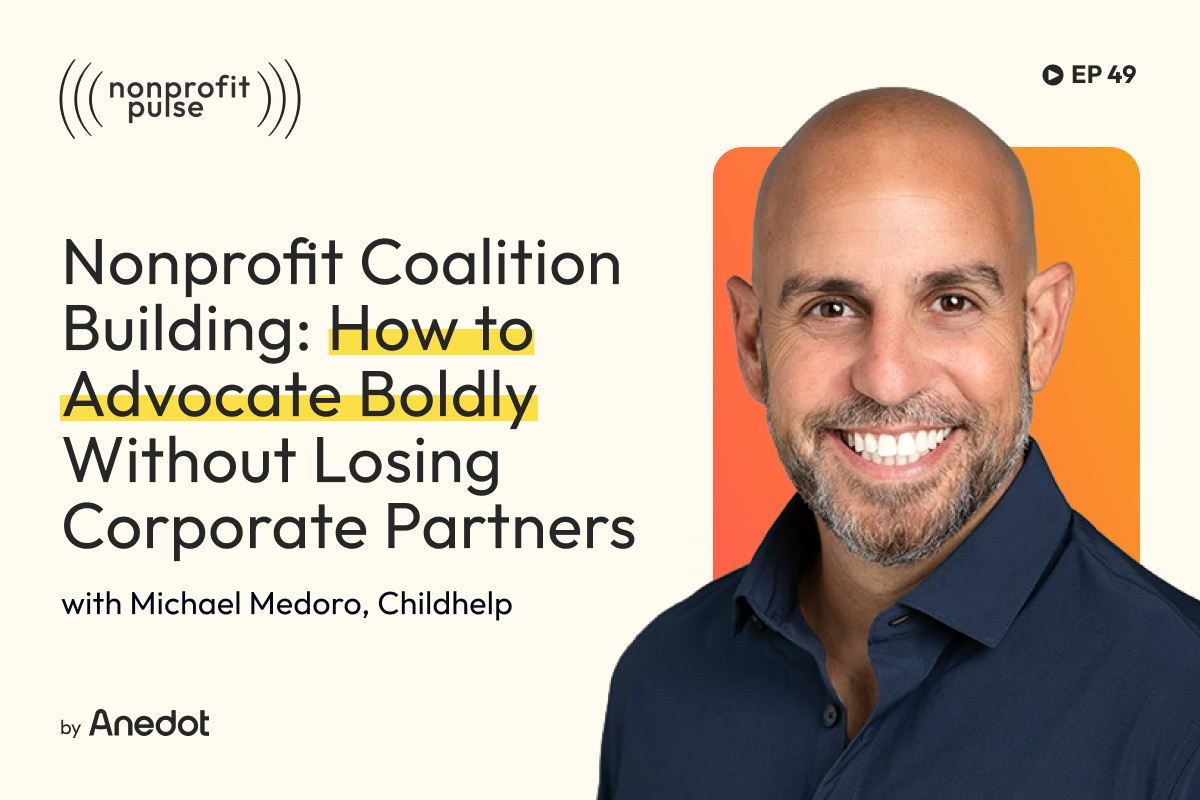
The short version: Nonprofit coalition building works when every partner stays grounded in a shared mission, brings its own strengths to the work, and remains clear about what it can and cannot do. Michael Medoro, Chief Operating Officer and Chief of Staff at Childhelp, says bold advocacy is not about being the loudest voice in the room. It is about being clear, disciplined, and focused on outcomes for the people you serve.
Key takeaways
- Start with the problem no organization can solve alone. Child abuse, trauma, and exploitation are systemic challenges that require nonprofits, government agencies, community partners, and corporations to work together. Coalitions can reduce duplicated work, pool scarce resources, and create a stronger collective voice.
- Keep coalition work centered on people, not politics. Effective coalitions focus on community outcomes and mission-aligned policy change, not political parties or candidates. That distinction can help corporate partners see how advocacy connects to their community impact and social responsibility goals.
- Use coalitions to create systemic change. Direct services can help an individual in front of you today, while coalition advocacy can address the systems that keep creating harm. Working together can help nonprofits move change forward faster than any one organization could alone.
- Stay focused on your core purpose. Strategic advocacy maps directly to the outcomes your mission is meant to achieve. If an issue is only trending or tied to a news cycle, without a clear and measurable connection to your mission, it may be reactive rather than strategic.
- Build trust before structure. Coalition partners need shared goals and confidence in one another before they can establish governance, roles, operations, and success metrics. Medoro’s practical framework is trust first, structure second, results measurement third, and ongoing communication throughout.
- Align values, not just funding and operations. A coalition can have funding and plans in place, but it will struggle to execute without shared values. Nonprofits, corporations, and government entities often have different risk tolerances, timelines, and internal cultures, so intentional alignment is essential.
- Know your role and respect others’ expertise. Childhelp does not try to become every resource a person may need. Instead, it focuses on the services it does best, such as providing a 24/7 hotline with professional counselors, while connecting people to qualified organizations in their communities.
- Bring boards and partners in early. Board leaders, legal teams, communications teams, and corporate partners should understand the coalition’s purpose, boundaries, and goals from the beginning. Surprises create risk, while clarity gives people the confidence to participate.
- Give partners a clear exit path. Coalition partners should know how they can step away if the work shifts in a direction that no longer aligns with their values or role. When people feel safe and informed, they are more willing to take part in bold work.
- Keep listening and communicating. Nonprofit leaders can undermine trust when they focus on talking instead of listening. Communicate coalition decisions by explaining the mission-based “why,” then tailor the same core message for staff, donors, corporate partners, and the communities served.
- His one-sentence takeaway: solidify yourself in your why, craft the words to communicate that why, and find your people.
Guest: Michael Medoro, Chief Operating Officer and Chief of Staff, Childhelp | LinkedIn
Podcast episode transcript ↓
Josh:
Some of the biggest challenges that nonprofits take on can't be solved by one organization alone.
Coalition building can bring nonprofits, communities, and partners together around a shared goal, helping them strengthen advocacy and create greater impact for the people they serve.
Coalition building is about more than getting the right organizations in the room. It’s about building a shared purpose, aligning values, and creating a strategy that moves the mission forward.
So what does that look like? How can nonprofits advocate boldly through coalition building while maintaining the trust of corporate partners, boards, donors, and the communities they serve?
I’m Josh with Anedot, and welcome to Nonprofit Pulse, where we explore trends, insights, and resources that help nonprofits accomplish their mission.
On this episode, we’re joined by Michael Medoro on how nonprofits can build coalitions that strengthen their advocacy and help advance their mission.
Michael is the Chief Operating Officer and Chief of Staff for Childhelp, where he helps lead strategic initiatives, strengthen community relationships, and develop partnerships that advance the organization’s mission.
A nationally recognized philanthropy leader, Michael brings more than 25 years of public and private sector experience, and has led global initiatives for organizations including Project C.U.R.E. and Easter Seals.
Hey, Michael, thanks for joining us on Nonprofit Pulse.
Michael:
Thank you for having me I appreciate it.
Why coalition building matters for nonprofits today

Josh:
Yeah, excited for our topic today a great topic.
We're talking about nonprofit coalition building, how to advocate boldly without losing corporate partners.
Michael, you're at Childhelp and you have run this playbook and have revised it and have learned so much over the years. Excited to talk with you about that.
So maybe just starting off, why is coalition building becoming a more common and necessary strategy in today's nonprofit landscape, and especially for organizations like Childhelp?
Michael:
Great question.
For organizations like Childhelp, because the problems we work on, such as child abuse, trauma, exploitation, those problems can't simply be solved by one organization working by itself in isolation.
They're systemic. So the response to them also needs to be systemic.
When organizations come together, we stop duplicating programs and services. We start pooling resources together that are very, very scarce.
Most nonprofit organizations will attest to that, and we can make the whole sector run much more efficiently. There's also a bit of a strategic piece in all of that.
Policy leaders and major funders, they pay attention when the sector speaks with one clear voice. Instead of a dozen different nonprofit organizations sharing fragmented and different messages all alike.
One of our partners, for example, is SEMA, the SEMA Association.
They've been a partner of ours since 2007, and a lot of times I get asked the question, why does an industry that is so focused on the automotive world care about something like child abuse?
I can't make the connection between those two things. And the reality is, is that that industry was built by people who look at something that was broken and figured out a way to repair it.
They look at things that most of us would discard or throw away, and they bring it back to life and restore it.
And that mentality, that passion, is something that originally introduced them to the idea of child abuse as being something to adopt.
But when you get an entire industry willing to stand up and say, we will not allow child abuse to be ignored, it changes the conversation.
It changes the landscape of that conversation globally. And that's why coalitions are such a necessary strategy for nonprofit organizations like Childhelp.
How nonprofit coalition building differs from political advocacy

Josh:
I love that, and I love the passion in that and that these are problems worth solving and using every bit of leverage and power in our society, in our social construct that we can to solve it.
So, Michael, when people hear coalition or advocacy campaign, they sometimes picture highly political movements that really might worry corporate partners.
So how is nonprofit coalition building different and what should leaders understand about its purpose?
Michael:
That's a fair concern. And the distinction between those two really matter.
Our work as a coalition isn't about an individual party or an individual candidate. It's human centric, as most nonprofit missions are.
When we're focused on community outcomes and on the people we serve, that's really the transformational difference between a coalition working together and simple advocacy.
Our goal is to reform policy so that more people, in our case, children at risk of abuse or experiencing abuse can truly thrive.
When you start framing coalition work in that way, it actually aligns very naturally with what corporate partners are already trying to do through their ESG and community impact and social corporate responsibility initiatives.
They want to see a natural alignment with community that enables that community to thrive.
And when you look at it from that perspective, that's the right community focused outcome perspective to have.
When people typically want to use the word advocacy, then they start getting more into the idea that this is political or government affairs, and there's a place for that, but it's definitely a difference than what real coalition work looks like.
Why nonprofits choose coalition advocacy to strengthen mission impact

Josh:
Yeah, and you've kind of alluded to this already in previous questions here, but what are the most mission driven reasons a nonprofit might choose to engage in a bold coalition advocacy, rather than working independently or just behind the scenes with strategic partners?
Michael:
Well, both kinds of work matter, right? And we really need champions that are going to do both.
Behind the scenes work really helps an individual person, or an individual victim or an individual need that's in front of you right now.
But bold policy advocacy can serve the masses because it fixes flawed systems that keep producing those victims in the first place.
So when you share that advocacy across a coalition, you're accelerating systemic change that would take what a single organization could do decades can now be done in a matter of years.
Josh:
Yeah, I love that. Super helpful. Maybe an example, Michael, of coalition effort that genuinely strengthened the impact for either Childhelp or a similar organization, and what made that successful?
Michael:
So the example that I use is honestly what I believe is probably the most amazing example of coalition work at its best.
And that's the Childhelp Children's Advocacy Center model.
And so Childhelp pioneered this model back in the early 80s. And it was really in direct response to how an individual who discloses abuse is treated in what they experience.
So historically, when an individual child discloses that they've been abused, they would have to tell that story of abuse to about six, seven, eight different professionals over about an eight, nine, ten month period of time.
What we discovered was that every time that child was disclosing their trauma, they were re-traumatized by that abuse. And then on top of that, so much information and evidence was lost because it took so long for all of those different interviews to come together.
But the question at the time was, so what are you going to do? How are you going to approach that differently?
You know, law enforcement needs their information, medical needs their information, legal needs their information. Everybody needs the information. So what are you going to do?
So Childhelp pioneered and created the multidisciplinary advocacy center model.
So for example, here in Phoenix, Arizona you have in a child friendly child centric environment, Childhelp working with Phoenix Children's Hospital, the largest children's hospital in the state, the largest child crimes unit of Phoenix PD, the office of the County Attorney, the Department of Child Welfare and Services, the Office of Child Welfare Investigations, all working together as one team under one roof.
Now, when a child comes in to disclose their trauma, instead of coming into an intimidating police station or cold and sterile hospital, and being interviewed by somebody who may not necessarily have ever been trained to conduct a forensic interview, now they're brought into an environment that is brightly colored.
It's got murals, it's got toys, it's got videos. It's an environment that's designed to allow the child to come and settle down in that environment.
Then they're met by a non-uniformed, forensically trained interviewer, and they're brought into a room where there's hidden audio and video equipment that allows that child to disclose their story, and that entire team of professionals to listen to that testimony in real time.
What has ended up happening? That child only needs to tell their story once, meaning they never have to experience the re-traumatization of their abuse ever again.
That entire team of professionals is able to capture everything that they need for their individual role and responsibility as a part of that unit and team, and we are now able to collect evidence much faster than we ever were before, which means that we're able to hold offenders accountable in ways that we were never able to do before.
More recently, partnering with law enforcement and technology partners, so to expand that coalition effort even greater, we then moved from what we were recording onto individual DVDs to now onto VidaNyx, which is a secure forensic video sharing platform that's cloud based.
So now we have the ability to capture things, minimize the expense on resources, but maximize the ability to share that information with appropriate and respected parties to further advance the prosecution of offenders and further advance the healing of children.
Now, that model hasn't always been successful in being implemented in other states because you've got well, I've got my own office.
I don't want to move. I don't want to, I've got free rent here. I've got proximity to this relationship. I got proximity to that resource, and I don't want to share that or I want to control how much that is shared, or I want to control how things are used.
When we start having conversations about I want to control, you've lost sight of the core purpose of what it is we're trying to achieve together.
Together, when everyone stays aligned, the child's well-being in our case, or your client's well-being overall becomes the center of focus, not an ancillary piece. And that's the value.
Common fears about coalition advocacy and corporate partnerships

Josh:
Mic drop moment. I mean, I am ready to storm the hill. I love the passion. Love the clarity.
What are some common misconceptions or fears nonprofit leaders and corporate partners have when the topic of bold advocacy or coalition building comes up?
Michael:
A few come up again and again. I'll identify a couple.
The first is the fear that bold advocacy is going to alienate customers, or it's going to alienate donors, or it's going to create bipartisan enemies and allies across the board.
The second is usually what I just kind of touched on, a fear of losing control, that you're going to lose control of your brand identity, or you're going to get overshadowed by a bigger coalition member or a bigger partner.
The third is usually operational, right? Our sector has so much red tape that everybody needs to cut through the make decisions and to get things done.
So there's this common fear or this common misconception that coalitions are just going to be endless meetings, that everything gets slowed down, nothing ever gets accomplished, and you're just burning through resources.
But here's the thing in effective coalition building, none of those turn out to be true.
Good structure prevents every single one of those fears from ever becoming a reality. Like I just highlighted in the Advocacy Center model.
How to keep advocacy focused on your mission

Josh:
So how can leaders discern the difference between advocacy that is reactive or risky versus that coalition work that is a strategic opportunity to advance their mission?
Michael:
You filter it through your core purpose. You always center on your why.
So strategic advocacy maps directly to whatever your mission outcomes are expected to be.
Reactive advocacy tends to be a response to whatever's trending, whatever's in the news cycle that week. That tends to be reactive advocacy. Don't do that.
Sometimes real impact means you've got to say no. Sometimes it means you got to turn down the trendy thing that doesn't have a clear, measurable policy or outcome attached to it, and to be successful at that requires discipline. If it maps to your mission, it's strategic. If it maps to something trendy or a news cycle, be very careful because you're probably doing something more reactive.
How shared values and clear roles build stronger coalitions

Josh:
Yeah. Thinking about culture too, what role does organizational culture play in coalition building, and why is aligning culture and values across coalition members and corporate partners often more challenging than aligning funding or in your area operations, aligning operations?
Michael:
Well, you just touched on it. I mean, alignment really is a difference between effort and impact.
You can have all the funding in the world and all the operational plans in place, but without shared values, you're not going to execute. Execution is not going to happen.
And that's genuinely hard because nonprofits, corporations, government entities, we all operate on very different timelines, very different risk tolerances, very different internal cultures.
So getting those to all move together takes discipline and intention, but it doesn't happen by accident.
Money and operations, you can align those numerically on the spreadsheet, but it's the individual values that people carry that it's going to translate that from paper to real work.
Josh:
Yeah. And I can imagine practically thinking about organizational culture, your organization is probably very welcoming to partners, very comfortable around partners, coalition members.
A lot of times nonprofits can get very insular and defensive, because of various reasons.
But, what does the culture look like at Childhelp that you would say is marked because of your coalition building?
Michael:
So I think that a term we often use is do you play well in the sandbox with others?
And if I were to describe Childhelp, I would say we're an organization that plays very well in the sandbox with others, because we don't try to stretch ourselves into areas that other people are doing well.
We want to amplify those other relationships and those partners.
We're very secure and confident in what we do well, and we invest a lot of our energy and our resources into those programmatic service areas that we do well. But then we look to align with other organizations that do other things that connect to us.
Well, for example, a big buzzword, that is in our industry right now is trafficking, right?
And so everybody wants to know, oh, if we could get involved with trafficking, more money is going to come in, more people are going to want to support that.
You'll find from my seat, a lot of the times, it's when you say, we want to get involved with trafficking, what does that mean? What does our involvement look like?
And asking those kind of questions is really what allows partners to feel comfortable working with you. And while there's wanting to be invited into join you, because when you have those conversations, for example, in the trafficking space, I am not going to go into another country and try to find a child.
I am not going to enforce a community to go in and address homelessness on the streets of Phoenix or Scottsdale.
There are great, amazing organizations that do that work.
But what I am going to do is I'm going to make sure that there is a 24/7 hotline available in up to 170 different languages with professional counselors, so that when that victim of trafficking needs help and needs to understand what resources are available to them, they know exactly where to call to find those resources.
I'm not going to be all those resources, though, either. I'm going to connect that individual with the resources in their respective community, because those organizations are doing really great work.
That's what brings people into the sandbox. That's what makes people feel comfortable about playing with you in a sandbox.
If I were to go on in and say, okay, listen, we now need to start a new group and a new program and we need to redirect funding because we're going to do this.
People are just like, all right, you go figure that out on your own. I've been already doing it for a couple of decades. Let me know when you, when you realize that. They don't want to play with you.
How boards and executive teams should approach coalition advocacy

Josh:
So thinking about boards and executive teams, how should those groups approach coalition conversations, especially when brand reputation, legacy, longstanding corporate relationships are really at stake?
Michael:
The number one thing you want to do is you want to bring people in early, involve board leadership in all of your partners, especially legal PR teams.
Bring them in upfront, set boundaries, express shared goals. You never want anybody to feel surprised.
What spooks board members, what spooks corporate partnerships with compromises, legacy, surprises. Surprises is what creates risk.
So you really want to frame your coalition’s work around objective community outcomes, not controversial rhetoric, not partizan viewpoints and opinions, real community outcomes.
And then you want to give partners a very clear exit strategy or very clear exit clause on if this is starting to go in a direction that's not comfortable for you, how do I allow you an opportunity to bow out without feeling like you're letting us down? Without feeling like you're looked at as somebody that doesn't care?
How do you negotiate that and create those opportunities?
When people feel safe, they are far more willing to be bold with you. When people feel insecure, they close up. They don't want to engage because they don't know what's ahead of them, and it's that surprise that they're afraid of.
Questions to ask before joining or launching a coalition

Josh:
What are some key questions nonprofits should ask before joining or launching a coalition to really ensure mission integrity?
And that mission integrity stays at the center while respecting the concerns of the partners.
Michael:
So some questions that a nonprofit should ask.
First off, when you're addressing this topic, you really want to make sure that what you're asking addresses and answers mission alignment, operational clarity, and your own brand and values.
So I might ask something to the effect of does this directly advance our ultimate objective, or is it pulling us away from our core strength, what we do really well?
Are governance and resource allocations clearly defined and agreed upon, or am I counting on things to be there without really understanding other commitments that they may be tied and connected to already?
Does every member of this coalition share an uncompromised commitment to ethics and to the people we serve, or are there ulterior agendas here and ulterior motives here, and something that is at play that not everybody is in alignment with and understand?
Those would be a few questions that I would ask.
And if you can answer those questions honestly and your honest answers protect your mission alignment, your operational clarity, and your brand and values, you're on the right track.
What effective coalition building looks like in practice

Josh:
Michael, from a practical standpoint, what does effective coalition building usually involve, and what timeline or phases should leaders realistically expect when they take on bolder coalition and advocacy work?
Michael:
Well, the timeline really depends on the coalition and who's in it, because again, you got different people coming from different walks of life with different priorities.
So it's hard to say, like this is a set timeline that everybody should follow.
But first you want to make sure that you spend a significant amount of time in the phase that identifies shared goals and really builds trust.
That's the foundation for everything. If there's no trust and there's no alignment on goals, nothing else you're about to do is going to succeed. It's all going to fail.
Then after you've established that, then you really want to define your operational systems, you want to define your leadership structure. And really what I love to do is define how you're going to measure success.
Once the coalition has done what it is set out to do, then you want to refine your strategy based on your real world results, your real world metrics, and keep that communication moving forward.
The last part is just that, staying in conversation with one another.
It's what keeps trust building. It's what keeps that foundation alive, and it's what keeps coalitions alive over an extended period of time.
So trust first, structure second, result measurements third, and never stop communicating.
How to communicate coalition decisions with stakeholders

Josh:
Love that. And it's a great segue to my next question, which is about communication.
So, how can nonprofit leaders communicate coalition decisions and advocacy positions clearly and compassionately to the stakeholder groups?
So thinking staff, donors, corporate partners, and the communities they serve.
Especially when there may be disagreement, there may be some suspicion, all those kind of negative emotions around the situation, either at a high level or even just about certain partners or certain programs that are being added in order to make this work?
Michael:
Great question. And this is something I think most nonprofits struggle with.
A lot of times I get asked, what's one of the biggest challenges with nonprofit leaders? It's we have a tendency of talking too much and listening too less. We've got to advance our understanding of listening first.
But that being said, when you're communicating and you're trying to send out an understanding of decisions and how those decisions are made, you should always begin by explaining the why behind every decision.
And that why should be grounded in the people or the mission that you're looking to serve. When the reasoning starts and ends with the mission, then it's very hard to argue against the decision that's being made.
You can always tailor your message to whatever audience that you're that you're looking at.
So corporate stakeholders, right? They're going to want to know about ROI.
Donors and staff, they're going to want to know about personal impact. It's the same truth. It's the same information. It's just how you're crafting that for them.
But if you're crafting that message to how this aligns and goes forward in pursuit of our mission, then it's going to be a very difficult time for everybody to argue against your decision.
And now they have an understanding of why you made that decision.
The future of coalition building for nonprofit impact

Josh:
So looking ahead, do you think coalition building will become a more central tool for nonprofits, especially around nonprofit seeking greater sustainability and impact?
And then what advice would you give to leaders who want to advocate more boldly without losing corporate partners?
Michael:
Oh, yeah. Absolutely. Without a doubt. Do I think that coalition building is going to become more essential.
Organizations that learn to work well with other organizations, including across sectors, like the example I used earlier between SEMA and Childhelp, those are the ones that are going to continue to secure funding far more easily than other organizations that are going to try to do it in isolation.
My advice? Bold advocacy is not going to be about volume or aggression. It's going to be about clarity, and it's going to be about discipline. You don't have to be the loudest voice in the room to be the boldest. You just have to be the clearest voice in the room. Bold isn't loud, bold is clear and bold is disciplined. Be bold.
Closing thoughts

Josh:
Love that. Love that. So helpful. Michael, as we wrap up, any resources that you'd like to share with our audience?
Michael:
So again, if you really want to take a look at true coalition work, in my opinion, operating and its finest, dig into how the Childhelp Children's Advocacy model was built and constructed, how that operates today, and really look at partner support in that kind of coalition efforts.
That would be the greatest resource that I can direct people to.
And I'm sure we can pass out some information for those that would like to get a head start on understanding and looking at that moving forward.
But honestly, the greatest resources probably exist in your own community. Coalition building starts when you're willing to listen first, just like I just got done saying.
So understanding what the partners in your community need, what their outcomes look like, and how those align with your core purpose, the greater alignment you can make with those, the more people you could put in that sandbox, the greater your direct experience with understanding the value of coalition work is going to be.
Josh:
As always, for our listeners, you can head over to nonprofitpulse.com to check out the show notes, find links for Childhelp, find links for Michael, and other resources mentioned in this episode.
Michael, last question. My favorite question of every episode.
If you are standing on stage in front of a thousand nonprofit leaders and can share one thing with them, one sentence about advocating boldly while keeping strong partnerships, what would you say?
Michael:
If I was standing in front of a thousand leaders, what I would say is solidify yourself in your why, craft the words to communicate that why, and find your people.
Josh:
Love it, love it. Michael, this has been such a great episode.
I love your energy. I love your passion, and it is so clear that you are steeped in your organization, in care for those around you, and just a great, great conversation. I'm so thankful you joined us.
Also, everyone again should go to nonprofitpulse.com to check out the show notes and check out Childhelp.
Incredible organization doing great things. Michael, again, thanks so much.
Michael:
Josh, thank you so much for having me, I appreciate it.
Josh:
Hey, thanks for listening.
If you enjoyed this conversation, please share or leave us a rating and review wherever you listen to podcasts.
Also, head on over to nonprofitpulse.com to sign up for our monthly newsletter, as well as check out all the links and resources in the show notes. We’ll see you next time.
Frequently Asked Questions
What is nonprofit coalition building?
Nonprofit coalition building brings organizations, community partners, and other stakeholders together around a shared outcome. It helps groups pool resources, reduce duplicated work, and address challenges that one organization cannot solve alone.
How is coalition building different from political advocacy?
Coalition building centers on the people and communities a nonprofit serves, not a political party or candidate. It can include policy advocacy, but the work should stay grounded in mission-aligned, measurable community outcomes.
How can nonprofits advocate boldly without losing corporate partners?
Start with a clear mission, involve partners early, and set expectations before public advocacy begins. Frame the work around community outcomes instead of partisan rhetoric, and give partners a clear way to step back if the coalition’s direction no longer fits their role.
How can a nonprofit avoid reactive advocacy?
Filter opportunities through the organization’s core purpose. If an issue directly supports a measurable mission outcome, it may be strategic; if it only follows a trend or news cycle, leaders should be cautious.
What makes a coalition effective?
Effective coalitions begin with shared goals and trust, then establish roles, governance, measurements of success, and regular communication. Clear structure helps prevent confusion, unnecessary meetings, and concerns about losing control.
What should nonprofits ask before joining a coalition?
Ask whether the coalition advances your mission, has clear governance and resource commitments, and shares your ethical standards. Leaders should also confirm that the group’s goals, public positions, and responsibilities align with the organization’s values and core strengths.
80 Community Service Ideas for Nonprofits