
The short version: nonprofit leaders do work that often feels urgent and unending, but carrying it without margin can leave them exhausted and less able to lead. Dacia Moore of Second Wind Counseling and Consulting shares practical ways to notice rising exhaustion, protect time away from work, focus on the tasks only a leader can do, and seek safe support. The central message is that sustaining the mission also requires sustaining the people who lead it.
Key takeaways
- Burnout can show up as declining energy and emotional exhaustion. Moore points to dragging in the morning, feeling exhausted much of the time, lower productivity, and believing the work does not matter as signals worth noticing.
- Put recovery time on the calendar before the year fills up. Moore recommends identifying safe dates for mental wellness days, a two- or three-day break, or a long weekend, then protecting those dates from new demands.
- Make breaks part of the workday. Taking lunch away from the desk, getting outside if possible, and giving the mind a different focus are practical ways Moore describes for creating space during a demanding day.
- Work in smaller, deliberate focus blocks. Rather than trying to power through a four-hour task, Moore describes focusing on one task for 15 minutes, then stepping away for 10 minutes before returning.
- Use margin time to identify the next right step. When overwhelm rises, Moore's practice is to pause and do something else, then return to the question of what only she can do that will move the needle.
- Prioritize the work that only the leader can do. A major-donor call or a board-member lunch may belong at the top of the list, while other tasks can be delegated.
- Support does not have to come from the direct-reporting structure. Moore and Josh recommend a safe person, such as a mentor, colleague, friend, coach, or counselor, for honest conversations that do not place the leader's burden on staff.
- Staff well-being should be a leadership value, not another box to check. Moore recommends asking staff what would help, sharing meeting leadership, keeping check-ins simple, and making people aware of benefits that are already available.
- Healthy boundaries begin with knowing what is yours to carry. Moore encourages leaders to distinguish their own role from other people's roles and to set clear limits around work communication when possible.
- Small habits matter over time. Moore closes with a reminder that actions such as taking lunch, stepping away, and making room for exercise can help leaders sustain their work.
Guest: Dacia Moore, Founder, Second Wind Counseling and Consulting | LinkedIn
Podcast episode transcript ↓
Josh:
Nonprofit leaders are known for their resilience, sacrifice, and deep commitment to their mission.
But behind the impact and long hours, many leaders are quietly carrying stress, burnout, and challenges to their mental wellness.
So why does mental well-being still feel like such a hard conversation in the nonprofit space? What warning signs do leaders often overlook in themselves and others?
And how does unaddressed burnout at the leadership level affect staff, culture, and long term mission impact?
I’m Josh with Anedot, and welcome to Nonprofit Pulse, where we explore trends, insights, and resources that help nonprofits accomplish their mission.
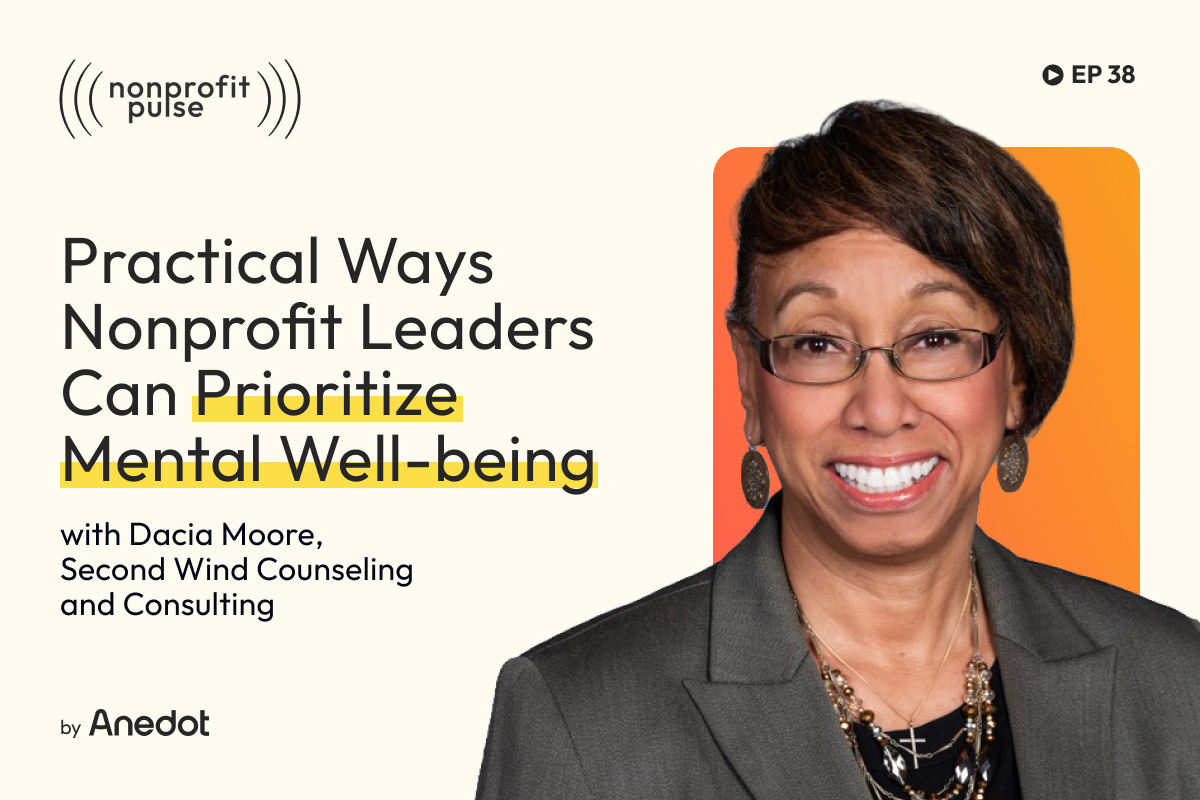
On this episode, we’re joined by Dacia Moore to talk about practical ways nonprofit leaders can prioritize their mental well-being.
Dacia is a transformational speaker, author, and mental health advocate with more than two decades of experience helping individuals break through barriers and lead with greater purpose and authority.
She is an award-winning business professional, a former nonprofit executive director, and the founder of Second Wind Counseling and Consulting, where she equips individuals with practical strategies for sustainable mental wellness.
She is also the author of From Stuck to Unstoppable: 5 Strategies for Getting Your Second Wind, a practical guide focused on emotional awareness and long-term personal and professional growth.
Hi Dacia, thanks for joining us on Nonprofit Pulse.
Dacia:
Oh, I'm excited to be here. We've got a great topic to talk about. It'll be so interesting and helpful to the nonprofit folks who are listening.
Why mental well-being for nonprofit leaders matters more than ever

Josh:
Yes, pumped about our conversation.
Today we're talking about sustaining the changemakers practical ways to help nonprofit leaders prioritize mental well-being.
And we're recording this in January, and it's a great time of the year, to talk about mental well-being.
We were talking earlier, Dacia, and I was just thinking about a lot of nonprofit leaders are wrapping up January right now, but are really still trying to catch their breath from the end of the year and needing a vacation from their vacation, if you know what I mean.
So, maybe just starting off, what drew you to focus on mental health specifically for nonprofit leaders? And why do you think this conversation is so urgent right now?
Dacia:
Well, I am a mental health professional. Licensed professional counselor.
I went to counseling early in, well, a quite a long time ago, 20, 25 years ago, because I was going through a very difficult time in my life and my counselor helped me to the degree.
I was reluctant. I didn't want to go. I was forced to go by threat of loss of job.
And, so I went to my counselor, and she helped me, and I thought, boy, I would love to help other people the way that she helped me.
So, I went to counseling school, got my master's degree. I did my clinicals at a nonprofit, which started my nonprofit career and rose up through the ranks and experienced burnout myself.
I was in the residential treatment at the time, loved the mission, loved what we did, loved who we served.
But my God, it was never ending. It was like I was going to, one of my clients calls it a poop show. That's the nice word for it, every day. I mean, it was just an emergency every single day, and it was extremely debilitating toward the end.
I lasted ten years at that nonprofit and then I did some other things, and then I became the executive director of a nonprofit of a counseling ministry in the Midwest.
And so I cared deeply about the mental well-being because and the title that you have for this episode, sustaining the changemakers, nonprofit leaders and workers do work that other people that for-profits can't or won't do.
And so we feel a vital role in the community. And it is important now because you have more and more people in need, the population has grown, there have been cuts to many social service programs.
Federal grants are at risk. I have one client who, she lost 62% of her funding. And that is a tremendous amount of stress. I'm happy to say that was last year this time.
I'm happy to say she has recovered and is doing very well because the city and county in which she lives pitched in, and it was great timing, but that was a stressful time.
I think that most leaders experience a lot of stress. But those in the nonprofit, because we care about people, I think we have an extra measure of stress that we carry.
The hidden mental well-being challenges nonprofit leaders face behind the scenes

Josh:
Yeah. And even beyond the load of the stress, it's the expectation of resilience that comes with nonprofit leadership that you are bringing, peace and calm to chaotic situations.
You're meeting needs there in your community or around the world.
What are some of the hidden mental health challenges that you see showing up behind the scenes?
Dacia:
Well, I certainly think that you hit the nail on the head in that there is the expectation of the leader to carry the load, to not be human, to be superhuman, and to be resilient, to be this wonderful superhuman woman or man who is taking everything in stride. And that just is not the case all of the time.
95% of nonprofit leaders, according to the Council of Philanthropy, are worried about their staff.
So the staff, leaders are worried about their staff, and rightfully so.
But one third of those 95% of leaders are worried about themselves.
You have a lot going on in terms of I'm worried about my staff. I know when I was an ED, I knew that people were depending on me to bring in the money.
I mean, right, people's livelihoods are depending on you. And so that's a lot of pressure, as well as trying to grow a program and serve more vulnerable populations.
So it's the weight of the nonprofit of your staff that you care about, who get the job done. And then of yourself. And I just think a lot of leaders don't give themselves the opportunity, nor do they feel that they have the space to even consider their mental well-being.
Just real quickly. I have a client that I am working with now, and she has sleeping problems and she gets up at 3 a.m., to do all the things and then she doesn't go to bed till midnight.
And I'm trying to convince her that's not sustainable, right? But she doesn’t feel that she has an option.
So we do want our leaders to be resilient, but that also means acknowledging your humanness and that your body requires certain very basic care. And you're not a machine.
You've got to figure out ways to feed your spirit, feed your soul, feed your body, feed your mind so that you can bring your best self to the nonprofit.
Because that's what we want ultimately.
→ Get practical nonprofit event planning tips to make your events meaningful, engage your supporters, and see results beyond dollars and attendance, with Karen Alonso from United Way of Southern Nevada!
Why mental well-being is still a difficult topic in nonprofit leadership

Josh:
Yeah.
And why do you think it is such a difficult topic for nonprofit leaders to talk openly about, even in mission driven organizations that are fighting against evils, fighting against hardship, and yet inside of nonprofits, it's hard to show weakness or to walk with a limp, maybe as a way to say it.
Dacia:
Well, I consider myself a warrior. I'm a woman of faith, of Christian faith, and I feel like I am a very strong warrior.
But you can feel that you need help even when you are strong.
But to your point, I think that people don't believe that.
They believe that strength means I don't need anybody else. I don't need to take care of myself.
I just need to jump in and get it done. And we do need to get it done.
Strength does not mean that you don't ask for help or that you don't take care of yourself straight.
I used to teach anger management and I would teach my teenagers, teenage boys, I would teach them that sometimes it's stronger to walk away than to stand and fight.
Now there are times to fight, but there are also times to walk away.
So the stigma around mental wellbeing and mental care is, oh, it's soft. Oh, that means I must be weak. That must mean, I don't have what it takes to be a leader.
I think there's this perception of, well, in my generation, John Wayne, the strong, silent type that didn't need anybody.
That’s not true. So it is okay and everybody has their own flavor of what they need to take care of themselves.
But it's the acknowledgment and as a person of faith, sometimes we have to recognize when we have come to the end of ourself and that doesn't mean that we're weak.
It just means that we need other people. We are interdependent.
But I think many leaders don't know how to do that Josh, or they don't know where to go, because you do have to be careful.
I mean, you can't tell your staff what you're struggling with, and you certainly don't want to tell your board what you're struggling with. And so where do you go to have that safe conversation?
And I think there's some places out there. I certainly am trying to organize something for leaders who want to have those safe spaces.
One of my colleagues, Bruce Scott in Arizona, he's got a group for nonprofit executive directors.
So finding those spaces, listening to these podcasts, but just understanding that it is okay to be interdependent and be a warrior at the same time.
Early warning signs of burnout and mental well-being strain nonprofit leaders often overlook

Josh:
Yeah.
Before we get to some of the practical ways to lean into mental well-being, what are some of the early signs of burnout, of maybe an extreme mental load?
What would you say to our audience around the early signs?
Dacia:
Well, the early signs.
And I think this is a great time of year to be discussing it, because leaders can look at their calendar for the rest of this year and insert some mental health days, mental wellness days, that are safe, that avoid some of the key dates that are coming up.
And you can insert those days and then put them in your calendar so that you can manage yourself and not allow infringement on those days.
So that's one thing that a person can do. Because what it looks like, Josh, is you're exhausted all the time. Which then leads to a decrease in productivity.
When you start to drag in the morning, you love what you do and you believe in the mission, but your energy seems to be decreasing.
You just don't have the amount of energy that you used to have. It's emotional exhaustion.
If you were to score yourself on a scale from 1 to 10, the hospitals use that pain scale with ten being the most exhausted that you've ever been and one being very little.
What number would you give yourself now and what number did you have last year?
So you can get some objective data to say, you know what, my energy level is decreasing. My exhaustion level is increasing. That is an indicator.
Now what happens Josh is many nonprofit leaders ignore the indicators and just push through because they have to. Which I get. I get that. I lived it and I get it.
But that then means that you've got to do something intentionally and proactively to thwart the progression of that exhaustion, okay?
Because it's not going to go away by itself. The nature of the beast that you are writing, we live in Texas, right? The rodeo is coming up, we got some bull riders and some wild horse riders.
The nature of the beast is what it is, okay? That's not going to change. So you have to change what you do in order to manage that beast, and to sustain and stay on it for as long as you can.
Does that make sense, Josh?
→ Discover how nonprofit leadership can leverage insights over instincts, make smarter decisions, and drive greater impact with Courtney De Ronde from Forge Financial and Management Consulting!
How leadership burnout affects nonprofit culture, retention, and mission outcomes

Josh:
Absolutely, absolutely. And and again, we're about to get to some practical steps.
But what's really at stake here for not managing the beast, right?
What is stress or burnout at the leadership level? How does that impact organizational culture, staff retention, and even mission outcomes?
Dacia:
Oh man. Significantly. And that is the danger. That's why this conversation is so important.
Because what is at risk is the life of the nonprofit, what’s at risk is that services decline, finances decline because you just don't have the energy or feel like doing the things that you used to do.
Your example with your staff, that's impacted. Staff begin to feel burnout.
They see you burnout, they feel burnout. They begin to become hopeless. That's another indicator. It feels like the mission is hopeless or what we're doing doesn't matter.
That is a key cognitive aspect of burnout is when you begin to feel that what you're doing doesn't matter. And that is such a lie from the pit of hell.
Because what you do does matter. But what happens is that we begin to feel like the ocean of need is too big, our efforts are too small, and that is very dangerous thinking.
So you have some nonprofits who go out of business, or you have some nonprofits that just limp along and you don't have the kind of cachet or juice or reputation in the community because you didn't, and I'm just being very specific, I have seen it, I have lived it, it's because you think that you can't stop or you have to keep going.
But the organization begins to suffer and your people begin to suffer. Your staff begin to suffer. And that's not fair to them.
Practical ways nonprofit leaders can prioritize mental well-being without compromising their mission

Josh:
Yes. So what are some practical, realistic ways nonprofit leaders can begin prioritizing their own mental health?
This is, like I said, recorded in January but will be out in February. So starting the year off strong.
How can folks lean into prioritizing their own mental health without feeling like they're neglecting their mission and their goals?
Dacia:
Right. So the first suggestion that I gave a few minutes ago was to look at your calendar for the year and, in the nonprofit in which I worked, the summer was a downtime.
Put some dates in your calendar for 2 or 3 days or a long weekend, so that you can plan around it and then do that with your staff as well.
One of the things that I was able to do, internally, I didn't necessarily tell the board this, but I certainly would allow paid time off for my staff, maybe in addition to what they normally would get.
So if they needed to leave early. Everybody this is Friday, let's get off at noon today.
Some bonus time. I didn't necessarily tell them in advance, but if we had the finances to do it and it just felt like we just finished a whole bunch of activity and work, like a lot of people are feeling right now.
Take half a day off, come in late on Monday. We'll start it at 10 or 11 on Monday.
Now, I certainly would go in on a Monday just because that's when people normally call. But I would let my staff come in later.
Taking your lunch or something as simple as, at least three days a week, taking your lunch outside of your office.
That sounds so simple, but it gives your brain a break. It gives you that needed break.
I would recommend taking your lunch outside of the office and then going for a walk in nature if you are able to.
Because when you can get outside and be in nature, there's something that puts things in perspective, right? There's a quote that I love. I've got it in my background.
Nature never hurries, yet everything is accomplished. And it can really readjust your view of what's important.
Your work is important, but so are you and your mental well-being.
So taking your lunch and then giving yourself, I used to teach psychology to adults many, many years ago, and I read a study that adults have an attention span of about 45 minutes.
I have begun the habit of I do a focus, and this is actually called the Pomodoro method, where you focus for 15 minutes on one thing, and then you get up for ten minutes, and you get away from the desk and you walk around, you go outside or you just clear your mind and you see something different.
So instead of trying to power through for four hours to get the grant written or to do whatever it is, to give yourself smaller pieces of time. Pomodoros.
Usually a pomodoro is about 25 minutes, but 45 minutes would be a max. 45 minutes, focus. Ten minutes, relax, listen to some music. Go take a walk.
Go have a conversation. Go drink some tea or something where you get away and allow your brain to ease down and allow your nervous system to calm itself down.
Some of the basics of mental well-being, Josh, get enough rest, managing your screen time, making sure that you turn off that phone two hours before you try to go to sleep to allow those neurons to calm down.
Getting up and having some, having easing into the morning, if you can. Those are some basic mental wellness habits.
So I love the book Atomic Habits, I love it, James Clear.
Because if you insert 1 or 2 habits that will help you, healthy habits that will help you, that can go a long way in thwarting off burnout and avoiding burnout.
→ Learn how nonprofit leaders can prepare for and overcome adversity from our conversation with Erin Davison from BBBS Southwest Louisiana!
Small, sustainable habits that protect nonprofit leaders’ mental well-being long-term

Josh:
Yeah, and this leads up well to our next question, which is, what small sustainable habits have you seen make the biggest difference for leaders who are trying to protect their mental health long term?
Dacia:
One of the biggest habits that helped me that I share with everybody is margin time. And that kind of goes along with the Pomodoro, the focus, and then you step away.
When you give yourself margin time, meaning that when you notice your anxiety or overwhelm or stress level rising. So some of this has to do with internal self-awareness, right?
When you notice that your anxiety or stress or overwhelm is rising, you give yourself permission to step away.
Now, that can be the best habit, because I have learned in my years as an executive director and all the things that I've done in my life, that when I step away, when I feel my overwhelm getting to be about right here, when I step away and just do something else, and right now I work from home, so I go clean.
I go clean the kitchen, or I put the dishes away. I do something that takes activity, right?
My mind settles down and then the next right thing presents itself. So it's almost as if you allow that stress and overwhelm to rise, you can't think of what to do.
And so you're doing like this. You're doing all the things, but not the next right thing.
And the thing about leadership, Josh, my mentor told me this long time ago. She said they see it.
There are a lot of things you're going to want to do, and there are many things that you can do, but they're only a few things that only you can do. Those things that only you can do have to be at the top of your priority list, calling that major donor, having lunch with that board member. Only you can do that. All the other things can be delegated, but you have to focus on the things that only you can do. So when I am feeling that feeling of overwhelm and I step away, I can think about, okay, what is the next right step that only I can do that's going to move the needle?
Because that's the other thing. We want to do the right things and we want to do things right. So what is the next thing that only I can do that will move the needle?
Because there's a lot of things I could do, but there's one thing or two things that I must do and that only I can do, and that is something that I think can help leaders to figure out, okay, with all the things, let me pick that one that is the most important thing that will move the needle that only I can do.
Josh:
Yeah. And I love that about taking a walk, taking a lunch every so often.
And one thing that's helped me through the years too is going intentionally every week or once a month, either going on a walk with a person or going to lunch with a person that you can be honest and vulnerable with and say, man, this month is killing me.
You may not feel the ability or the culture to say that inside of your office.
Or maybe you're an executive director and so everyone is in the org chart below you and you don't want to overshare or put that stress on them, but find someone that every week, every month, there's a time where you get to go on a walk or a lunch or grab coffee, to just have a moment of time that is not about you performing, but it is about you being heard.
And then also you listening.
Dacia:
Absolutely. That is a great suggestion. And also, especially if you come back and share with your staff from a high level.
I've got a mentor, I've got a friend, I've got a colleague, I've got a coach that I talk to that helps me to adjust some things in my head, using it as a teaching opportunity so that your staff get permission to do the same thing.
We all need that non-judgmental support. And, you do have to be careful that it's a safe person.
But, man, that is so liberating to feel acceptance and accept it. Not for your performance, but just for who you are.
And to share on a real level what's going on with you and to have somebody be supportive of that.
And then, they share what's going on with them as well. Yeah, I love that.
How nonprofits can build a culture that truly supports mental well-being

Josh:
So thinking about culture inside of nonprofits, how can leaders really create a culture where mental health is normalized, mental well-being is normalized and supported without turning it into a kind of a rote, check the box initiative of, okay everyone, you're all now going to be accountable for going on a walk, for taking one day off a month.
You know, the things that we can turn this into a performance exercise rather than what it genuinely is, which is an exercise in helping mental well-being and helping someone deal with the stress and the load of their work.
Dacia:
Well, I would say, yeah, we don't want to make it performative where it's just another box to check.
And then, you have to do a report on it. Oh, I used hate doing reports, but, I mean you got to do reports, right? But, we want to minimize those reports and make them concise.
Anyway, I would say, number one, it has to be a value of the leader. And, hopefully they can learn if they don't value that intrinsically now, they can learn to value it.
But what I would also recommend is to have a conversation with your staff. We have staff meetings twice a month.
And I used to certainly weigh in on them, but we rotated who would lead the staff meetings so that everybody gets an opportunity to show their leadership skill.
I would help them with the agenda. But they ran the meeting.
And I would say there's probably somebody on your staff who has a very healthy respect for mental wellness and well-being.
Maybe that's the person that you can go to to say, hey, let's find and get suggestions from the staff on things that we can do to make sure that we have a healthy working environment.
I mean, how supportive would that be? How wonderful would that be for your staff to feel like they had a voice in saying what are some of the things that would help them?
Even just having the conversation. Let some of the air out of the balloon of the tension that everybody may be feeling just because it sometimes it feels like a hamster wheel.
And we're just going, going, going, going, going, going.
So I would say promoting a healthy work environment by collaborating with that one person who that's their energy, that's their vibe.
Having them be the lead, and getting suggestions from everybody else on what can we do each month? Every month has a number of different special holidays.
And so how can we support each other's mental well-being once a month, right? And, certainly exercise, eating right.
All of those baseline things for a good, healthy body are important.
I'm thinking of heart health for February, right? Because that's Valentine's Day. But every month you could have a focus. And that person who is their leadership, they could just do like a ten minute thing.
It doesn't have to be all planned out with notebooks passed around and a PowerPoint presentation, but just, hey, how's everybody doing with their mental wellness?
Asking the question, how's everybody doing? Thumbs up, thumbs down. We have an EAP. Use it. Letting people know about their insurance benefits if you offer insurance.
I had, and I'll just finish with this story, I had somebody ask me because I used to do and I still do mental wellness in the church because that's the question as well.
You're supposed to be able to pray through it, and you shouldn't need a counselor if you are a real Christian. Okay. That's ridiculous.
But anyway, the question was, how can you help people in the church to accept counseling if the pastor talks about it from the pulpit and says, it's okay?
Hey, listen, I have a counselor or it's okay to have counseling, to take medication, and to pray. You need all of it.
So to have the ED say something about, it's okay if you need a counselor. I don't need to know about it. But you know what? If you feel the need that you need extra support, get it.
There's nothing wrong with that. It doesn't make you weak. If you have a broken leg, you would use crutches, right? Until you didn't need crutches anymore.
A mental health counselor is not a crutch. It actually is somebody who will help you to be stronger.
→ Learn how using the power of play can positively shape nonprofit culture with Elizabeth Cushing from Playworks!
Why mental well-being is mission-critical for nonprofit leaders, not selfish

Josh:
For those in our audience who are thinking, I've tried to do this before. Last year, I tried to lean in to taking time for myself, for self-care, to give myself margin.
But I felt so guilty when I saw others still working or when my spouse was not doing the same thing and I felt like I wasn't working as hard as my spouse.
What would you say to that person as far as setting up those boundaries and really having a mind shift to see self-care as mission critical and not just something nice?
Dacia:
Yeah, yeah, yeah. So a couple of things come to mind. One is that belief that self-care is mission critical, and it is okay for me to take care of myself.
People, probably, if they go to bed earlier than their spouse does, do you feel guilty? I mean, you might, but, you are you and what you need is what you need.
We can't compare our behavior to other people. Comparison is the enemy of self-esteem and of confidence.
So your road, your path is your path. And you need what you need. So that is a belief though that you have to develop over time.
And first of all that you are working harder than your staff and nobody can really explain what an executive director does. There are not enough words to explain everything that an ED does.
So you need to take care of yourself in order to take care of other people. But your staff may not understand that.
I had a staff member. I used to take a walk for about an hour and I had a staff member say, where do you go for an hour every day? And I had to check her.
Listen, you don't know that I work until 8 p.m. some nights. You don't know the extent of what I do.
I'm doing this to help me take care of you. I had to let her know, because listen, you can't, don't try to, what is this, spend my money or spend my time because I, you're here, right? The doors are still open.
And then the other thing I would say just finally and I tell my clients and coaching clients this as well. You're going to have feelings about everything you do.
Either you're going to feel guilty, you may feel guilty if you take care of yourself because you feel like you should be working 24/7, 365, which is ridiculous.
But some people have that vibe, so you may feel guilty.
But on the other hand, if you don't do it, you're going to feel resentful. You're going to feel burnout, you're going to feel tired and exhausted.
So which can you deal with better? You can deal with the guilt because you are healthy and you're getting things done. And that grant just came in, that new donor just donated whatever. As opposed to the exhaustion.
So sometimes you have to weigh it to say, okay, whatever I do, I'm going to feel a way, feel a negative way about it.
So which is the best course of action to take? Dealing with the guilt, but still being healthy or dealing with the burnout and then not being healthy?
How nonprofit leaders can set healthy boundaries in mission-driven work

Josh:
So thinking more about boundaries and boundaries is a huge topic, and I feel like most folks don't discover boundaries until they're in their maybe late 20s, 30s, even 40s.
Because it's just go, go, go do what's expected of you. Reach the next level, do the next thing.
But boundaries are super important, and especially for leaders to model for their staff.
And that's leaders on the board. It's leaders within the organization. It's leaders modeling that for volunteers as well.
Because even in volunteering, it is difficult to draw boundaries that are healthy for you.
So how would you recommend leaders set boundaries in nonprofit life where the work often feels not only deeply personal, but also never truly finished?
Dacia:
Yeah, well, it actually it is unending and, so this brings up the distinction or maybe it's not a distinction. It's two sides of the same coin.
We're talking about professional leadership as executive director, development director, staff, people who listen to your podcast.
But then we're also talking about personal leadership. And personal leadership has to do with leading yourself so that you can be your best self.
And I have run into many people who have very poor personal leadership, poor boundaries.
Many people need to learn how to have healthy boundaries because that was not modeled in their families of origin. And I have a lot of clients who I can tell you stories about that.
It's hard to have healthy boundaries if you haven't learned them. And so you have to learn where is your boundaries.
This is one tactic or strategy that I use with my counseling clients.
Because boundaries have to be healthy and you have to learn to say, what is mine, what is my role to do and what is other people's role?
So that is a personal journey that I think a lot of people need to make.
There's a book called Safe People: How to Find Relationships that are Good for You and Avoid Those That Aren't by Henry Cloud and John Townsend.
When you feel that unction that you can't say no, and sometimes this might be with a board member. It might be with a major donor. That's an indicator that a boundary line is being crossed.
So, yeah, we can say a lot about boundaries, but having healthy boundaries, like, for example, having a time when we go home, we the end of the workday is what, 6 p.m. in a lot of places.
And I am not going to text you, email you, or call you after 6 p.m..
If it's work related, I will call you, I will reach out to you in the morning. That's an example of a healthy boundary.
Now EDs and development directors, we do things in the evening. We take work home which you know that I would say is we want to have a healthy boundary around how much work we take home or otherwise we are working all the time and not investing in our personal relationships.
So you're not balanced. If there is such a thing.
But, just establishing some lines that you won't cross into inappropriate behavior as it relates to communicating with your staff and or your board members.
Board members might be a little different, because you may only be able to reach them in the evening because they're working.
But, that's what I would have to say about boundaries. That's a personal journey. And some people have very poor boundaries, especially those who are perfectionistic in nature.
So, you know, that’s a personal journey.
Josh:
Yes. And high performers, it's very hard to draw boundaries.
And it sounds like a good take away from what you just said is maybe even just starting out and setting boundaries is sit down with a journal and make a list of things that you feel like you can't say no to. If something happens and you're asked to do something or be somewhere, you cannot say no.
And write those down and then assess those from as objective as a perspective and point of view as you can and say, actually, I can say no, I'm just choosing to say yes.
I think people will find quickly there are many things where they feel like, they can't draw a boundary and that it's harmful to them, but they can't say no, that they actually can.
And a lot of a lot of high performers often fall into that trap of thinking, oh, well, some other person, whether my manager, my mentor, or my coworker, is going to think less of me and lose trust when that's actually not the case at all.
Nobody's putting that on them except for them. And that's a great place to draw a boundary.
→ Learn how to improve donor retention, build lasting loyalty, and re-engage supporters with James Misner from The Kipos Group!
Closing thoughts

Josh:
So just wrapping up here Dacia, any resources you would like to share with our audience around today's topic?
Dacia:
Oh, yeah. Yeah, I do have some.
Certainly the book by James Clear, Atomic Habits. I think there's a really good, there's several good books.
Learned Optimism by Martin Seligman that helps us to reframe things in a more optimistic way.
And many times, since we're dealing with vulnerable populations, we see the worst of people, and we have to shift our mindset to be optimistic and you can learn to be optimistic.
I am a living, I'm living proof of that as a former pessimist, you can shift your mindset.
And then that's the other, psychology book, Mindset: The New Psychology of Success by Carol Dweck, where you can have a growth mindset.
You can have just the belief that even though things aren't working out perfectly, what I'm doing matters.
And I am contributing and really believing that everything is not all your fault or on your shoulders, but you are putting out good work into the world.
You're putting out good effort into the world and meaningful work. And so just having that growth mindset is super important.
And then I would say finally, I am an advocate of getting a coach, or a counselor.
I think everybody needs a counselor, quite frankly. And everybody needs a coach.
And I am impressed with my grandson, who is 16, he's on the football team, and I am just so impressed by how many coaches his high school football team has and how he is coached and encouraged.
And to me, it is a real example of how we can be better in the professional world by having people in our corner who are watching our behavior, watching what we do, and then we go in, we have a conversation, and we sharpen our saw to be even better.
In addition to the ones that I've mentioned, I definitely want to share with the audience my newest book, From Stuck to Unstoppable: 5 Strategies for Getting Your Second Wind.
This is a book that I created with some foundational psychological principles.
It is geared to the Christian executive so that there there are a lot of scriptures in it that talk about who God says we are and, helping us to realign our thinking.
So it'll be in, I'll send you the link for the book, but we want to get unstuck and we want to become unstoppable.
So I would love for folks to take a look at the book. It's on Amazon. So yeah.
Josh:
Awesome. Thinking about resources as well, you mentioned a book on boundaries, I've got another book I would recommend.
It's called Boundaries by Dr. Henry Cloud. It has been a huge help to me, personally, as someone who struggles with boundaries, so we'll have that in the show notes at Nonprofitpulse.com.
There you'll find links to connect with Dacia as well as some of the resources we've mentioned here.
So, last question, Dacia. If you were standing on stage in front of a thousand nonprofit leaders and could share one thing with them about today's topic, one sentence, what would you say?
Dacia:
Well, I would say little things matter, little things matter.
And so those small habits that you institute like taking your lunch when you need to, like taking a break and stepping away, like getting that exercise, small things matter.
I'm reminded of the book Slight Edge, as well as a book, Don't Sweat the Small Stuff where if you are flying in a plane and it goes off course one degree, you are going to end up in a very different place.
Don't discount the small things that will help you mentally, physically, spiritually, emotionally that can help you be the leader that you have always wanted to be.
Josh:
I love that, and it just reminds me that in mental wellness, mental health, mental well-being, there is no neutral.
You are never standing still. You are either trending towards health and wellness or you are falling backwards and trending towards dysfunction and pain.
So I hope this conversation today has been an encouragement to our audience to lean into your mental wellness this year, it's too important.
And for a lot of these things that we've talked about, practical tips, you can either start doing them now, or you can wait until you're burned out and unhelpful in your organization and then start doing them.
But I think Dacia you would say start now.
Dacia:
Start now, start now. Being burned out is too late.
I mean, you can recover, but it takes longer. Start now.
Josh:
Awesome. Thanks so much, Dacia.
Dacia:
Thank you.
Josh:
Hey, thanks for listening.
If you enjoyed this conversation, please share or leave us a rating and review wherever you listen to podcasts.
Also, head on over to Nonprofitpulse.com to sign up for our monthly newsletter, as well as check out all the links and resources in the show notes. We’ll see you next time.
Frequently Asked Questions
How can nonprofit leaders recognize burnout early?
The episode identifies persistent exhaustion, lower energy, dragging in the morning, and a sense that the work does not matter as signs leaders can pay attention to. Moore suggests comparing your current exhaustion rating on a one-to-ten scale with last year's rating to notice a change over time.
What are practical ways nonprofit leaders can stay well during busy seasons?
Start by putting a few mental wellness days or a long weekend on the calendar before key dates fill it. Moore also suggests simple routines such as taking lunch away from the desk, getting outside if possible, and giving staff occasional flexibility when the organization can support it.
What small habits can help nonprofit leaders manage stress?
Moore recommends building margin into the day and stepping away when stress or overwhelm begins to rise. Her personal focus routine is to work on one task for 15 minutes, then take 10 minutes away from the desk before returning to the work.
How can nonprofit leaders decide what to focus on when overwhelmed?
Ask which next task only you can do and which one will move the needle for the organization. Moore says leaders can delegate many tasks, while priorities such as a major-donor call or a board-member lunch may need the leader's attention.
How can nonprofit leaders set healthy work boundaries?
Begin by separating what is yours to do from what belongs to someone else. Moore gives an end-of-day communication cutoff as one example, while recognizing that leaders may need different arrangements for evening work or board members.
How can executive directors get support without oversharing with staff?
Find a safe, non-judgmental mentor, friend, colleague, coach, or counselor with whom you can speak honestly. The episode also suggests that leaders can tell staff at a high level that they use support, which can give staff permission to seek support too.
How can nonprofits support staff well-being without making it performative?
Make well-being a leadership value and invite staff into a practical conversation about what would make the work environment healthier. Moore suggests keeping the effort simple, such as rotating staff-meeting leadership, gathering ideas, checking in briefly, and reminding people about available benefits.
80 Community Service Ideas for Nonprofits


Show notes:
- Nonprofit Pulse
- Second Wind Counseling and Consulting
- Dacia's book: From Stuck to Unstoppable: 5 Strategies for Getting Your Second Wind
- Atomic Habits by James Clear
- Safe People: How to Find Relationships that are Good for You and Avoid Those That Aren't by Henry Cloud, John Townsend
- Learned Optimism by Martin Seligman
- Mindset: The New Psychology of Success by Carol Dweck
- Boundaries by Henry Cloud, John Townsend
- Slight Edge by Jeff Olson, John David Mann
- Don't Sweat the Small Stuff by Richard Carlson
- Dacia Moore on LinkedIn