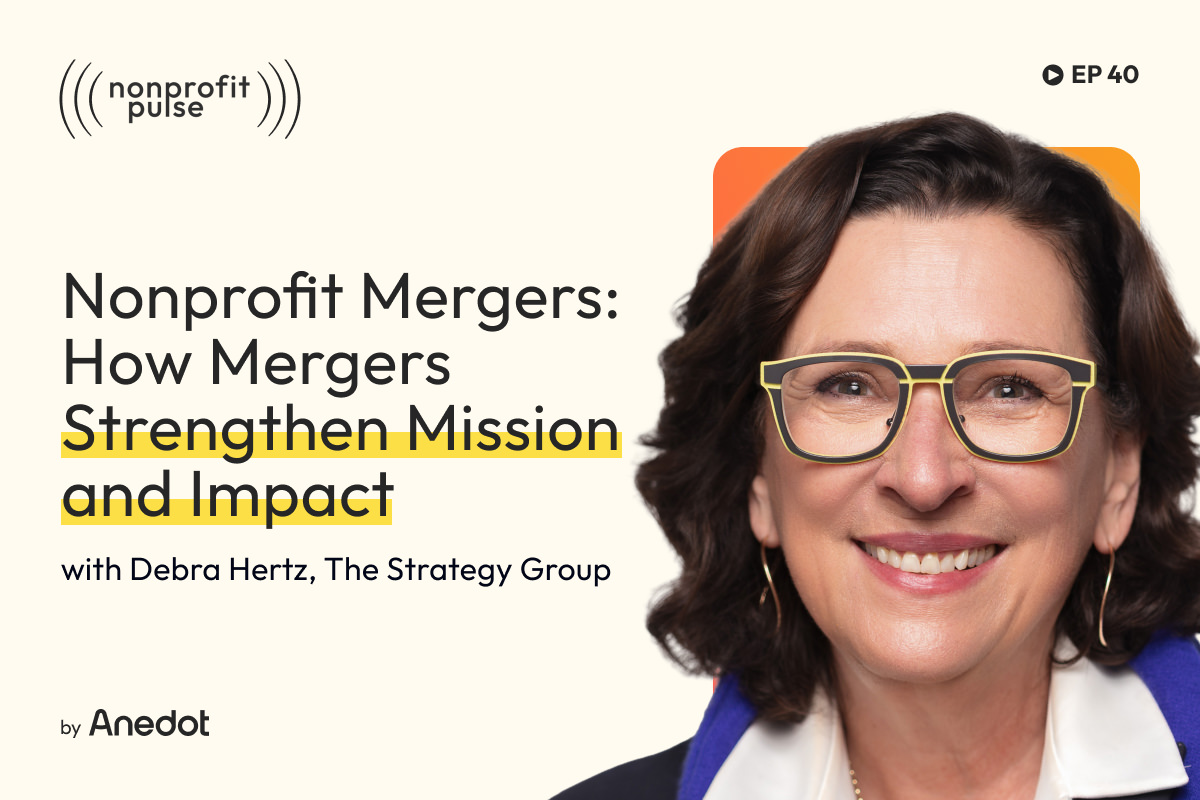

The short version: nonprofit mergers are most useful when leaders treat them as a mission decision, not a rescue plan or a loss of identity. Debra Hertz, Managing Director & Founder of The Strategy Group, explains how boards can test for strategic fit, face cultural differences early, and accept the investment of time and money required to build a stronger organization. The goal is not simply to combine operations, but to serve more people with greater strength and clarity.
Key takeaways
- A nonprofit merger is not a takeover. Unlike for-profit entities, nonprofits have no stock to buy, though thoughtful mergers still require shared values and a shared vision.
- Sustainability, growth, and efficiency are the three main reasons to consider joining forces. Financial uncertainty can create pressure, but a merger can also be a proactive opportunity to expand mission impact.
- Desperation leaves signals in the record. Financial reports, audits, 990s, and heavy leadership turnover can show when an organization has waited too long and may become a liability to another organization.
- Define the strategic opportunity before talking with another organization. Leaders should identify whether they could reach a broader geography, offer more mission-aligned programs, or do more with less money.
- A mission-led merger can produce measurable efficiency. After two Connecticut food banks came together, they served more food pantries and saved $1 million a year after a couple of years.
- The people served must outrank institutional ego. One merger committee used a simple agreement to guide decisions: choose what was best for the people of Connecticut, not what was best for either organization.
- Cultures do not automatically merge. Leaders should discuss culture early, use tools such as culture surveys, and intentionally create a new culture instead of letting the dominant one prevail.
- Boards should begin with an honest internal conversation. Before approaching a potential organization, clarify the reason for the merger, each side's value add, expectations, and how well the organizations know one another.
- The process needs time, money, and credible champions. A quick but realistic process can take seven to eight months, and trusted board or staff leaders need to keep the work moving when it gets difficult.
- A conversation does not have to end in a merger to be worthwhile. Debra Hertz says probably 40 to 45% of the merger conversations she starts are executed, so leaders should do their homework and try to stay on good terms whatever the outcome.
Guest: Debra Hertz, Managing Director & Founder, The Strategy Group | LinkedIn
Podcast episode transcript ↓
Josh:
For many nonprofit leaders, the idea of merging with another organization can feel uncomfortable.
Nonprofits are often deeply tied to their identity, legacy, and mission.
But in today's changing landscape, more leaders are beginning to ask whether the right merger could actually expand their impact, rather than diminish it.
So why are nonprofit mergers becoming more common today?
How can leaders discern the difference between a merger driven by desperation and one rooted in strategic opportunity?
And what does it take to bring two organizations together in a way that truly strengthens mission and community impact?
I’m Josh with Anedot, and welcome to Nonprofit Pulse, where we explore trends, insights, and resources that help nonprofits accomplish their mission.
On this episode, we’re joined by Debra Hertz on the topic of how nonprofit mergers strengthen mission and impact.
Debra is the Managing Director and founder of The Strategy Group, a strategic advisory firm that helps nonprofit organizations build strength, clarity, and impact.
Over the past decade, she has partnered with hundreds of nonprofits nationwide, guiding boards and executives through moments of growth, transition, and complexity.
Before founding The Strategy Group, Debra served as Executive Director of the William Pitt Foundation and spent more than 20 years teaching nonprofit leadership at Fordham University’s Graduate School of Social Service.
Hi Debra, thanks for joining us on Nonprofit Pulse.
Debra:
Nice to be here with you today, Josh. Thank you.
Why nonprofit mergers are on the rise and the mission-driven reasons behind them

Josh:
Yeah, excited for our topic today, a topic we haven't discussed on the podcast, which is nonprofit mergers, how mergers strengthen mission and impact.
So maybe just starting off, Debra why are nonprofit mergers becoming more common and even a more common strategy in today's nonprofit landscape?
Debra:
I think that there are two big reasons right now, and one of them is there's a lot of uncertainty in the nonprofit landscape.
And so organizations are looking at their mission and looking for ways that they can still complete their mission, but also realizing the financial constraints and other limitations that they might be facing.
So that's one reason, that's sort of the more negative reason.
The positive reason is that organizations see mergers as an opportunity for expansion and growth.
And so I would say those are the two biggest reasons right now.
Josh:
Yeah, and when people hear the word merger, they often think of negatives, right? So corporate takeovers for example.
How is a nonprofit merger different and what should leaders understand about the purpose behind it?
Debra:
There's a big difference between nonprofit and for-profit mergers.
And for for-profit mergers, you can take over a for-profit. You buy their stock and you have the power to take over that organization.
Nonprofits don't have stock, so you can't take over a nonprofit. And so the big difference or a difference is or that is a difference.
I would say the similarity is the strongest mergers are mergers that are thoughtful, that are clear, and that there are common values and a common vision between the two organizations.
You’re looking for opportunities where you can really make one plus one equal five.
Josh:
What are the most mission driven reasons a nonprofit might consider merging rather than continuing independently?
Debra:
Three big reasons.
The biggest reason is sustainability. The second is growth, the opportunities for growth.
And the third, and this does tie into sustainability, is efficiencies. How do you gain efficiencies by working together?
A real example of a nonprofit merger that strengthened mission and impact

Josh:
Yeah.
What's an example of maybe some of those efficiencies gained when two nonprofits with a similar mission or missions that are overlapping join and are able to expand their work in the community?
Debra:
Well, I'm going to give you an example of two organizations in Connecticut, and that's where I am.
Connecticut had two food banks, and those two food banks in the state served all of the smaller food pantries.
And the two organizations had talked before, years before, about joining forces.
There was no reason in a state as small as Connecticut to have two food banks, but they weren't able to do it. They weren't able to come to an agreement.
So I worked with the two food banks to come together, and it takes a long time. Mergers take a long time. And there's a big investment to making a merger work.
But the outcome was after a couple of years, they were serving more food pantries and saving $1 million a year.
And so that was such a win win merger between these two large organizations that really became a mega organization in the state.
→ Discover practical strategies nonprofit leaders can use to move beyond one-time fundraising events, run high-impact $10K+ sprint campaigns, and build sustainable donor engagement, with Christina Edwards from Splendid Consulting!
Common misconceptions nonprofit leaders have about mergers

Josh:
Love that.
And thinking about maybe some misconceptions that nonprofit leaders may have about mergers or fears, what would you say are some of the most common misconceptions or fears?
Debra:
The most common fear is a sense of loss.
People are losing their identity. People feel like they're losing their baby.
At the bottom line is organizations need to look beyond themselves, and they need to look at what is best for the people that they serve. What is the best opportunity for them to provide high quality services to people who need them? And so in mergers and I do consulting on mergers, there usually comes a point where you have to say to the partners, you know, it's not all about you. It's about the people that you serve. And that has to be foundationally what you're after.
Josh:
It does sound like mergers often are a battle of the ego.
Debra:
Have you worked on mergers, Josh? They are a battle of the ego. They are.
And I will give an example, it's something that changed for me with all mergers after the two, Connecticut food bank mergers.
The merger committee met for the first time.
And a board member of one of the organizations, one of the first things he said is we have to make an agreement that the decisions that we make in this committee are based on what is best for the people of Connecticut and not what is best for either one of us.
And by saying that what we could do is when egos became big, we were able to bring it back to that.
How nonprofit leaders can tell the difference between a strategic merger and one driven by desperation

Josh:
So thinking about how leaders can discern the difference between a merger that is driven by desperation versus one driven by strategic opportunity, what would you tell our listeners around that?
Debra:
It's pretty easy to spot mergers based in desperation.
And look at organization’s financial reports, look at their audits, look at their 990s. You see pretty quickly how an organization is doing.
And organizations can wait too long to start a merger. Organizations who basically are going to become a liability to somebody else. Nobody wants that.
The other thing that is a sign of desperation rather than opportunity is leadership.
Has there been a lot of turnover in leadership? And if there has been, that is absolutely a red flag for the other organization.
And so when you look at strategic opportunity, organizations need to look individually before they start any merger conversations of what is it they can gain.
What can they do differently? Are they going to be able to have a broader, geographic footprint?
Are they going to be able to offer more programs that fit their mission? Are they going to be able to do more with less money?
They need to really be able to discern for themselves where the key opportunities lie.
→ Discover practical approaches nonprofit leaders can use to prioritize mental well-being, recognize burnout, and build sustainable leadership practices, with Dacia Moore from Second Wind Counseling and Consulting!
Why culture and organizational alignment matter in nonprofit mergers

Josh:
You kind of alluded to it, but thinking about culture, what role does culture play in nonprofit mergers and why is cultural alignment often more challenging than, say, financial or operational alignment?
Debra:
You're singing my song, Josh.
Organizations often forget about culture when they are doing mergers, and culture is extremely important.
The bottom line is: cultures don't merge, the dominant culture dominates.
So when you are doing a merger, what you want to do is you want to talk about how you are going to together develop a new culture.
How are you going to and this easier if you have two similarly sized organizations. If you're talking about a large organization and a small organization, it becomes trickier.
And so talking honestly about culture. And you can do this. You can do culture surveys. You can talk about what needs to stay and what should go.
But I'd like to give an example of culture, if that's okay with you.
Many years ago, I was involved in a merger. I was COO of a large organization. And so you had a very large organization that was just more businesslike, more corporate almost.
And the small grassroots organization, it was an AIDS organization where a man, a beloved man, died of AIDS, and his family and friends came together and created this organization.
The organization was a tribute to this beautiful spirit and it was very much a family.
And when my CEO came to me and said, we're looking at merging with this organization. I said, really? Really? How is that going to work?
He said, well, I want you to go to their board meeting. And I went to their board meeting. Beautiful people.
At the end of this board meeting, the board chair got up and said, well, at the end of every board meeting, Debra, we have a group hug, okay.
Which is really nice, but I'm like, oh my goodness, this is not going to really work.
I went home or I went back and I told the CEO, I said they do group hugs at the end of board meetings.
And he's like, he really wants to do the merger, and he's like, no, it's going to be fine.
Well it wasn't fine. And we did the merger, but they lost their whole culture because nobody was willing to talk about the elephant in the room.
So culture must be part of the discussion early.
How nonprofit boards should approach merger conversations

Josh:
That's so insightful too, you mentioned at the beginning about when merging, you have to do the diligent work of establishing a new combined culture.
That is so insightful because absolutely, the larger org or the org with a stronger culture is going to dominate and just suffocate and drown out what was left of the other org.
And so that makes so much sense.
So, Debra, thinking about how boards should approach merger conversations, how should that go?
Especially when legacy, identity, and history are so deeply tied to the organization?
Debra:
So boards should approach these conversations early and honestly.
You start by having an internal conversation. You start by asking yourselves, why are we doing this?
What are we bring to the table? What is our value add and what are our expectations of the partners? And then you look at so who are the potential partners?
Do we know them? How well do we know them? It's most helpful when you know them.
So having those internal conversations and not surface ones are number one, is the first thing that you need to do.
Then you need to really look at the foundational issues that are part of mergers. And again I had brought this one up earlier.
Always forefront your northstar what is best for the people you serve.
Number two, boards need to understand the process and respect the process.
I have had, I had one merger and there was an incredibly enthusiastic board member, a real champion. But he kept saying to me, Debra, this is a no brainer. This is a no brainer.
We don't need to follow the process. And I kept saying, please, please follow the process. And what would happen is they would not follow the process and then they'd have to backtrack.
So respect that there's a process that works and follow it. It doesn't have to be, you don't have to dot every i and cross every t. But you have to do most of it.
Number three, you need to with your partner assume good intention.
That seems like a no brainer, except it's not. There is a sense of distrust. What are you trying to get from us? And so I think that is important.
The other too I would say, don't hide the hard stuff. It's going to come out.
Be honest. And understand you might be looking for efficiencies, but before you get the efficiencies, you need to make an investment because mergers cost money.
→ Learn how nonprofits can ensure long-term sustainability by building diverse revenue streams with Ciara Byrne from Green Our Planet!
Key questions nonprofits should ask before pursuing a merger

Josh:
Yeah. So thinking about the hard stuff kind of leads into my next question.
What are some key questions nonprofits should ask before entering those merger discussions to ensure mission integrity stays at the center of this new possibility?
Debra:
There are a couple. What are we trying to accomplish?
How will this benefit the people we serve? Is there a strategic fit, is there a mission fit, and is there culture fit with the other organizations?
How would a merger help our organization and what are the risks and what are the non-negotiables?
When I start merger conversations, have I talk to each partner individually before we come together?
One of the questions I always ask is so what are your non-negotiables?
And I say, but before you answer, understand one thing. All non-negotiables are negotiable.
But I want to hear where you're coming from, because that tells me whether this really is going to be able to move forward or not.
What the nonprofit merger process looks like and how long it typically takes

Josh:
From a practical standpoint, Debra, what does the merger process usually involve?
And what timeline should leaders realistically expect when just starting out to wrapping it up?
Debra:
If you do it at a quick pace, a trot, not a gallop, you're probably talking 7 to 8 months.
I did one merger and when we started, the two organizations said, we have to do this within 60 days.
And we said, okay, we did. But what happened was the honest conversations that they would have had during negotiations actually happened after implementation and it was very difficult.
So mergers take time, they take money, and they take a champion.
Somebody needs to champion this cause on each side. There has to be.
Hopefully it's a board member. But if it's the leadership, the staff leadership, but there needs to be that cheerleader who when times get tough, they can stand up and say, no, we have to keep going.
Josh:
I love that. I love that. And typically who have you seen be those champions? You mentioned board members, maybe leadership.
Just in general, is it tenure? Is it competence? Like what is it coloring those folks who stand in that role?
Debra:
I think part of it is tenure.
So champions who have gravitas, who people listen to most, they have some tenure with the organization.
That's not somebody who joined the board last month.
And I think that's really important. If it can be the board chair, that is very helpful as well.
→ Learn how adopting a corporate mindset can drive nonprofit growth, scale impact, and build stronger networks with Laura Bonnell from The Bonnell Foundation!
Will nonprofit mergers become a key strategy for long-term sustainability?

Josh:
So looking ahead, Debra, do you think mergers will become more essential for nonprofit sustainability?
And what advice would you give to leaders considering that path?
Debra:
I would say do your homework and be realistic.
And of the merger conversations that we start, probably 40 to 45% are executed and the others are not.
So at the very beginning, what's important is saying we're starting a conversation that we're not sure is going to come out at the end is a merger, but let's try to stay friends no matter what happens.
Josh:
And for those who are in our listening audience who may be thinking, you know, 2026 might be the year we need to start looking at a potential merger, whether that's from a larger organization wanting to expand its footprint and merge with a smaller or a smaller organization.
What would you say is their next step today to get that conversation and ball rolling?
Debra:
There is a great, very practical guide for nonprofit mergers that I highly recommend, and it's called the La Piana Mergers Workbook. I would get that.
I think that that gives you a really good overview of what you are in for.
The other thing I would say is start thinking about who might be your best partners.
As I said earlier, the best partners are people you know. It doesn't 100% have to be that way. But there is hopefully trust there.
Have a conversation in the boardroom, not a lot outside of that, because mergers scare people.
Closing thoughts

Josh:
I can totally appreciate that.
I mean, it is a world shaking event for an organization that has cared for and has survived many years and many adversities, to then be joining another organization. It's just a massive undertaking.
You mentioned that resource, Debra, what are some other resources that you'd like to share with our audience around today's topic?
Debra:
Well, they can certainly reach out to me and have a conversation with me about what it looks like and what the ins and outs are.
There are some great blogs about mergers. I believe BoardSource has some information on mergers. So it's out there.
And we did a webinar with one of our merger partners: How a Nonprofit Merger Led to a Bigger and Better Mission.
And recently they can look at that webinar, because it is important that you start a process as well-informed as you can.
I will just add one other thing. I mentioned earlier mergers cost money.
I think that what I would look at is are there organizations, are there foundations out there who might support the merger?
There are and oftentimes community foundations have capacity building grants.
So I think that talking to funders who may be supportive is also important, but you have to be able to talk with some fluency before you go to them.
Josh:
That's so helpful.
And for our audience, head on over to Nonprofitpulse.com for the show notes where you'll find all these resources listed, as well as a link to connect with Debra, and see the transcript and all the things there. So Nonprofitpulse.com.
Debra, our last question of the interview, my favorite question of of every episode, if you were standing on stage in front of a thousand nonprofit leaders and could share one thing with them about today's topic, one sentence, what would you say?
Debra:
So I actually have a post-it note on my desk with a quote, and it says:
The future belongs not to those who preserve convention, but to those who dare to reimagine it. And that's what nonprofit leaders are being asked to do right now, reimagine their future.
Josh:
Awesome. I love it. Love it. Debra, thanks so much for spending time with us and sharing on mergers and again for our audience, head on over to the show notes to find these resources.
And who knows, we may be in the decade of nonprofit mergers with the way grants are getting shaken up and fundraising is changing.
Who knows what's ahead, but Debra again, thank you so much for your wisdom on nonprofit mergers.
Debra:
And thank you, Josh, for including me and having such a great conversation.
Josh:
Hey, thanks for listening.
If you enjoyed this conversation, please share or leave us a rating and review wherever you listen to podcasts.
Also, head on over to Nonprofitpulse.com to sign up for our monthly newsletter, as well as check out all the links and resources in the show notes. We’ll see you next time.
Frequently Asked Questions
How do nonprofit mergers work?
Nonprofit mergers ask whether two organizations can serve people better by joining forces. They are not hostile takeovers because nonprofits do not have stock, and the strongest discussions begin with shared values, a shared vision, and a clear purpose.
Why are nonprofit mergers becoming more common?
Nonprofit mergers are becoming more common because financial uncertainty is creating constraints for some organizations, while others see a path to growth and expansion. Sustainability, growth, and operating efficiencies are the three core reasons discussed in this episode.
How can a nonprofit tell if a merger is strategic or driven by desperation?
A strategic merger starts with a clear view of what each organization can gain, such as a broader geographic footprint, more mission-aligned programs, or the ability to do more with less. Financial reports, audits, 990s, and frequent leadership turnover can reveal whether an organization has waited so long that it may become a liability to the other side.
What should a nonprofit board discuss before considering a merger?
A board should first discuss why it is considering a merger, what it brings to the table, its expectations, and whether it knows potential organizations well. It should also test strategic, mission, and culture fit, clarify risks and non-negotiables, and keep the needs of the people served as its north star.
How do you protect culture in a nonprofit merger?
Bring culture into the discussion early and decide together what should stay, what should go, and how to build a new culture. If leaders ignore the issue, the dominant culture is likely to take over, especially when organizations are very different in size.
How long does a nonprofit merger take?
At a quick but realistic pace, a nonprofit merger can take seven to eight months. A rushed 60-day process may move the timeline forward, but it can force difficult negotiations to surface after implementation instead.
How often do nonprofit merger conversations result in a merger?
In Debra Hertz's experience, probably 40 to 45% of the merger conversations she starts are executed. Leaders should do their homework, be realistic about the outcome, and try to preserve the relationship even if the conversation does not end in a merger.
80 Community Service Ideas for Nonprofits