The short version: a nonprofit ambassador program works when it builds trust and belonging, not when it treats supporters as an unpaid distribution channel. Tasha Van Vlack, Founder & Co-Director of The Nonprofit Hive, explains how to give ambassadors a clear purpose, flexible ways to contribute, and reciprocal support that can sustain their engagement.
Key takeaways
- A nonprofit ambassador program formalizes support that is already aligned with the mission. It gives committed people a role in spreading the word, welcoming others, and deepening trust instead of leaving their help informal.
- Trust and belonging matter more than turning ambassadors into a marketing tactic. A Slack channel or email chain that only asks people to share posts becomes extractive and gives supporters little reason to stay involved.
- Choose a narrow purpose before recruiting anyone. A program can focus on trust and advocacy, for example, but it should not be expected to handle awareness, fundraising, advocacy, leadership, and everything else at once.
- Put the ambassador role in writing. The Nonprofit Hive used a one-page overview that spelled out the minimum expectations, possible deeper involvement, and the role's boundaries.
- Give ambassadors a toolkit and one clear internal owner. Support materials make participation easier for busy volunteers, while a consistent staff contact prevents confusion about who can answer questions or create the group's environment.
- Choose people based on demonstrated alignment, not just visibility. Look at different signals, such as sustained participation, social engagement, or the quieter members who may have completed 50 one-to-one conversations in 12 months.
- Guidance is necessary, but control is not. The right ambassadors already represent the mission well, and a range of lived experiences can make the community more credible than a single high-profile influencer.
- Offer different tracks for different strengths. Someone who will not use TikTok may still be well positioned to connect the organization through a local chamber of commerce or another community network.
- Scale capacity before you scale individual demands. If a small group cannot reasonably meet a goal, add more ambassadors or cohorts rather than asking the same people to do more than the role promised.
- Build belonging through consistent, reciprocal practices. Regular meetings, group chats, recognition, peer connection, and support for ambassadors' professional goals help them feel like insiders instead of helpers.
Guest: Tasha Van Vlack, Founder & Co-Director, The Nonprofit Hive | LinkedIn
Podcast episode transcript ↓
Josh:
On paper, ambassador programs seem like a no brainer.
Empower your supporters, expand your reach, and build a stronger community around your mission.
But in practice, many ambassador programs lose momentum, become transactional, or quietly fade out before they ever reach their potential.
So what does it take to design an ambassador program that actually works?
What separates a well structured program from a loose group of volunteers?
How can nonprofits build an ambassador program that creates real ownership, belonging, and long term engagement?
I'm Josh with Anedot and welcome to Nonprofit Pulse, where we explore trends, insights, and resources that help nonprofits accomplish their mission.
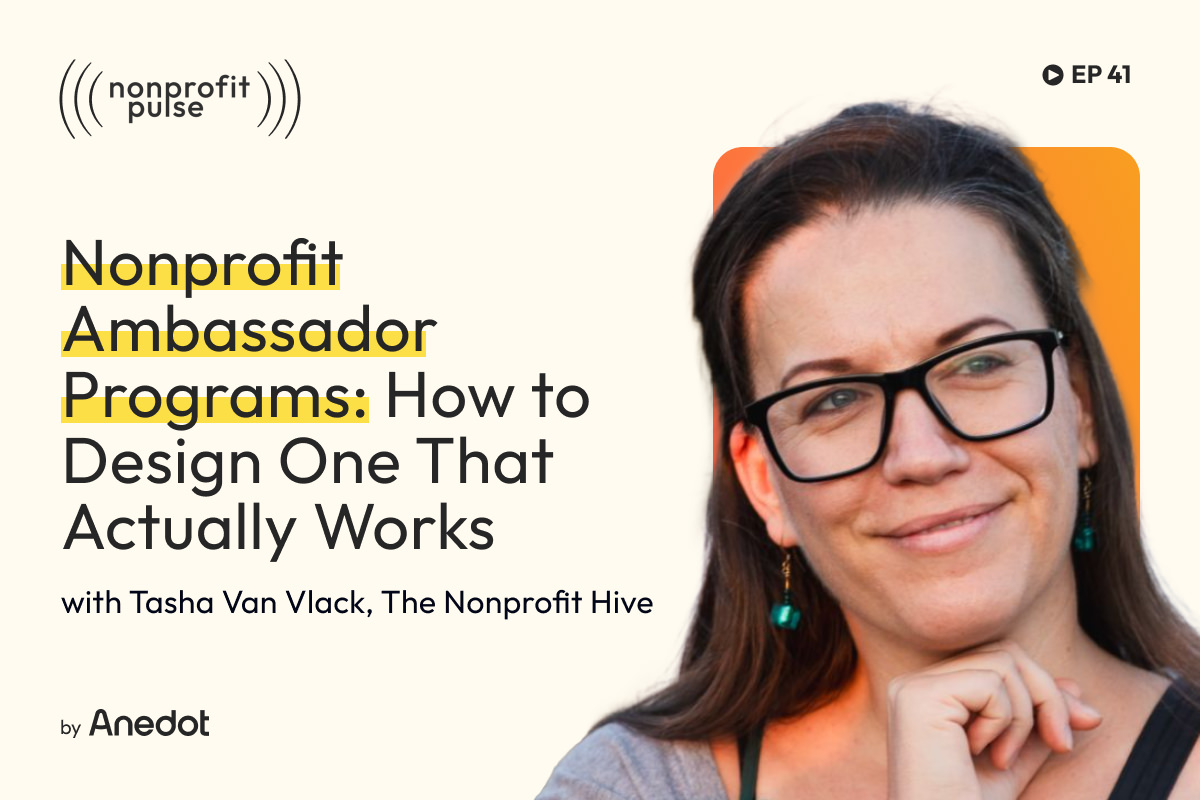
In this episode, we're joined by Tasha Van Vlack on the topic of how to design ambassador programs that actually work.
Tasha is the founder and co-director of the The Nonprofit Hive, a global peer community that helps nonprofit professionals build meaningful connections through 1 to 1 conversations and shared learning.
She’s passionate about community building, organic growth, and helping organizations create stronger relationships around their mission.
Hi Tasha, thanks for joining us on Nonprofit Pulse.
Tasha:
Hi Josh, thanks so much for having me.
Why so many nonprofit ambassador programs fail and what’s really going wrong

Josh:
Yeah, I've been trying to get you on the podcast for at least a year. I think maybe a year and a half.
So excited to have you on. Excited for what you're doing over at Nonprofit Hive.
But, yeah, just a great topic today.
We're talking about designing ambassador programs that actually work and, nonprofit ambassador programs, they sound great in theory, but often fall flat in practice.
So maybe first, just defining terms here, what do we mean when we say an ambassador program and what are the most common reasons they typically fail?
Tasha:
Absolutely. I love that you reached out about this topic in particular, because it's one that I keep throwing around in my head trying to figure out what it means.
And defining it is really cool because it’s one of the parts that have been working for us at The Nonprofit Hive, and so came up and a formal way to engage your most aligned supporters and helping spread the word, welcome others in, and deepen trust around your mission was when I tried to roll it all into something coherent.
Josh:
Love that.
And for many folks listening, this may be the first time you've ever heard it defined. You may have seen others.
You have one. Or you've been in an organization that had one.
But maybe it was a very loose definition. So that's super helpful.
Thinking through why they often fail. What would you say to our audience on that?
Tasha:
Absolutely. I think one of the biggest things that we make a mistake on when we use the word ambassador, sometimes there's other better words to use too.
So don't feel like you have to be locked in to say ambassador, if that doesn't fit with the vibe of your nonprofit. Don't go there if you don't want to.
But it's the trust part. That little piece on the end that I added on, where it's like your ambassadors should be deepening trust.
I think we often forget that that should be one of the ultimate goals, because your ambassadors act very much as a part of your marketing engine.
I love marketing. Marketing is my jam. I love talking about nonprofit marketing, but we treat ambassadors like they should be a marketing tactic.
And it kind of lessens the trust factor, right? We're not going, hey, we have ambassadors.
It's a community strategy. We're looking at it as a way to get out there, to have more people care about us.
We're looking at ambassadors and going, ooh, brand awareness folks, right? And building that which they may do that, but I don't know that that should be the ultimate goal.
One of the other big things, and it's really hard, is that we're often choosing the wrong people for the wrong reasons. It's great.
Maybe your nonprofit has someone who's kind of an influencer, who's paying attention to what you're doing, but that person's motivations may be entirely different than that person you've got who's just like in on everything.
And they talk about your organization in a way that feels really good to your team.
So that was another thing I’ve come up with when I was thinking about it.
And the last thing is often the structure of what does it mean to be an ambassador is just not clearly defined.
We do a really not a great job in nonprofit of going, hey, this is what it's going to look like.
Here are the guardrails around it. And we just kind of expect our ambassadors to do that, like work for us.
And they're not paid to do this. So it's really on your nonprofit to figure that out.
When ambassador programs get too transactional and how that kills long term success

Josh:
Yeah, that's a great segue into the next question I have, because I think a lot of nonprofits, when they launch something new, they're hesitant to define it very rigidly because of the nature of nonprofit work, the nature of people who are doing things for the organization without being paid.
They don't want to box them in or have them do something that they may feel uncomfortable with.
And so a lot of times, without defining things and setting boundaries, they say, oh, we'll just get Jill to do it.
And Jill, she'll figure it out. She'll be a great ambassador. And then Jill, just, maybe you don't know this side of Jill or who Jill is, but Jill can be very transactional and not very relational.
And so that's the second question I want to ask you is, you've mentioned before about ambassador programs being too transactional.
What does that look like in practice and how does it undermine long term program success?
Tasha:
Absolutely.
I don't know if you've been part of a LinkedIn pod group where you share your LinkedIn posts and everybody like comments and bumps them up. It was really, really hot for sure a year ago.
I think there's still some of them kicking around, but I feel like a lot of nonprofits kind of use ambassador programs like that.
Hey, we're going to have this side channel in Slack or an email chain, and we, the nonprofit, are going to put things we want you to share and post and promote in there.
And the ambassador becomes a distribution channel. And it's kind of better than paying for paid advertising. It feels organic, but it also is very extractive, right.
Like, why do people want to do that for that long? And it's not like an LinkedIn Pod where in theory I am posting about community building.
And my friend that's in there is posting about nonprofit building strategies and things like that. And we're pumping each other up.
It's just too often I think ambassador programs is just so one way, audience only.
And, kind of sometimes how we treat donors too, right? Like, donors want to be a part of something and feel like there's a relationship there, right?
We're not building for a long term belonging for our ambassadors. We're just hoping they're going to output for us.
→ Learn how leaders can approach nonprofit mergers thoughtfully, navigate the challenges involved, and decide when joining forces can actually strengthen their mission, with Debra Hertz from The Strategy Group!
Clarifying the true purpose of your nonprofit ambassador program before you recruit\

Josh:
So how should nonprofits think about the purpose of an ambassador program, really, before they ever recruit their first ambassador?
You gave a great definition, earlier, but maybe organizations might want to define it more aligned with their culture specifically or their community and those community needs.
What would you say to that?
Tasha:
We started our own ambassador program at The Nonprofit Hive at the beginning of 2025, because we're on our second cohort of ambassadors right now.
When we even started thinking about it, talking about it, we had some of our members actually go, how can I help?
And people were constantly going, how can we help? How can we help?
Those folks that kept showing up again and again, I was like, oh, you're being amazing. You're helping so much. How do we give something back to you?
But the real question, I think has to start with, like, why does this exist?
Are we using it for awareness? Are we using it for fundraising? Is it advocacy leadership? Are we looking to build trust?
And you can't have your ambassadors or the program that you're building, you can't do all of those things, right.
Maybe you can pick off two things.
Hey, we're building trust and advocacy, but you then shouldn't rely on those people to also help you build your fundraising or awareness of fundraising campaigns.
I think it's just too much to hold in one program with one group.
I know when we were talking a little bit before we got started, volunteers often have very specific roles, different things that volunteers are doing.
I think you need to think of your ambassadors very similarly. What's their purpose and what's their role?
And it can't be vague, so that they know also, hey, I'm meant to jump in here and that they can decide how they help out right?
Not hey, the strategy is you're helping with absolutely everything.
What a well structured ambassador program includes and the components that actually work

Josh:
Yeah, I want to get into kind of the nitty gritty of a well structured ambassador program and what that looks like.
So what would you tell our audience about the key components that separate effective programs from those kind of loose volunteer groups that leaders might say, oh, yeah, Bob's an ambassador.
And then other staff are like, Bob's not in our ambassador program.
What would you say to our audience about that?
Tasha:
Yeah. So number one, clear purpose.
And it has to be something that everyone on your nonprofit team, even if you're a small group or maybe you have a larger marketing team, everyone on your marketing team should be able to go, the ambassador program is this. And its purpose is absolutely so clear.
I think defining the role, even something we did with our Hive program was we had a one pager, and when we went out inviting people to be ambassadors, we were like, this is exactly what it is.
This is the expectations of the role at a minimum. And this is also what it could be if you want to dive in this far.
But there's no expectations to go to this level. But it could look like this for you.
And so we wrote it all out very, very clearly. We started with support materials and a toolkit because people are busy, people are exhausted.
This is a largely still volunteer role as an ambassador. I don't really know of ambassador programs that are paid.
Mine are definitely people who are volunteering their time and energy. So they may decide to talk about me and our community in their own fashion.
But if they don't, what do I have for them? What do I have for them that makes it just an easy, hey, can you post about us once a month? Or invite people in once a month?
They've got something that says, this is what you can say if you don't have an idea of your own of what you'd like to say.
Another big challenge and something I think kind of started to allude to in the beginning for mistakes, and you even said it, who's the owner on the nonprofit end of the ambassador program?
Because if you're just giving it and saying, oh, hey, this month Tasha's dealing with it, and next month Josh is on it and Joseph's on it next month.
That's not great for your ambassadors either, because who do they talk to should something come up and arise and they're not sure who that person is.
And I think that gets really confusing.
So in the same way that you probably have someone who is doing volunteer engagement and is that person on your team, you need somebody and maybe that's the same person, but you should have an internal owner and define that early.
And choose structure that's sustainable. I think there's lots of people who will ramp up over time, and it gets bigger over time.
But in months one, don't ask people like to shoot for the moon and you’ve set expectations they can never reach.
And that makes people feel discouraged when they can't meet what you're hoping they're going to do.
Josh:
Yeah, and I love you mentioning about having a leader because I think that's super important for kind of a leadership pipeline, too.
That you may start out with a staffed leader of your ambassador program, but that may change in the future to where you've got somebody who's been an ambassador for three years walking closely with that staff leader of the ambassador program, who can then lead that from a more volunteer, unpaid perspective?
I love that, like clearly defining this is who the leader is.
This is the leader's responsibility. And then holding that person accountable, that's super important.
Tasha:
And I think one thing I didn't get into, and I don't know how I could miss this, but that circle, whoever your ambassador group is, they should have their own feelings of belonging that are going to probably be different than your donors and your volunteers and your internal staff.
What is the rally cry for those people to feel like they belong in a part of something, and that's on that leader, internal leader to initially create the environment for that.
Because I think just the stickiness, we talk in marketing about stickiness, but like this is the thing how do we get people who are like the enthusiasm is maintained and it's usually because they feel like they belong somewhere.
→ Discover practical strategies nonprofit leaders can use to move beyond one-time fundraising events, run high-impact $10K+ sprint campaigns, and build sustainable donor engagement, with Christina Edwards from Splendid Consulting!
Designing an ambassador program that reflects your values not just your marketing goals

Josh:
Yeah. And this is related to our next question.
But the culture side of it, that person needs to be somebody who exudes your culture. Who when people think of the best parts of your mission, of your organization, they think of that person.
That's just so important because if you have someone who's maybe on their way out or has always kind of there's been some issues with mission alignment.
I think that's a recipe for disaster if you're trying to reproduce that cultural alignment.
So that's my next question for you is around culture, and cultural alignment.
How do you design an ambassador program that's really truly aligned with the organization's values and culture and not just its marketing goals, as you mentioned earlier, like, your marketing person may not be the best person to lead your ambassador program, even though operationally it makes sense right?
Tasha:
Absolutely. And I don't think you can measure your ambassador program in the exact same way you can look at your marketing goals with this clear thread.
You've made a beautiful Google ad set and you follow the people along the journey. It's not going to be as clear as that. And that's okay.
→ Learn how nonprofits can expand their impact by using Google Ad Grants and search marketing strategies
That's actually the beauty of an ambassador program is because it's that trust building, you're building trust over time.
So it can actually be really complementary to your marketing goals, but it shouldn't be a marketing goal.
I always use the word vibe a lot. It's a little bit of a messy word. But, how are people feeling when they're part of this, right?
Not just what are they doing, but how are they feeling when they're here in the room together.
We meet up monthly with our ambassadors all together in a group conversation. And they know it's the second Wednesday of every month at exactly the same time, so they can put it in their calendar for 12 months.
We're going to do that exact same time schedule for 12 months. This is when we meet up.
But there's also like we have our WhatsApp with multiple channels and we're engaging over LinkedIn.
And so we try to find those different places. And so we're designing how we want them to feel right? Like there's a design to the ambassador piece that is worth thinking through.
How are we going to create this continued momentum instead of just showing up once a month and going hi here we all are right?
The other big thing and I know this is scary for a lot of nonprofits and I think from what I'm gathering, this is why a lot of them are not dipping their toes into ambassador programs is they want to control it too much.
What are people going to say? Where are they going to post it? How are they going to say it?
That's not what an ambassador program is going to be.
It's guidance, but it's not control. You need to trust that you've chosen the right people who are going to represent you.
And that's why I don't think, I'm not sure that ambassador programs where the people opt in to being ambassadors are as powerful as ones where you choose who are part of your ambassador programs, right?
Like you go, you recognize those people, you start to go that’s the person. And they're doing this and I love how they're talking about us. Those are your ambassadors, right?
Because you already kind of see how they are out in the world.
And then, we're a global community. We have members from 90 countries, even though we are very heavily weighted to North America.
We needed to have ambassadors represent the the whole range of people in our community right? And that meant we had to find people whose human experience mattered.
So, we don't have a macro influencer from LinkedIn, but we have people who are known in their ecosystems for being amazing. And that was kind of the point, right?
Like, they're not the same. They're all coming at it from a different angle. And they bring that to the conversation. And it makes us so much more powerful for it.
Turning ambassadors into leaders who shape community and influence
Josh:
Yeah, and I want to dig deeper into the influence and leadership side of an ambassador program and ambassadors.
What role do you see ambassadors playing in that extended leadership in the community and really not just promoting the organization, but shaping community and influence? How do you see that?
Tasha:
Yeah. Oh my goodness, it’s such a great question because, and anybody who's listening go and find our list of ambassadors.
We have them on our website. Go and follow these humans. They are phenomenal.
Like I proudly stand next to any of these people, same for our folks from last year. They were just incredible.
And so they're not just promoters, but they're really like carrying the culture of what The Nonprofit Hive is into the world. And they're influencing the culture at the same time.
Like, I'm looking to them to go, this is not being created just in my image. This is being created in like the communities image. And these are the people who carry the community.
So and I think nonprofits, we're all also busy. Things are crazy. It's a huge job and role and teams are small. These are people who can help you figure out how you want to be looked at.
If you let them have that role. So, also our ambassadors are amazing for showcasing how we are welcomed into being a part of the larger ecosystem.
They connect for us, they model our values and they really just like they're not just amplifying but they're sharing influence.
So I feel so thankful, just this week ended up in a conversation where one of our ambassadors was going, hey, do you know Brad? No, I don't know Brad.
And he's like, let me get in conversation with Brad.
Brad's been someone I've been following for a long time, just never reached out, wasn't sure if Brad be interested, and all of a sudden because Gord going to shout him out and Gord goes, hey, you should meet Brad.
I get in a conversation that I don't know that I would have been in the room without Gord's influence getting me in that room.
So that's what your ambassadors can be if you let them make those connections for you.
→ Discover practical approaches nonprofit leaders can use to prioritize mental well-being, recognize burnout, and build sustainable leadership practices, with Dacia Moore from Second Wind Counseling and Consulting!
Scaling ambassador programs without burning out your most passionate supporters

Josh:
So thinking about burnout, which is a huge topic this year in kind of nonprofit content, I'm seeing more and more, videos, articles, reports, etc. on burnout.
And it's a real issue that's hitting volunteer driven programs. And, by extension, ambassador programs.
So how can nonprofits scale an ambassador program without overloading their most passionate supporters?
Tasha:
We just said earlier that we shouldn't tie this to marketing goals, but I'm going to rewind what I said a moment ago and just kind of narrow that in, because if what you're hoping is that your ambassadors are going to maybe post once a week or hey, we're hoping that we're going to get three really cool referrals from this group a month.
If you think that that's going to be really hard with 12 people, then maybe consider 18 people, right?
And so don't actually change the expectations of the group, but open the doors more so that more people can carry the load that you're hoping they might do.
So instead, just scale up the number of wonderful humans in that group.
And bring in more people to help with what you're hoping the the ambassador program might accomplish.
Again, clear boundaries are key.
If you say, this is what the ambassador program is that is beholden on your team to stick to that, don't all of a sudden turn around and go, our capital campaign is really failing.
Could you somehow find us this money? And they were never supposed to be involved in fundraising. That is unfair.
These are the people who are probably going to try to help you, which is not their job. Like that's not what you ask them for.
So I think, again, maybe does this mean running multiple ambassador cohorts who are around and maybe that's the key if you have capacity on your team to support them.
Sometimes with ambassador programs, we have to remember that we're building rhythm.
Just even seeing this we are a month into our 2026/2027 cohort, started in February for this new ambassador group.
And two people we had stay from last year's cohort just to kind of help ease like expectations. And they both asked to stay on.
Our 2025/2026 group, phenomenal humans. They all got exceptionally more busy. It was actually great that they were connected to us.
They were seeing new opportunities because they'd been part of what we were doing. And so it was only fair to also go, has it been phenomenal?
Thank you for your year, which is what we asked for. And now please let me continue to support you.
But you are not under the obligation the same way.
So it's hard because instead of continuing to ask for more and more, it was like, hey, with flexibility, we still will love if you talk about us and that you want to and are inspired to, but the obligation is now over and you can set it down and that's okay right?
Josh:
Yeah, I love that. And being forward about caring for your people and telling them it's okay to step away.
One thing I was thinking about while you're talking is just how an ambassador program really could be one tool among many where you have volunteers who may be burning out.
Maybe they've done this for a season that's too long.
I don't want to say a certain amount of months because depending on what you're doing, it may be only days of doing that, that where you get burned out and you're in a bad place.
But an ambassador program could be a great tool to allow people to step away from rigorous volunteering into something where they still have the heart, they still have the influence.
They may even still have the time. But they can't show up to, for a food pantry example, they can't show up, three times a week to pack bags or boxes, but they still want to be involved.
It could be a great way to keep those folks plugged in. Instead of saying, yeah, I no longer do anything with my local food pantry.
They could say I'm now an ambassador after serving for three years as a volunteer faithfully.
I'm now an ambassador. I'm enjoying this season. And, really just leaning into them and encouraging them during that season.
Tasha:
And there needs to be different tracks, right?
Sometimes it's due to personality. Different personalities are going to be like, I want Harden over here.
We actually are very, very fortunate that our ambassadors have sometimes led our LinkedIn lives.
Most of them have participated as members as part of our LinkedIn live series, where we get professionals who are in house to talk about certain subjects.
We've also had a couple people be like, no, under no circumstances do I want to do that, even though I think they'd be amazing.
They don't want to. That's not my choice. I don't get to make that decision.
So different tracks. And a perfect example is maybe your nonprofit really loves TikTok and you want to grow your TikTok and you've got somebody who was like, I don't even want to download TikTok.
Nonetheless, get involved in posting on TikTok. What can you do that like, but this is somebody who maybe actually has some influence at your local chamber of commerce.
They're deeply involved in the community right? Like we have to be able to be flexible for how people want to engage.
And that, I think, tends to prevent burnout when we don't say, this is the only way you can do this and that they may try to do it because they care about the organization, right?
Like they may try to meet that. And really you're like, I shouldn't have asked them to do this. This was clearly not their comfort zone.
Building a sense of belonging so ambassadors feel like insiders not just helpers

Josh:
So thinking about belonging and that should be part of every nonprofit's culture is how do we make people or how do we help people feel like they belong here?
What are some practical ways that you would advise our listeners that they can build a strong sense of belonging and identity among ambassadors so that they feel like insiders and not just helpers.
Tasha:
Yeah. For me, belonging is built in small, consistent things.
And when I talk about just even how I do my relational marketing when we're talking about the nonprofit space and Nonprofit Hive in particular, it's the consistency that I think leaves people feeling they're part of something real.
And so that looks like regular updates for us. It's group chats. It's meet ups.
It’s sometimes insider access to go I have a couple free tickets to a nonprofit conference, does anybody of this group that's putting more time and energy into what we're building, would you like this?
And we're just about to launch starting April 1st, every Sunday, we're going to recognize over social media those 12 ambassadors and highlight their mission, what they're doing out in the sector because they're doing that.
That's incredible right? And I know there's a fine line obviously with and everyone's always a little concerned about putting in a hero complex.
There's a lot in storytelling talking about this. But I think recognition matters.
And if they're recognizing us, like, what can we do back for our ambassadors?
Obviously we're running a professional network. There's professional networking as part of The Nonprofit Hive because everyone's in social impact.
I also went around and gave, LinkedIn recommendations to all of our ambassadors from last year, because it took me a couple hours because I wanted it to be meaningful.
But that matters, right? Like those individuals put in time and energy and gave of themselves to us.
And we always invite all of our ambassadors, if this is a role that you will influence anything for you professionally, put it on your LinkedIn.
Like take advantage of this. We are absolutely trying to make sure that this comes off as just as much of a win for them as it is for us.
Josh:
I love that and that cost nothing to do, to give them a LinkedIn recommendation.
But it sounds like maybe nonprofits should also budget for this as well, right?
Budget for a once a quarter offsite or a once a year ambassador recognition dinner or depending on the size of your program, of course.
But that just came to my mind as you were talking is like, make sure you have some type of budget there to do something.
Tasha:
Yeah, yeah. I mean, we're a very small grassroots organization.
We're still figuring out our sustainability model. Anybody who comes on a LinkedIn live gets a lovely little thank you mug.
And it's not that’s not an expense for us, but it's a very easy like oh my goodness, you guys gave an hour of your time talking about all of these cool things. We just had one about startups.
Can't wait to send those. And we've sent them to India like I’ve sent them as far away as members in India to just be like, thank you so much for your time and energy here, because it mattered and it made a difference.
I think if we always think it has to be big, and I think that sometimes scares nonprofits where they think, oh, it's going to have to be really big.
And, what do we as a nonprofit have to offer? You have lots to offer. You have lots to offer individuals.
But I think it is unrealistic to think that people who you have as the expectations go up, I think it's fair to say that people will start going, okay, how is this a reciprocal relationship?
And at some point, maybe not, there's going to be always those people who just kind of do things and you aren't even sure why they keep on just jumping into that next level.
I do think it's worthy of your time to try to figure out how you can honor what those individuals are doing for your organization.
→ Learn how to improve donor retention, build lasting loyalty, and re-engage supporters with James Misner from The Kipos Group!
First steps for building an ambassador program that works and lasts

Josh:
So, Tasha, thinking about our audience who may be wanting to take a first step, an initial step, towards an ambassador program, starting from scratch, what are the first, let's say, 2 to 3 steps that they should take to build an ambassador program that is actually poised for success and not failure?
Tasha:
Great question. And I know this is always the tricky one.
So for our Nonprofit Hive community, we very much, we've actually built a platform to manage our 1 to 1 connections.
And so I can, A, see who is taking the most conversations in the last eight months or six months.
That's kind of my first line that I kind of go in and go, oh, hey, who's really involved? Who's really engaged in the last how long?
What's interesting, and I think really challenging for a lot of nonprofits is if you're only running in person or webinars or, you're looking just at sheer donation numbers, those may not be your natural champions, like, right?
Because someone who engages heavily in a webinar speaks up really loud. I'll raise my hand.
I'm that person who speaks up really loud. I'm also someone who's incredibly busy, but I'm just comfortable using my voice in rooms.
That may or may not be your natural champion, because they might already have a whole bunch of obligations and things they're involved in, because they say yes to a lot of things. I am that person.
I say yes to a lot of things. So I may not be the champion you're looking for.
But in our one to ones, those quieter voices that maybe don't speak up as often started to flow to the surface because they had taken 50 conversations in the last 12 months.
And you kind of are going, so you have to, I think, be willing to look at different metrics.
Who is the person who quietly engages on all of your social media?
If what you're wanting is ambassadors who help bump your social media, which is a totally fair thing, well, then you should be looking at who's always engaging with your social media, right?
Like don't use some outside influencer who engaged one time and disappeared and you're like, well, I don't even know if they like us, but they engaged one time.
No, choose those champions who are already kind of doing the work and make it more formalized, because they're only going to double down on how they were already supporting you because of that level of recognition.
I would talk to them before you build anything, right. Like those people, as you identify those natural champions, what are they interested in doing to help you out?
And if basically you identify 12 people and you reach out and only four of them are interested, maybe your idea of what this program is and theirs is too far apart, and you should be rethinking your expectations.
Or maybe they're going to say, hey, I just need a kit and I would do X, Y, and Z for you way more often.
Or hey, you want to be introduced to someone once a month? Hey, I've got these introductions for you.
I think it just needs to maybe match your marketing a little bit or what you're hoping they're going to do to support the marketing. And start really small.
You know, I don't think it needs to be, we built out a program for the last three months and now finally launched it.
What could you do that would be small to start and make it feel like a pilot and then launch it and learn and refine it again.
And what we're doing this year and what we realized worked really well, has been and critical. And we also threw out a few things from last year where we were like, this is way too intensive.
We shouldn't have done this. This was unfair.
Josh:
It sounds like you're saying, just get started, figure out who the resources you have, what you want to accomplish, how your culture goes into that, and can expand out into the community through those folks in that program and get started and hold everything loosely, because iteration will serve you.
I'm just thinking about even my wife, who is involved with a nonprofit that we were involved with up in Indiana, and then found out that they were just getting involved in Austin, Texas, five years after we had left Indiana.
And she's been involved every year. And I think about she's not an official ambassador, but she may as well be, because she wears the bracelet and wears the shirts and goes out in community and goes to, she's a social butterfly.
So everywhere she's going, she's often rocking the swag from this organization.
It's amazing the conversations she's been able to have and say, oh, yeah, they just built a new house for foster kids up in Georgetown or in Hutto, just north of Austin here.
And then people start saying, oh, I heard about that. Or, oh, I've been looking for an organization that does special things for foster kids or orphans or whatever.
It's just a natural extension of someone's life when you're an ambassador or a champion for organization.
And organizations just need to define like, what does that look like? Is it for social media and or in media in general?
Is it, we're trying to, have more people involved with our local government know about us, support us, think about us when a grant comes in, right?
Well, then you need to connect with Sally, who's super involved with rotary, and her husband is on the city council, and she loves your organization.
So just think strategically about what you're trying to accomplish and have it time bound, like you mentioned. Like, what is this? Is it three months? Is it six months? Is it a year?
That you're trying to kind of hit these areas with your mission. So I love this. I hope organizations will take a first step, will get interested in this.
And look, if you've tried this and failed, do it again. That's one of the hardest things I feel like for nonprofits is, we did this 12 years ago, and it was a calamity.
It's like, okay, well, that was 12 years ago. Let's have another go at it.
Tasha:
That was 12 years ago, and you know this intimately.
Like, marketing is changing rapidly and trust referrals, that's going to matter more and more.
So you know, as much as I go out there and I talk about The Nonprofit Hive and anybody who knows me, you're probably sick of hearing about The Nonprofit Hive from me. I talk about it way too much.
But maybe you haven't heard our ambassador Amina, talk about it in her words. And you haven't heard Shafkat talk about it in his words and Anna and all these individuals, and they talk about it differently than me because they're getting different value out of it.
And, I mean, ultimately, I'm the founder and like chief cheerleader. So everyone kind of takes it with a grain of salt.Tasha says it's amazing.
Can we believe her right? Because she obviously has a vested interest.
But your ambassadors are there for different reasons, and they're going to be able to hit different areas of your community if you build with them, like build with them and let them help guide what the ambassador program is too. It's such a power move.
You are creating something powerful within your organization by enabling these people.
Closing thoughts

Josh:
Absolutely. Tasha, any resources you'd like to, suggest our audience?
Tasha:
Oh my goodness, there's so much, so many good resources out there.
There's a really cool I don't know if anybody has encountered the Othering and Belonging Institute, John Powell’s group, talking about belonging and things like that.
There's lots of books about rituals, and I think peer connections are really important.
I don't know if I mentioned this, but your ambassadors should be connected to each other and you should step away and go get to know each other.
Like, don't be like the gatekeeper in that community. I probably didn't say that.
The Nonprofit Hive. Great place to come and meet some people who have been doing this in our community.
But people have taken like over a 100 one to ones in the last two and a half years, which is bonkers. And like, I just feel so thankful for them.
And then, Community-Centric Fundraising movement is also a really good place to kind of see what it looks like to fundraise in more of a community setting.
So they've also got some great resources, but I think most of us already know what we should be doing. It's a little scary to pull the trigger on and on it to be honest.
Josh:
Our last question of every episode, it’s my favorite question.
If you're standing on stage in front of a thousand nonprofit leaders and can share one thing with them, one sentence about today's topic, which is ambassador programs, what would you say Tasha?
Tasha:
Oh my goodness, I had to think this through and I came with like multiple ideas.
If people only experience your organization when you need something from them, you do not have a community yet, you have transactions. When you're thinking about ambassadors, these are people who are not going to make it feel like a transaction, and they're going to be the ones who help establish it as a community.
Josh:
I love that, I love that.
Tasha, this has been such a great conversation on ambassador programs. I've learned so much. I hope our audience has as well.
And more importantly, I hope our audience takes a first step and starting their own ambassador program, and reaching out to others.
Reach out to Tasha. You can find her information on the show notes at Nonprofitpulse.com.
You can also subscribe to our newsletter there as well. But all of Tasha's links and resources will be posted there in the show notes. Tasha, thanks so much for joining us. And, let's do it again soon.
Tasha:
Absolutely. Thanks so much, Josh.
Josh:
Hey, thanks for listening.
If you enjoyed this conversation, please share or leave us a rating and review wherever you listen to podcasts.
Also, head on over to Nonprofitpulse.com to sign up for our monthly newsletter, as well as check out all the links and resources in the show notes. We’ll see you next time.
Frequently Asked Questions
What is a nonprofit ambassador program?
A nonprofit ambassador program is a formal way to engage highly aligned supporters in spreading the word, welcoming others, and deepening trust around a mission. In the episode, it is framed as a community strategy rather than an unpaid marketing channel. Ambassadors need a defined role and a sense of belonging within the group.
How do you design a nonprofit ambassador program?
Design a nonprofit ambassador program by first choosing a specific purpose, such as trust-building, advocacy, awareness, fundraising, or leadership. Identify people who already show real alignment, ask what kind of support they want to offer, and put the role and its boundaries in writing. Start with a small pilot, learn from it, and refine the program instead of trying to build everything at once.
What should a nonprofit ambassador program structure include?
A nonprofit ambassador program structure should include a clear purpose, a written role description, support materials, and one named staff owner. The episode recommends a one-page overview that explains the minimum expectations and optional ways to go further. The structure also needs a sustainable rhythm so ambassadors know who to contact and what participation looks like.
How should nonprofits choose ambassadors?
Nonprofits should choose ambassadors by looking for people who already engage consistently and represent the culture well, not simply people with a large audience. The episode suggests looking beyond obvious measures such as donation totals or who speaks most loudly in a webinar. Natural champions may be the quieter people who repeatedly participate, engage on social media, or make meaningful connections.
How can social media ambassadors for nonprofits help without becoming a post-sharing group?
Social media ambassadors for nonprofits can help best when the organization gives them easy-to-use materials and lets them communicate in their own voice. A toolkit can make a monthly post or invitation easy, but the relationship should not become a one-way request to distribute content. The episode's guidance is to offer direction without trying to control every message or channel.
How do nonprofits prevent ambassador burnout?
Nonprofits can prevent ambassador burnout by keeping expectations realistic, honoring the original role, and giving people choices about how they participate. If the program needs more capacity, the episode recommends adding people instead of increasing the load on the same small group. Time-bound cohorts and a clear option to step back also keep an ambassador role from becoming an open-ended obligation.
What nonprofit ambassador program examples does this episode offer?
This episode offers illustrative nonprofit ambassador program scenarios, not a catalogue of case studies. The Nonprofit Hive's own program uses cohorts, written expectations, a toolkit, regular group conversations, and recognition, while the discussion also imagines a food pantry supporter who shifts from hands-on volunteering into an ambassador role. Another scenario matches a supporter to a channel that fits them, such as local chamber connections instead of TikTok.
80 Community Service Ideas for Nonprofits