The short version: AI won't fix a confused organization. It will scale the confusion. Stewart Severino, Head of Digital Ministry and Innovation at The Navigators, says nonprofits need strong human intelligence before they add AI: clear priorities, shared definitions of success, clean data, and clear decision rights. He shares the early warning signs, what went wrong when one organization automated too soon, and a 90-day plan to follow before you approve any new AI initiative.
Key takeaways
- Fix the human layer before you add AI. Stewart calls AI an amplifier, not an editor. If teams lack clear priorities, shared definitions of success, connected data, and clear decision rights, AI produces more content and activity without better decisions.
- Watch for the early warning signs. People can't say what problem you're solving, what outcomes you want, or who owns the decision. Knowledge lives in one person's head, and meetings keep reopening the same decisions.
- Don't automate what you can't explain. If a process can't be explained without AI in the middle of it, Stewart says it probably shouldn't be automated with AI.
- Treat innovation as a discipline. Instead of asking what a new tool can do, start with the problem you're trying to solve and the core need of the people you serve, not their felt needs or demographics.
- Build human intelligence at every level. Stewart describes it as an organization's ability to discern, decide, coordinate, learn, and stay accountable to the mission, across strategy, teams, and governance.
- Define the journey before you automate it. In one composite example, automated donor follow-up sent inconsistent and duplicate messages because teams had no shared definition of an engaged person. It took about six months of defining the journey, cleaning up data, and clarifying ownership before automation helped.
- Separate the essence of your mission from its expressions. At The Navigators, life-to-life disciple making doesn't change. The methods, platforms, and structures that support it can evolve.
- Slow down consequences, not learning. Keep learning from conferences, peers, and newsletters. Then test one contained workflow for 60 to 90 days with a baseline, data boundaries, and a human decision maker.
- Don't confuse productivity with impact. Twice as many emails or reports doesn't matter if they don't lead to a meaningful outcome. AI output also isn't objective, and it doesn't carry fiduciary responsibility or spiritual discernment.
- Use a 90-day plan. Map the work in the first 30 days, design one high-value, low-risk pilot in the next 30, then run it, meet weekly, and decide to scale, revise, or sunset it.
- Be ready to show the return on AI. Stewart expects finance teams and boards to start asking what AI spending contributes to the mission. He built an AI ROI calculator to help organizations answer that question.
- His one-sentence takeaway: If you don't have your human intelligence layer operating in a way that is repeatable, that is transferable, then your AI layer is only going to amplify that brokenness and there's going to be consequences.
Guest: Stewart Severino, Head of Digital Ministry and Innovation, The Navigators | LinkedIn
Podcast episode transcript ↓
Josh:
AI won’t fix a confused organization. It will scale the confusion. That’s because AI is an amplifier, not an editor. It speeds up whatever already exists.
If your team can’t agree on the problem you’re solving, who owns the decision, or what success looks like, AI won’t settle it.
It will just produce more content, more analysis, and more activity, without better decisions. So how do you strengthen the human side of your organization first, so AI actually serves your mission?
I’m Josh with Anedot and welcome to Nonprofit Pulse, where we explore trends, insights, and resources that help nonprofits accomplish their mission.
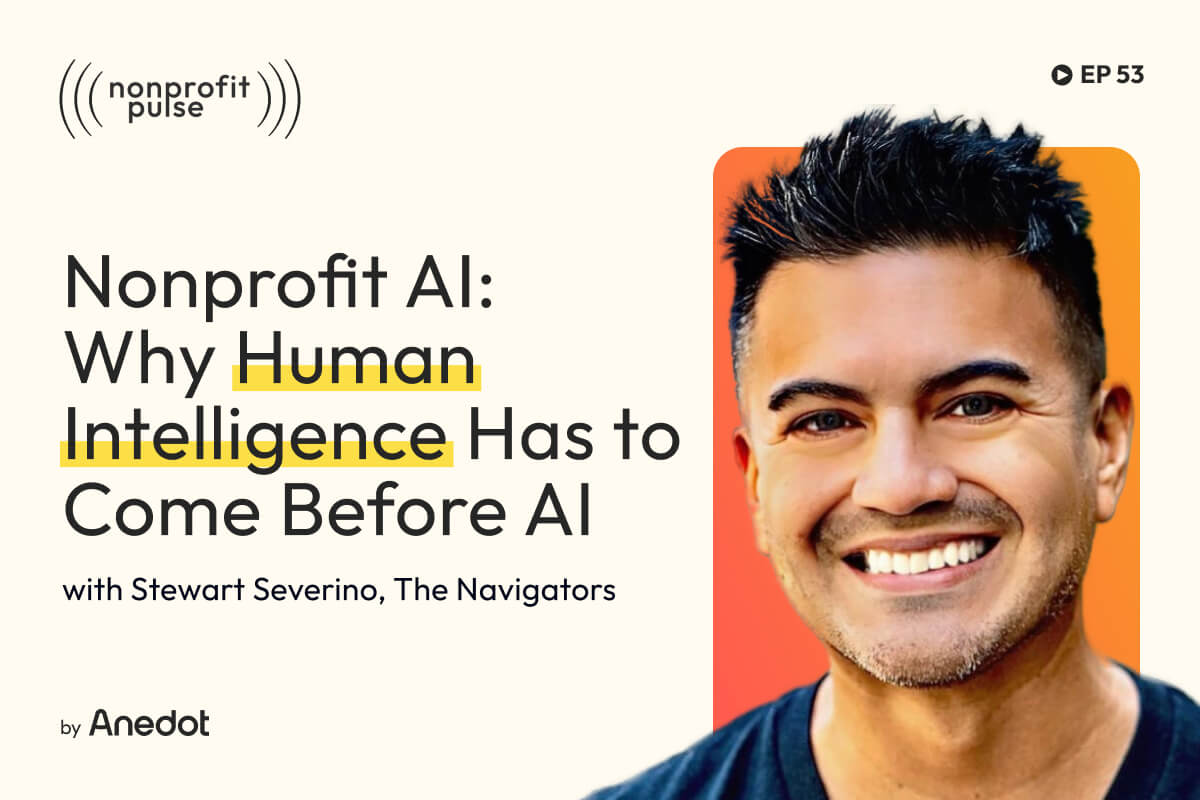
On this episode, we’re joined by Stewart Severino on why human intelligence has to come before AI.
Stewart is the head of Digital Ministry and Innovation at The Navigators, where he architects cross-functional initiatives to scale both digital and in-person impact.
Over a 25-year career spanning corporate marketing, nonprofit leadership, private equity backed startups, and innovation strategy, he has built strategic frameworks that deliver scalable impact.
Josh:
Hey, Stewart, thanks for joining us on Nonprofit Pulse.
Stewart:
Hey, Josh, how's it going?
Why AI amplifies weak human intelligence

Josh:
Welcome back. Welcome back. So love our topic today. Today we're talking about why human intelligence has to come before AI or artificial intelligence.
Stewart you said if human intelligence is weak AI just amplifies that weakness. How did you first come to that conclusion in your work with ministries and nonprofits?
Stewart:
Yeah, I think that's a term that's finally making its way around LinkedIn and social media and all the conferences. And that's a great thing.
So it's happening more and more. So I'm thankful about that. But it's really I keep seeing this investment toward new technology, automation, data systems.
And there's like a, I don't know like a hope that goes into those investments obviously, right? But the hope is that these tools will solve deeper operational issues.
But underneath all that technology, people still don't have consensus around what the problem is that they're trying to solve.
You have an idea of what the problem is. You're an organization, you're there to solve those problems.
But when it comes to consensus between marketing and technology and PR and your operations department and your insurance departments, risk departments, when you ask those leaders what problem are they looking to solve, they give you very different answers.
And so when they buy software infrastructure systems, like I said, data systems, there's a hope there that those things are just going to help the entire organization just go streamline.
And so, if you don't have those things figured out, you're just going to amplify a lot of the weakness that already exists. So, I'll just name a few, I guess.
Yeah. Teams have unclear priorities, right? Again, there's no consensus or very rarely do they have consensus on what the issues are for their clients or their customer.
There's competing definitions of success, right? There's not that one core. Sure, you have your mission, your vision.
But when it comes to establishing data, analytics, there's a couple varying differences between what their agreed upon goals are. Data is fragmented.
There's no clarity about who has decision making authority. So decision matrixes are often lacking. So I see a lot of that happening.
It's like man I hate to call it human intelligence, but really collectively when you introduce AI into an environment where that kind of division or confusion sets in, it doesn't correct any of those weaknesses.
It just helps the organization produce more content, more analysis, more activity, right? We're talking about tactical stuff a little earlier before the show.
But yeah, people love it. They’ll eat it up because, hey, I get to produce more. There's more activity coming out of my department and I look more useful.
But the AI or the tech isn't necessarily producing better decisions or greater impact. And that's what stands out as obvious to many organizations today.
AI, is an amplifier, but it's not an editor.
And so there's a huge difference there.
Early signs your operating model isn't ready for AI

Josh:
Yeah. When you're helping an organization, what are the first signs that their operating model or decision making is really not strong enough yet for serious AI adoption?
Stewart:
I'll think about this collectively and not just singling out one organization. I think the first line is that people can't give you an answer to a few basic questions.
Again, what problem are we trying to solve? What outcomes are we trying to produce? Who owns the decisions?
You're going to see this repeated over and over again, because it's a basic framework for how operational excellence typically runs.
How do we know this thing worked well? So that would be a first sign. A second sign would be, at least for me, it would be, organizations run primarily through relationships and personalities, right?
Think about the intellectual property that’s stuck in the head of that one person, right? It's that legacy information. So it's not recorded as a repeatable process.
You know, maybe they don't have a strong operational excellence kind of initiative happening. And so therefore you start to depend on that one individual.
So no repeatable process, all the intellectual properties in one person's head. And when they leave so does the intellectual property, right?
So sure the work still gets done, but it gets done because certain people know whom to call. What history matters. How to work around the system.
How to be creative around when issues arise. So that knowledge lives in your head rather than the organization and that's a big issue.
I also watch for decisions that are repeatedly reopened. You know, meetings that distribute a lot of information but never resolve anything.
We've all been there in those meetings that, hey, didn't we cover this last month or last quarter? And we're dedicating another hour for this again?
This is wonky.
So those aren't necessarily technology problems. They're operating model problems.
And when people hear operating problems or operating procedures, that sounds so boring, right? Because it's a lot of tedious work to get your organization running, like a well-oiled machine.
So I'll say it like this.
If a process can't be explained without AI in the middle of it, it probably shouldn't be automated with AI, right?
Get your house in order first before throwing in that layer of technology, whether it's AI or some sort of automated system and not hoping that thing is going to solve everything for you.
→ Learn how to use strategy and storytelling to run a membership nonprofit at scale with Gregg Hunter from Christian Camp and Conference Association.
How innovation as a discipline changes the way leaders use AI

Josh:
You talk a lot about innovation as a discipline and not a buzzword. We even have an episode on that in season two. Listeners, check it out.
Great episode. How does treating innovation as a discipline change the way leaders think about using AI inside their organization?
Stewart:
Yeah. You know, unfortunately, I keep beating that drum at conferences and on podcasts, and it doesn't seem to want to stick right?
When you hear that word innovation, it's treated as whimsical and generating ideas. And it is some of that. But like you said, buzzword.
Leaders tend to chase novelty is what I see.
Leaders, whether at the board level or at the executive level or mid-level managers, you're surrounded and impacted by individuals, whether you go to conferences or listen to podcasts or just scroll on social media.
There's this novelty approach about innovation, and there is no discipline anywhere in that process because we want to keep it free and creative.
We want to brainstorm. And so, people aren't oh, I should say this. People tend to ask, for example, what can this new tool do for me?
Or what are other organizations doing with AI? It's very, you know, copycat, right?
And of course, you want to piggyback off of what somebody already did, what somebody already invested in, what did somebody already learn?
So I understand that. And that makes sense. But there's that inclination to just try to copy another model. But when innovation becomes a discipline, a methodology, a process, the question changes.
We start asking, hey, what problem are we trying to solve? What is the core need of an individual, not a felt need? Many marketing agencies lead with felt needs.
You hear that term a lot, and unfortunately it becomes the language of a lot of leaders. And so felt needs is thrown around a lot.
So there's a distinction between core need and felt need.
And so core needs tend to transcend demographics. I now have started calling demographics, phantom segments.
So whether you're white and I'm Hispanic, married or single, affluent or poor, those are phantom segments useful later. But you and I can share a core need.
Maybe there's a core need for hey, I need to deal with my anxiety or my depression. That's a core need. It transcends our demographics.
So what I tell people is, hey, don't be fooled by these phantom segments. Let's look for that core need.
And so that changes the way AI goes from being the strategy to it's just another capability that we have in our toolbox.
What strong human intelligence looks like in a ministry

Josh:
I love that. So thinking about faith based nonprofits or ministries, what a strong human intelligence actually look like in practice before any AI tools are turned on?
And I'm thinking across strategy, teams, and maybe governance.
Stewart:
Yeah, I love the practicality there because you start throwing around new buzzwords like human intelligence. Oh, look, there's another way to combat AI, right?
Let's throw in this new buzzword and people want the practicality out of it. So when I think in terms of human intelligence, it's bigger than just having smart people in the room.
It's about, I think about it this way, the organization's collective ability to discern, to decide, to coordinate, to learn, and most importantly, how to remain accountable to the mission.
Those are things inherently, as a person, we don't gravitate toward. Accountability toward the mission? You know, that's for my board.
They're accountable for making sure the mission vision gets executed. So, yeah, those are some big things. I see them as 2 or 3 different levels.
At the strategic level, it means having clarity about the mission. What are priorities in the mission? What are some trade offs or desired outcomes?
So those are some tactical ways to approach human intelligence or how to think about human intelligence and its contribution.
Another would be, ministry has to know what it'll protect and what it'll jettison. So you think about legacy, right? We talk about legacy.
So what is it willing to change without losing its identity? What will it deliberately stop doing?
A lot of legacy organizations carry old procedures or just ways of doing things, and they don't really know why they carry it into the next generation.
So that's another level of human intelligence that discernment has to inform. And then at the team level, is that three? Yeah, that's three.
At the team level, it means clear ownership, healthy disagreement. Trusted relationships, the ability to to turn a strategy into repeatable work.
We often look for that mechanism, that flywheel or that turnkey service. This is where that comes from. People need to know who recommends, who decides, who executes, and who has to be consulted.
So those are some ways I think about human intelligence in its tactical form. Governance is another one.
At the governance level, it means decision rights, ethical boundaries, now that we start to talk about AI and producing content. Well, what about data stewardship, financial accountability?
A clear understanding of where human oversight is non-negotiable. It's so easy to get into that rhythm of my Claude producing work, whatever you use, ChatGPT or your favorite tool.
But I see a lot of documents flying back and forth in different organizations where there’s not a lot of human intervention and a lot of over-dependence over-reliance.
And so where is the human accountability, the human intelligence in ensuring that you fully have vetted your AI process, but it's even bigger for a Christian ministry.
There's a different dimension there. There's theological discernment.
For the Christian space, people aren't data points, they’re image bearers of God.
Totally distinct and unique from a consumerist mindset.
So efficiency can't become your highest value.
So AI can help you discover information, reduce administrative burdens, and personalize experiences with your donors. But it can't carry that spiritual responsibility.
So that's one way I would explain or try to understand, how does human intelligence contribute to this whole AI space?
→ Learn how to lead with data, not instinct and make clearer decisions with Courtney De Ronde from Forge Financial and Management Consulting.
Why AI exposes weak decision making

Josh:
Yeah. That's helpful. And, thinking from my experience working inside and outside of faith based nonprofits, ministries. One area that intrigues me is decision making.
Because oftentimes in decision making in these organizations, it's very vibe centered, right? Like, well, we know when we need to get someone to help us with this decision when we see it.
And, you know, one of the things about AI that's great is the productivity and efficiency that you can get.
But, these directors, managers, leaders, they're going to have a lot more decisions in their lap from using AI and being productive.
And if you don't have a proper decision tree there and understanding of how decisions are made, that can get very, what would be the word that can get very complex very soon.
And then if something happens where a negative outcome is seen, it's like, oh, well, this is why I said we shouldn't be using AI instead of saying, actually, we never had a good decision making process in the first place and this exposed it.
Stewart:
Yeah. That comes up quite a bit.
You know there's always the oh we tried that already and it didn't work.
So yeah that's good. That's a good insight.
What happens when automation scales confusion

Josh:
So thinking of a story Stewart of where an organization tried to jump into AI or automation too early and it ended up just scaling confusion or dysfunction instead of impact.
Can you share a story like that? What broke down underneath the tech kind of what happened there?
Stewart:
Yeah. I'll describe this as a composite of several situations again. So no one feels if they ever listen in, no one ever feel like they're being singled out.
I would say, an organization like many want to automate personalized follow up with donors or participants or ministry constituents.
The vision sounded compelling. Let's use data and AI to deliver the right message to the right person at the right time.
We see that all the time, especially with those donor agencies that are out there.
But once the work began, we quickly discovered that the organization didn't have a shared definition of what an engaged person looks like.
Again, this goes back to what we discussed a few questions ago. Do we have clear consensus on what our metrics look like? So different departments use different categories.
Records were duplicated. Ownership of the relationship was unclear. Does marketing own it? Does the donor team own it? Each team had developed its own follow up practices.
That's dangerous. You can see a donor being touched several times by different departments if the suppression lists aren't thought about or well regulated.
So automation didn't solve any of that. It began sending inconsistent messages, duplicating communication, creating confusion about who is responsible for the next step.
So the staff started losing confidence, just like you said earlier, just a few seconds ago. The staff loses confidence in the system.
Oh, we tried that. It didn't work. You know, I think the people being served received fragmented experience. You see disjointed customer journeys, if you will, because of that approach.
So it wasn't the tech that failed. It was the operating model that was underneath it.
So we had to step back, define the journey, as painstaking as that is, clean up the data, clarify who owns what. Establish a source of truth that goes back to the data again.
How are we defining success? And determining how expectations would be handled?
Only then at that point, that was probably a six month journey overall on average, but only then did the automation truly become helpful.
The lesson was, if I were to aggregate all that, so it's never about automating ambiguity.
Design the human system first, then decide which parts of the technology should support it.
So, hard lessons learned.
→ Learn how to turn donation processing into a nonprofit data strategy you can act on with Amberlee Burrows from Bearing Tree.
How a legacy ministry keeps AI serving the mission

Josh:
Yeah. That's great. And that's a perfect segue into what I want to ask next. So you work at The Navigators as head of innovation.
The Navigators, for those who don't know is a 90 year old global ministry.
How do you help a legacy organization strengthen its operating model so that AI and digital tools actually support, rather than distort, as we've talked about the mission?
And thinking tactically here, what are the hard questions that need to be asked, either at a leadership meeting or in the boardroom?
How do you help them really shore up that operating model?
Stewart:
Yeah. I would say in any legacy organization of any kind, I think the first responsibility is to distinguish between essence of the mission and the expressions of the mission.
So I'll give you an example. At The Navigators, the essence is life to life disciple making. That's in person or in person small group, or 1 to 1.
Living, loving, mentoring that individual. And the goal there, the essence there is to know Christ, make Him known, and help others do the same.
So that doesn't change. That's the essence, immutable, that's what we do. But the expressions are the systems.
So the methods, the platforms, organizational structures, anything that supports the mission that should and can evolve. So those are the expressions.
So you can see the legacy as an asset until it becomes an assumption.
Oh, we've always done it that way. So we begin with ministry outcomes and the needs of the people. Going back to discipline innovation, what are the needs of the people we're trying to serve?
Not with the technology. Put the technology aside. Let's figure out the human condition first. So we ask Scripture.
We ask how Scripture, prayer, spiritual practices, community, life to life relationships should work together.
Then we consider, how does AI or CRM or marketing automation remove friction in those areas, or how are they barriers to scalability or to spreading the gospel, for example?
So operationally speaking, that requires accountable owners. It requires clear decision rights. Targeted consultation. Appropriate content and data safeguards.
Governance models, small pilots that generate evidence before we can scale. Just because it's a large organization doesn't mean you're all united in that one effort.
You have to prove yourself. Innovation has to prove itself. The digital mission has to prove itself. And so you gain alliances and you execute small pilots that you have clear agreement upon.
And those become the model for which the ministry begins to function in.
So if you begin replacing the relational and spiritual core of the mission, then the technology is no longer serving the mission.
It tends to redefine it. And so you see that in some organizations out there where they now have become like this tech bro workshop, and they start to lose their essence.
So that would be a caution as well.
Why a staff survey can show how your organization really runs

Josh:
I love that and thinking about operational standards, SOP, culture, you mentioned earlier about how many view operations inside an organization as boring.
And I think a lot of times that happens because not enough leaders are brought into how do we run this organization. And so there's a lack of proximity, there's a lack of knowledge.
And there's really not a motivation or an invitation to go ask those questions and get clarity on it, because it's usually 2 or 3 folks, or maybe the board gets involved, but those type of decisions are not pushed down into the organization.
And I really wonder if starting off with a survey of your staff around some of these operational questions and trying to get an understanding of where are our leaders at and even understanding how we operate as an organization, how decisions are made, how we escalate things, whether that's on the development side or on other like the program side, right?
They may not speak to each other or know how these things are done.
And yet with AI and increased productivity, there may be more times where those departments actually do overlap and need to hand off work because they're doing new things.
They're increasing their impact in their community and the pressure or, that's to speak negatively but to speak positively, the opportunities are going to be increasing.
So I just wonder what your thoughts are on actually doing a survey similar to how when consultants come to organizations, they often do discovery like that.
Stewart:
Yeah, I would love to do that type of survey.
I think it'll be met with, I think more broadly it'll be met with encouragement, but it'll also be scary to a lot of individuals because you got to realize in the ministry space, and this is not a slight at anyone, but a lot of individuals come up through serving, through missionary work.
And as you become trusted, more experienced, you get elevated to certain positions. And while that's happening, you're not learning or growing from an organizational standpoint.
The operations, the high reliability, the processes, the governance, a lot of that that you get from the marketplace are lacking.
And you see with every organization that, you see the founder and it's built on a movement, right? It's not an organization. It's a movement.
And that movement over the years, through funding and expansion, become an organization. So at that point now, who is needed for that season to run, to take over and run an organization?
You see the example with Tim Cook from Apple just stepped down. And Steve Jobs was needed for that season of innovation, of product development and expansion.
But his time ended and Cook took over and he was the operationally minded individual that Apple needed. And look where they got $4 trillion evaluation.
I mean that's incredible, right? Steve Jobs could have never have taken it to that level. But you get my point, right?
Different people for different seasons for different needs.
→ Learn how to build a nonprofit digital transformation strategy that puts people first with Tim Lockie from The Human Stack.
How to slow down on AI without falling behind

Josh:
So a lot of leaders are feeling pressure from their board, from donors, even inside their organizations, not to fall behind on AI.
How do you coach them to slow down enough to really shore up process, clarity, culture without feeling like they're missing out on the moment?
Stewart:
Yeah. With caution. So I tell leaders that they don't have to slow down their learning, right? Go to conferences, listen to their peers, of course, depending on who their peers are.
Sign up to newsletters. Continue your education. Try to get a wide breath.
But what they do need to slow down are potential, irreversible consequences.
So there's a difference between running a focus experiment and launching an organization wide AI transformation, which sounds so sexy, and it sounds like you're going to get all the credit for launching an AI transformation initiative in your organization.
You can learn quickly. You don't have to buy an enterprise platform or reorganize a department. We've seen this with CRMs.
How many organizations, right, have gone out or a one department within an organization has gone out without talking to the tech department and purchased an enterprise subscription to a CRM?
And it just did not go well. So there are lessons learned that already exist. AI is not new in that sense.
So if we look at it from a software enterprise standpoint, there are a lot of lessons where we can reach back into history and pull those and use those for today.
But yeah, for them, I would choose one meaningful but contained workflow. Establish a baseline, define the outcomes you need again.
Right. I'm starting to sound redundant. Define those outcomes that you want to improve on. Put boundaries around the data. Identify a human decision maker.
Run the experiment for, I don't know, 60, 90 days. Examine the quality, was time saved? Was staff capacity increased? Was risk reduced?
What was the mission to the impact? Those are practical, tactical, easy, I guess low hanging fruit experiments that you can do to learn.
So that's part of hey slow down on launching an enterprise wide AI solution and slow down and start measuring smaller impacts. So that's a way to quickly accumulate knowledge.
The board assumptions about AI that need a reframe

Josh:
Stewart, when you think about boardrooms and executive teams, what mindsets or assumptions about AI concern you the most and how would you reframe those?
Do they put human judgment back at the center?
Stewart:
Yeah. So one of the things that concerns me the most is when the board becomes too involved in operational strategy, they start to get into the weeds of things.
That could result in or often does result in dictating buying. Yeah. It'll dictate that, hey, buying AI constitutes having an AI strategy, right?
A collection of tools isn't a strategy, but because of their sphere of influence, because of how many other peers from other organizations they talk to, whether it's other vendors or folks who have already done the hard work of implementing AI, they tend to say, hey, why aren't we doing that here?
The president suffers for that because the president serves at the pleasure of the board, and the president now feels the pressure, and he or she will go into the organization and say, where are we with AI?
Where's our governance policy? What are we executing? I need to see some results before next quarter ends. That's how that happens.
A little bit of pressure and it gets influence into the organization. And so that's one of my biggest.
My second fear stemming from the board is that, productivity automatically equals impact, which is not true.
But that's what we see, right? Oh, because we're doing so much more, we must be impacting the kingdom in such a way.
So, sure, AI can help a team produce twice as many emails or reports or proposals or pieces of content. But if those activities aren't producing a meaningful outcome, again, what's an outcome, right?
The organization hasn't become more efficient in doing that work. So at the end of the day, it doesn't matter, right? There's a third temptation that just popped in my head.
It's to treat AI, or how should I say this? To treat AI's output as objective, right?
We all know, we all have the family member or the friend who googles everything, or because they watch a certain amount of reels on Instagram or just spends all day on Reddit, they're the guru of something, right?
We all know that person. But yeah, sure.
AI can synthesize information, it can identify patterns, but it doesn't carry fiduciary responsibility.
It doesn't carry spiritual discernment, or accountability for the consequences of a decision. So those are my biggest fears, right?
It's the influence of the board. But they're not thinking about those things. Who's accountable? What are those consequences look like?
Am I going to take the heat for that? So we need to pause. Those are one of the areas where we need to pause and have some real talk.
→ Learn which AI tools help nonprofits advance their mission with Albert Chen from Anago.
Why people trust AI answers too much

Josh:
I'm laughing because I'm thinking about an experience that I had recently, and I'm sure many people have had with an AI tool where I had to call it out for doing something stupid or hallucinating or whatever it was, and it said, I'm sorry, yeah, I shouldn't have done that.
You know, etcetera, etcetera.
And I was thinking of presenting something in front of the board or sending something to your email list that was not objective, but because that trust is there with the AI tool.
You know, going back to that and saying, hey, that was dumb. And it says, yeah, sorry, I shouldn't have done that.
Real damage can happen from these tools.
And I don't think that's being said enough. And I don't think we're really talking about human behavior with AI enough because you mentioned about people have this bias that AI tools are objective.
And I think we're seeing that actually in the numbers. I'll give you an example.
Currently, when looking across products, software products, other products as well, the conversion rates on AI provided service or products is 4 to 5 times higher than previous Google links or other ad campaigns.
People, when they say what’s the best product for X? What's the best agency, the best service for Y?
People are treating that as objective, as more valuable than than any type of influencer ad or anything like that.
It's very strange how much we are trusting these tools, and we've even seen it in our own numbers around conversion rates of ads versus, AI tool answers.
It's interesting how AI is still so new, and yet we are just willing to give over our decision making to it.
Stewart:
I think, yeah, you're on something there. I think that takes advantage of the human desire to be told what to do or what to buy.
If you look back in history a little bit in late 90s, before Google was Google at Stanford, it was called BackRub. And BackRub was intended to evaluate research papers.
I mean, okay, so research papers, a researcher exists to write research papers about research papers.
And so when you're able to have a human intervene and give a review about that research paper, that's what Sergey and I forget the other guy's name was on to.
They're like, we're going to go through all these research papers, but I want I need to get my graduate work done more efficiently.
So how do we annotate and rank those annotations? So BackRub turned into PageRank. And so that human instinct, they caught on to that and they quickly started developing AI like tools back then.
This is late 90s, early 2000s. And so what we're seeing today, yeah, it makes sense. Tell me what to do. Tell me what to buy. Because it sounds like a referral.
It sounds like human objective input, which is why you see these conversion rates skyrocket. That's my guess.
Josh:
Yes. And at least for now, right? I mean, everything changes. Everything dies in the digital world.
You know, thinking of all the different ways and tactics that worked for ads and getting new customers or getting new donors. But right now, people are over trusting AI for sure.
A 90-day plan before you approve any AI initiative
Josh:
So thinking about the listener who is loving this conversation, wants to take a next step but doesn't know where to start, what are the first 2 or 3 steps they should take in the next, let's say 90 days before approving any new AI initiative?
Stewart:
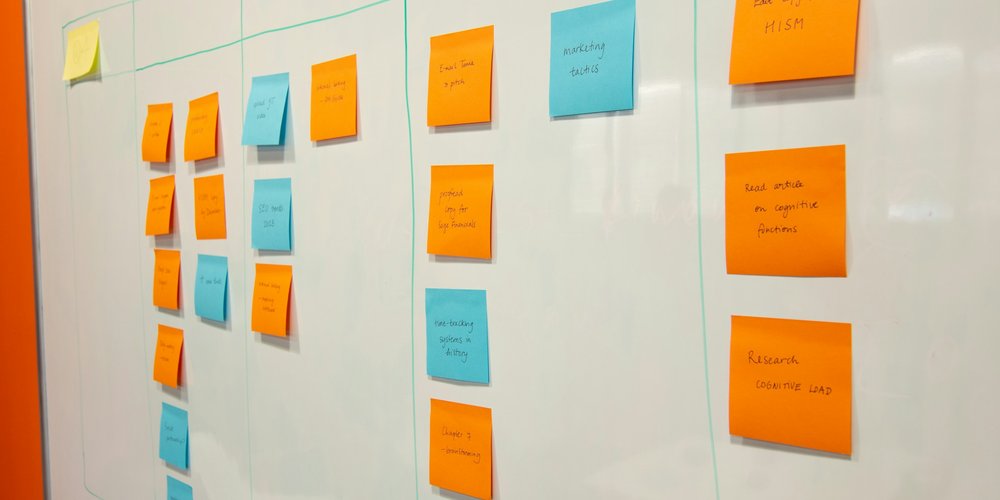
All right. We could break it out into three areas. Or, you know, 30, 30, 30, obviously, map the work.
When I go consult sometimes I'll ask, depending on what the need is, I'll ask, show me your process. And oftentimes, I'm looking for a sheet of paper.
Oftentimes I'll be met with like a sheet of paper that has bullet lists.
And I'm like, that's not a process. That's a bullet list.
That's like a checklist. The process, the work of map. I said map the work, the process of mapping is that painstaking going through your operations.
If this happens what happens next? If and then, right? It's the boxes and the arrows and decision trees. It's that ugly, tedious work.
So map the work. Hey, we don't have a journey. We don't have a customer journey. We don't have a defined process. Yeah, you do, because you're functioning.
Phone calls are made, donations are being had, emails are going out. All of that requires process. Even though you may not have it documented, there's a process there.
So map the work. First 30 days.
Yes, it takes a lot of work, but to be able to designate the time and again, going back to the intellectual property of the person, put it on paper so that you can see, oh, look, that is our process.
And then you start to see the value of decisions that are made and where there's risk and where there's mistakes. And yeah, so, map the work, map the process.
During the next 30 days, I’d choose one high value, relatively low risk use case. So define the current baseline, the outcome you want to improve.
Name and accountable owner. Establish data and privacy boundaries. Decide where human review will remain required.
And so that's part of your pilot or your use case, your business case, whatever you want to call it. That's a nice tangible piece to do in that 30 day period of time.
The final 30 days, execute. Run that controlled pilot. Meet weekly. Just to share, hey, here's what we're seeing, what we're capturing, here's what we're learning.
Create a learning loop that can be used over and over again for other initiatives. Measure quality, cycle time, staff capacity, cost, risk, mission impact.
So at the end, you make an explicit decision to scale, to revise, or just to sunset it all together.
I think the important thing is that you're not just testing the AI or whatever tool you're using here in your operations.
You're testing the organization's ability to use it responsibly.
That's really what you're doing. Because AI and I'm sure you see this, it's uncovering a lot of stuff. It's making us take a look under the hood and saying it's not pretty.
We're not running well. So that's how the human intelligence layer gets stronger. Super practical.
Josh:
Yeah. And for conflict avoidant cultures inside of organizations, that is a hard place to be.
Stewart:
Yeah, yeah. That's why you put it all into that pilot, into that operations. Break it down over those 90 days and those three main parts.
And hopefully your listeners will just grab the transcript and throw that into their Claude or ChatGPT and create a framework for that.
That's super practical because it displaces that personal, he said she said finger pointing, but it puts it squarely on the operations and understanding that we have to improve here.
→ Learn how to start with AI using the people, data, and tools you already have with Erica Cox from Provisio.
Closing thoughts on nonprofit AI

Josh:
As we're closing out the episode, any resources you'd like to share with our audience?
Stewart:
There's a number. So on my personal website, I post a lot on LinkedIn, but on my personal website, stewartseverino.com, there are a number of resources.
The latest one that I developed was an AI ROI calculator. So organizations are buying subscriptions. You're burning through tokens on a monthly basis.
And so very soon finance or the board, they're going to start asking questions. And so I give the example of and this is going to sound so disconnected.
But in our headquarter building we may spend $10,000 a month in a utility bill.
Well nobody turns around and says, hey, out of that utility bill, out of that 10,000, how did that impact our kingdom impact? What's the ROI on spending electricity?
Nobody does that. Nobody makes that attribution. And I liken that to burning tokens because there's a lot of energy in that, which is why you're paying for tokens.
So soon, if not already, the question will be had what is the ROI on your AI initiative? How did AI contribute to marketing producing more resources in less time?
How did AI impact your donor journey for second and third appeals? So you can see the connection there so quickly. Organizations are going to have to justify that.
It's going to have to be another line item in your budget. So I would take a look at that and again throw it into your Claude. The formulas are all there.
Super easy.
Josh:
Awesome, awesome. And for those listening you can check out the resources at nonprofitpulse.com, find the show notes there, find our monthly newsletter as well.
And we'll have links to Stewart’s LinkedIn, his website, and additional resources. Stewart, our last question of the day.
My favorite question of every episode, where we ask the guest to be pithy around today's topic.
If you were standing on stage in front of a thousand nonprofit leaders and can share one thing, one sentence about why human intelligence has to come before AI, what would you say?
Stewart:
If you don't have your human intelligence layer operating in a way that is repeatable, that is transferable, then your AI layer is only going to amplify that brokenness and there's going to be consequences.
So align with the strategic partnerships in your organization that will advance the human intelligence layer because AI is not going anywhere.
Human intelligence isn't going anywhere. But AI will expose the lack of human intelligence in your organization rather quickly.
Josh:
More than one sentence, but we will take it.
Stewart:
Well, yeah. It could be a run on sentence.
Josh:
Stewart, this has been such a helpful conversation. Thanks for joining us again.
And just a reminder for those listening, in season two, we interviewed Stewart on innovation as a discipline, a great episode. Please check that out as well.
And again Stewart, thanks for joining us.
Stewart:
Yeah, great to be here. Thanks for having me again Josh. I'll see you.
Josh:
Hey, thanks for listening. If you enjoyed this conversation, please share or leave us a rating and review wherever you listen to podcasts.
Also, head over to nonprofitpulse.com to sign up for our monthly newsletter, as well as check out all the links and resources in the show notes.
We'll see you next time.
Frequently Asked Questions
Why does human intelligence have to come before AI?
AI amplifies whatever already exists in an organization. Stewart Severino says that if teams lack consensus on the problem they're solving, shared definitions of success, connected data, and clear decision rights, AI will produce more content, analysis, and activity without better decisions or greater impact.
What is human intelligence in an organization?
Stewart Severino defines it as an organization's collective ability to discern, decide, coordinate, learn, and remain accountable to the mission. It's bigger than having smart people in the room, and it shows up at the strategic, team, and governance levels.
How can you tell if your nonprofit isn't ready for AI?
Early signs include people who can't say what problem you're trying to solve, what outcomes you want, or who owns the decisions. Others are knowledge that lives in one person's head and decisions that keep getting reopened in meetings.
Why do AI and automation projects fail at nonprofits?
Often the technology isn't the problem. In one composite example Stewart Severino shared, automated donor follow-up sent inconsistent and duplicate messages because departments used different categories, records were duplicated, and no one clearly owned the relationship.
How should a nonprofit board think about AI?
Buying AI tools isn't the same as having an AI strategy, and productivity doesn't automatically equal impact. AI can synthesize information and identify patterns, but it doesn't carry fiduciary responsibility, spiritual discernment, or accountability for the consequences of a decision.
What should a nonprofit do in the 90 days before approving an AI initiative?
Spend the first 30 days mapping your work and processes. In the next 30, choose one high-value, low-risk use case with a baseline, an accountable owner, data and privacy boundaries, and required human review. In the final 30, run the pilot, meet weekly, and then decide to scale, revise, or sunset it.
How do you measure the ROI of AI at a nonprofit?
Stewart Severino expects finance teams and boards to start asking what AI subscriptions are worth. He suggests asking how AI helped marketing produce more in less time, or how it improved the donor journey for second and third appeals. He shares an AI ROI calculator on his website, stewartseverino.com.
Where can I listen to this Nonprofit Pulse episode?
Nonprofit Pulse is a nonprofit podcast from Anedot hosted by Josh Breland. You can listen to this episode with Stewart Severino on Spotify, Apple Podcasts, and YouTube, and we list every episode with show notes at anedot.com/nonprofit-pulse.
80 Community Service Ideas for Nonprofits


Show notes:
- Nonprofit Pulse
- The Navigators
- Stewart Severino's website
- Stewart Severino's AI ROI Calculator
- Stewart Severino on LinkedIn
Related Nonprofit Pulse episodes
- Stephen Minix explains how to make nonprofit impact data useful.
- Kimberly Thornbury shares where to start with nonprofit capacity building.